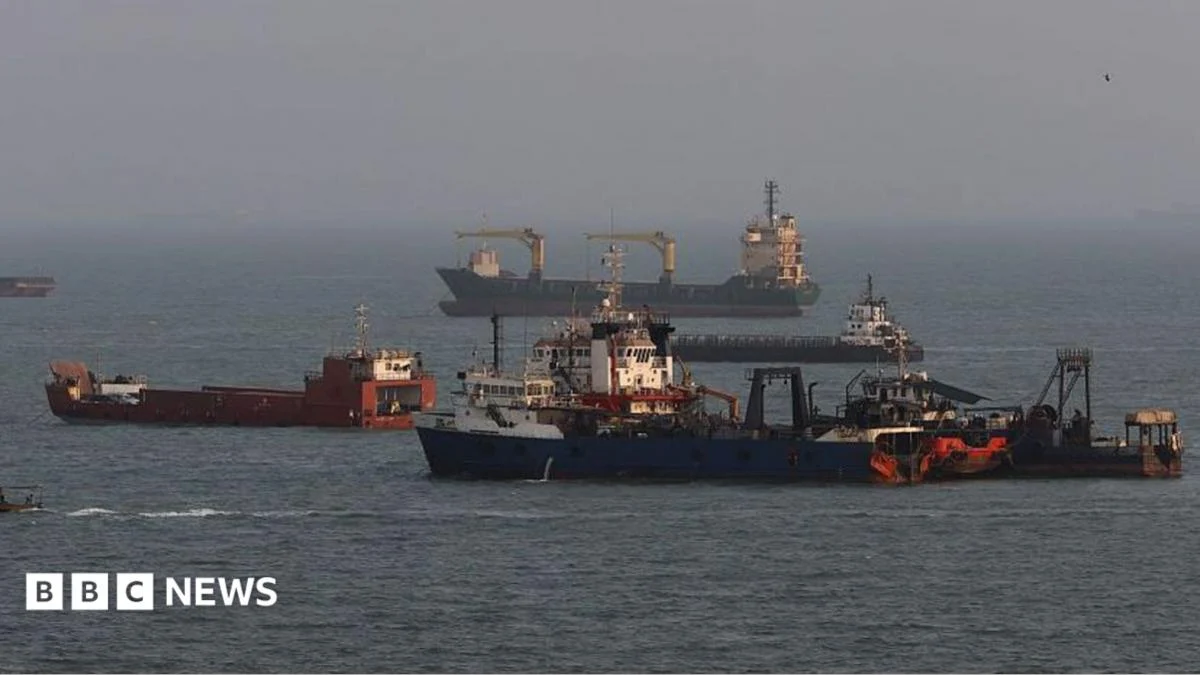
Saudi Arabia has unequivocally condemned what it describes as a deliberate Iranian attack on a Saudi-owned supertanker, the Sidr, on Monday night, an incident that tragically claimed the lives of two Filipino seafarers. The national shipping company, Bahri, confirmed the "security incident" involving its vessel while it was transiting the critical Strait of Hormuz, marking a grave escalation in a region already volatile from ongoing conflicts and geopolitical maneuvers. This maritime assault occurred concurrently with a broader surge in hostilities between the United States and Iran, characterized by recent US military airstrikes against Iranian targets and retaliatory missile and drone attacks by Iranian forces on US bases in neighboring Arab nations, representing the most significant exchange of fire since July.
Maritime Incident Details and Immediate Aftermath
The Sidr, a crucial asset in global crude oil transportation owned by Saudi Arabia’s prominent shipping firm Bahri, encountered the "security incident" at approximately 23:40 local time (19:40 GMT) on Monday. Maritime security and intelligence firms, including Marisks and Kpler, reported that the vessel was struck by "unknown projectiles" while navigating outbound through the Strait of Hormuz. Specifically, Marisks pinpointed the strike at 19:52 GMT, approximately 16 nautical miles (30 km) north-east of Khasab, Oman, a strategic location near the Musandam Peninsula.
In a deeply distressing statement released on Wednesday, Bahri confirmed the "profound sadness" of losing two of its Filipino seafarers due to the incident. The company extended its "deepest condolences and heartfelt sympathies" to the victims’ families, loved ones, and colleagues, underscoring the human cost of the escalating regional tensions. The exact nature of the projectiles and the methodology of the attack remain under investigation, with Saudi authorities firmly pointing the finger at Iran.
Adding to the complexity of the situation, a South Korean-owned supertanker, the Senegal Prosperity, was reportedly struck in a similar fashion around the same time, east of Oman’s Musandam Peninsula. Marisks indicated this vessel was hit by "three unknown projectiles" about 17 nautical miles east of Khasab. The UK Maritime Trade Operations (UKMTO) agency, a British military organization that monitors shipping in the region, also reported two distinct incidents in these approximate locations, corroborating the multiple attacks. Both tankers were reportedly laden with two million barrels of Saudi crude oil, highlighting the direct threat to global energy supplies.
Iran’s Counter-Narrative and Accusations
While Iran has not directly responded to Saudi Arabia’s specific allegations concerning the Sidr and Senegal Prosperity, its Islamic Revolution Guard Corps (IRGC) offered a contrasting narrative on Wednesday. The IRGC claimed that two oil tankers had "sought, at the urging of the US military, to transit via an illegal route" in the Strait of Hormuz before "striking mines and exploding." The statement added that these vessels were "currently on fire." This assertion directly contradicts the Saudi account of projectile attacks and implies a deliberate attempt by the US to utilize unauthorized maritime passages, leading to self-inflicted damage. The US military has not commented on Iran’s specific claims regarding mines or an "illegal route."
Earlier in the week, Iran had generally stated that two tankers had caught fire after hitting mines while using an unauthorized route through the strait, laying the groundwork for its later, more specific IRGC statement. This divergence in accounts underscores the profound distrust and propaganda warfare characteristic of the protracted US-Iran rivalry.
Broader Context of US-Iran Escalation
The attacks on the supertankers did not occur in isolation but were set against a backdrop of intensified military engagements between the United States and Iran. Just prior to the maritime incidents, the US military executed a series of air strikes against Iranian and Iran-backed forces. These strikes, according to Iran’s health minister, resulted in 18 fatalities and 108 injuries. Iran has vehemently accused the US of committing a "war crime" over one particular strike that allegedly killed four people, including two children, at a wedding party in the southern city of Sirik. The US military has acknowledged these reports, stating it is "looking into them."
In a tit-for-tat response, Iranian forces targeted US bases in neighboring Arab states with missiles and drones, marking the most significant military exchange between the two powers since July. The US military justified its recent strikes by stating they followed "recent attempted attacks by the IRGC against commercial shipping in the Strait of Hormuz and against American service members," indicating a pattern of Iranian aggression that predates the Sidr incident.
The Strait of Hormuz: A Chokepoint Under Siege
The Strait of Hormuz is not merely a shipping lane; it is a geopolitical artery, a narrow chokepoint through which approximately one-fifth of the world’s total oil and gas shipments typically pass. This amounts to roughly 20-21 million barrels of crude oil per day under normal circumstances, making it indispensable for global energy security and commerce. Its strategic significance means any disruption has immediate and far-reaching economic consequences.
Historically, the Strait has been a flashpoint for regional tensions, notably during the "Tanker War" of the 1980s, where both Iran and Iraq targeted commercial shipping during their protracted conflict. In recent years, particularly since 2019, the Strait has again become a theatre of escalating maritime incidents, including mine attacks, seizures of vessels, and drone assaults, often attributed to Iran. This continuous state of tension has transformed one of the world’s busiest maritime passages into a zone of high risk.
Since February, the strait has been described as "effectively closed" due to the ongoing US and Israel’s "war with Iran." This period has witnessed a systematic targeting of commercial vessels by Iranian missile and drone attacks, coupled with a US blockade of Iranian ports. In June, there was a glimmer of hope when the US and Iran reportedly reached a preliminary agreement aimed at ending the conflict and reopening the strait. However, this agreement swiftly collapsed within weeks, primarily due to the resumption of Iranian attacks on shipping and the subsequent reinstatement of the US blockade. Iran has consistently asserted its right to maintain a measure of control over this vital waterway, often targeting vessels that opt for a southern route through Omani waters, which bypasses its preferred route through Iranian waters.
Despite these persistent Iranian attacks, US President Donald Trump has adamantly declared the strait "open," with the US military actively assisting commercial ships in navigating the southern route. This posture underscores the US commitment to upholding freedom of navigation and ensuring global energy flow, even in the face of direct threats. US Energy Secretary Chris Wright highlighted the scale of recent shipping activity, noting that a remarkable 17 million barrels of oil flowed through the Strait of Hormuz by ship on Monday alone – a record daily total since the "start of the war" in February, indicating continued, albeit perilous, reliance on the strait.
Official Reactions and International Calls
Saudi Arabia’s Strong Condemnation:
Beyond Bahri’s statement, the Saudi foreign ministry issued a robust condemnation of "Iran’s targeting of the Saudi tanker (Sidr) while it was transiting the Strait of Hormuz." The ministry also denounced recent Iranian attacks on Jordan, Bahrain, and Kuwait, signaling a broader concern about Iranian regional destabilization. Crucially, the statement stressed the "need to halt escalation and respect the security and safety of international navigation," as well as the security of global energy supplies, national sovereignty, and international law. This emphasizes Saudi Arabia’s role as a major oil producer and its vested interest in maritime stability.
Silence and Counter-Claims from Iran:
As noted, Iran has not directly acknowledged the Saudi accusations regarding the Sidr. Instead, its IRGC statement focused on the narrative of tankers hitting mines after using an "illegal route" at US urging. This strategic silence on specific accusations while presenting an alternative explanation is a common tactic in diplomatic standoffs, aiming to deflect responsibility and cast doubt on the accuser’s narrative.
United States’ Stance and Scrutiny:
The US military’s general statement regarding its strikes, linking them to IRGC attacks on shipping and American service members, frames the overall escalation as a defensive measure. Its "looking into" reports of civilian casualties in Sirik indicates adherence, at least outwardly, to accountability, while President Trump’s declaration of an "open" strait reinforces a policy of maintaining maritime freedom despite risks. The US Energy Secretary’s data on Monday’s oil flow serves to illustrate the continued strategic importance of the waterway and perhaps the efficacy of US naval escorts.
International Community and Shipping Concerns:
The tragic deaths of the two Filipino seafarers will undoubtedly prompt the Philippine government to seek a thorough investigation and justice for its citizens, a common reaction when seafarers from developing nations are caught in geopolitical conflicts. International bodies such as the United Nations (UN) and the International Maritime Organization (IMO) are expected to issue condemnations of attacks on commercial shipping and call for de-escalation, urging adherence to international maritime law. Shipping companies and their insurers will likely raise war risk premiums for transiting the region, reflecting the heightened threat perception and further impacting global trade costs.
Implications: Geopolitical, Economic, and Humanitarian
The attack on the Sidr and the ongoing hostilities in the Strait of Hormuz carry profound implications across several dimensions:
Geopolitical Intensification: This incident directly exacerbates the already fraught relationship between Saudi Arabia and Iran, two regional arch-rivals vying for influence. It risks transforming existing proxy conflicts in the Middle East into more direct confrontations, raising the specter of a broader regional war. The explicit involvement of the US and the strong condemnation from Saudi Arabia underscore the internationalization of this conflict, challenging international maritime law and potentially drawing in more actors, including regional allies of both sides.
Economic Volatility and Energy Security: The Strait of Hormuz is a linchpin of global energy markets. Any disruption or perceived threat immediately triggers volatility in oil prices, impacting economies worldwide. Increased insurance premiums for shipping, potential rerouting of vessels (though limited alternatives exist for such a high volume of traffic), and delays in transit can significantly inflate operational costs for global trade, particularly for energy-dependent nations in Asia and Europe. The incident serves as a stark reminder of the fragility of global energy supply chains and the critical need for stability in key maritime chokepoints.
Maritime Security and Seafarer Safety: The repeated targeting of commercial vessels, regardless of the method (projectiles or mines), poses an existential threat to maritime security. It jeopardizes the safety of thousands of seafarers, who are often innocent civilians caught in geopolitical crossfire. The deaths of the two Filipino sailors highlight the ultimate humanitarian cost, underscoring the need for international protection for merchant shipping and its personnel. Shipping companies face immense pressure to balance economic viability with the paramount safety of their crews in increasingly dangerous waters.
Challenges to International Law: The differing accounts – Saudi Arabia’s accusation of an Iranian attack versus Iran’s claim of vessels hitting mines on an "illegal route" – present a significant challenge to international maritime law, specifically the principles of freedom of navigation and innocent passage. Establishing accountability and enforcing international norms become incredibly difficult in an environment of conflicting narratives and state-sponsored proxy actions. The international community faces the challenge of upholding the rule of law in a highly militarized and politically charged maritime domain, where incidents can be easily manipulated for political gain.
Risk of Miscalculation: The rapid succession of US-Iran military exchanges and the direct attack on commercial shipping create an environment ripe for miscalculation. A single, unintended incident or an overreaction could spiral into a full-scale military confrontation with devastating consequences for the region and the global economy. The lack of direct communication channels and the prevalence of proxy actions further complicate de-escalation efforts, making diplomatic solutions difficult to achieve.
In conclusion, the attack on the Saudi supertanker Sidr, resulting in the tragic loss of life, is more than an isolated maritime incident. It is a potent symptom of a deeply entrenched and escalating regional conflict, with the Strait of Hormuz at its volatile heart. The interplay of accusations, denials, and military actions between major powers like Saudi Arabia, Iran, and the United States underscores the perilous trajectory of Middle Eastern geopolitics, threatening global energy security, international maritime safety, and the fragile peace of the region. The international community watches with growing apprehension, hoping for a de-escalation that seems increasingly distant amidst this complex and dangerous geopolitical landscape.