In the annals of World War II, amidst the grim realities of Nazi occupation, a remarkable act of defiance unfolded in Brussels in November 1943. A clandestine group of Belgian journalists and printers orchestrated what is widely considered the world’s first media hack: they infiltrated the Nazi-controlled newspaper Le Soir and replaced it with a cleverly crafted satirical counterfeit, Le Faux Soir (The Fake Evening). This audacious stunt, a masterful blend of subterfuge and sharp wit, served as a potent symbol of resistance, poking fun at the occupying forces and offering a moment of levity and hope to a beleaguered populace.
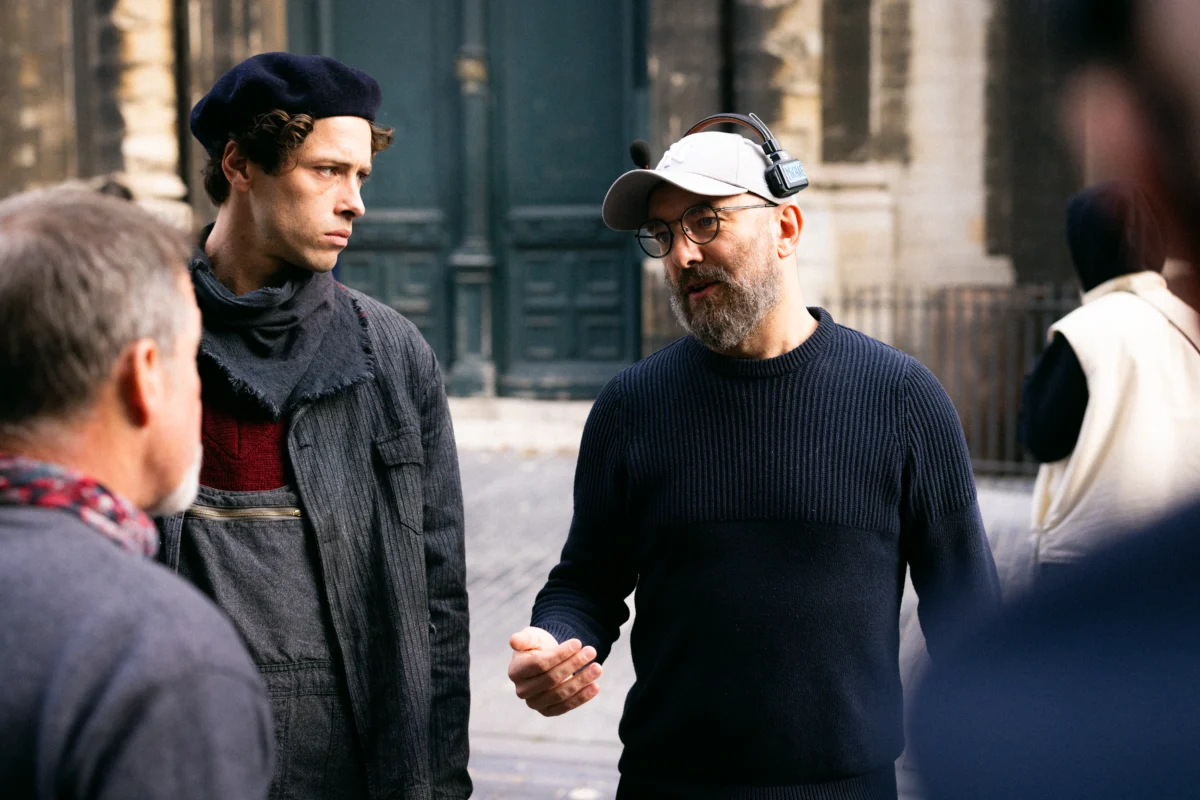
Now, Belgian director Michaël R. Roskam, known for his critically acclaimed films Bullhead, The Drop, and Racer and the Jailbird, brings this extraordinary story to the screen in a vibrant caper film. Roskam envisions the narrative as an "Ocean’s Eleven, but with a newspaper," a thrilling heist populated by some of Belgium and France’s most gifted comedic actors. The film, Le Faux Soir, is set to have its world premiere at the Toronto International Film Festival (TIFF) and is being handled for worldwide sales by Goodfellas.
In an interview from Brussels, Roskam delved into the meticulous research that underpinned the film, from unearthing the nuances of 1940s humor and the intricate mechanics of linotype machines to exploring the fundamental vulnerability of authoritarians to mockery and the enduring power and limitations of satire.
The Genesis of a Media Heist Film
The inspiration for Le Faux Soir emerged from a university course on media piracy and satire, undertaken by Roskam’s co-writer, Bernard Falaise. It was during this academic exploration that Falaise first encountered the story of Le Faux Soir. The narrative gained a chilling resonance when, while studying the topic, students’ phones buzzed with news of the attacks on the French satirical magazine Charlie Hebdo. This juxtaposition of historical resistance and contemporary challenges to freedom of expression profoundly impacted Falaise.
"A year later they had a choice: either write a thesis or write a script," Roskam explained. "He wanted to write a script on the Le Faux Soir story. He came to me because we’re friends and he really helped me with casting on Bullhead. He’s French-speaking, I’m Flemish-speaking. He’s like, ‘Dude, I want to make the script. It’s tough. You want to give it a read?’ And he told me the story, and I was like, ‘That’s a movie. This is amazing. I’ve never heard of it.’"
The story of Le Faux Soir was not widely known, even within Belgium. "No one on the Flemish side [of Belgium], with very few exceptions, had ever heard of this story," Roskam noted. "Even on the French-speaking side, it was mostly the subscribers of Le Soir, because every year they do a kind of article about it." Recognizing the cinematic potential, Roskam made a pact with Falaise: "Dude, if you manage to write this, I’ll direct it."
However, the initial script, while capturing the essence of the story, did not fully align with Roskam’s visual and thematic interpretation. "His script was fairly cool. But I said, ‘You already told me the story, and I see images, how I would direct it, and your script is not what I see.’ But I wouldn’t want to steal the project from him so I said ‘Let’s write it together, and I’ll direct it.’" This collaborative effort laid the foundation for a film that balances historical accuracy with a thrilling narrative arc.
Cracking the Code: Humor, Heist, and Historical Nuance
The primary challenge in crafting the screenplay, according to Roskam, lay in reinterpreting the humor of the original Le Faux Soir. The satirical content, while effective in its time, relied on cultural references and specific political figures of the 1940s that might not resonate with contemporary audiences. "The hardest problem was the text [of the fake newspaper] because the text is funny. It’s a satire. The text is funny, but the text is also old, it’s from the ’40s. A few of the jokes still hold up, but a lot of them refer to people or things where it’s more ‘I feel it’s funny, but I don’t get the joke, because I don’t know what they’re talking about.’"
Roskam’s fascination, however, extended beyond the satirical content to the ingenious execution of the operation. "And I was way more fascinated in how they pulled the thing off. Because writing a satire isn’t the dangerous bit, it’s publishing it. How they did it felt to me like a heist movie. Ocean’s Eleven, but with a newspaper." This perspective shifted the film’s focus from a pure satire to a realistic portrayal of a dangerous undertaking.

"That’s what I said: we need to be very disciplined about the humor, to make it funny without making a satire movie, like Life is Beautiful – which is fantastic – or Taika Waititi’s Jojo Rabbit. I didn’t want to make a satire. I wanted to make a realistic movie about very realistic, very funny people risking their lives." This approach underscored the bravery and ingenuity of the individuals involved, framing their actions as acts of profound courage.
Casting the Laughs: Assembling a Comedic Ensemble
The film’s emphasis on a realistic portrayal of a daring operation necessitated a cast capable of delivering both comedic timing and genuine dramatic weight. Roskam sought actors with innate "funny bones" who could embody the spirit of resistance through humor.
"Even at the script stage, I said: ‘Dude, we need to cast people with funny bones.’ I needed François Damiens, I needed Arieh Worthalter, I needed Bouli Lanners," Roskam stated. These actors are prominent figures in the French-speaking film world, celebrated for their comedic prowess. "They’re big names in the French-speaking community, the funniest guys on the planet. Bouli is funny and poetic. Arieh is a great, sensitive and funny actor. François Damiens is a funny clown who does everything to hide that he’s actually a fantastic actor."
The ensemble also includes Mélanie Thierry, whose presence adds a layer of poetic gravitas. "And then you have Mélanie Thierry, who is very poetic, serious, but she also has a little something, a twinkle in the eye." Roskam recognized the delicate balance required in directing such talented individuals: "When I had my Ocean’s Eleven together, it was also about holding them back, or they’d turn the film into a full-blown comedy." This directorial control was crucial to maintaining the film’s intended tone, which blends humor with the high stakes of wartime resistance.
The Power of Words: Satire as a Weapon of Resistance
The narrative of Le Faux Soir offers a compelling counterpoint to the typical portrayals of wartime heroism, which often focus on armed conflict. Here, the resistance is waged not with bombs, but with jokes, puns, and witty prose. Roskam positions his film within a rich cinematic tradition, drawing parallels to iconic works that have explored the intersection of humor and authoritarianism.
"I see this film as right in between something like Chaplin’s The Great Dictator and Inglourious Basterds," Roskam mused. "For me, it was not about doing what Chaplin does, making that kind of satire. It was about showing how Chaplin does it." This distinction highlights Roskam’s intention to explore the mechanics and impact of satirical resistance, rather than simply replicating its form.
The film’s exploration of the resistance through humor is particularly relevant today, as the dissemination of disinformation and the suppression of free speech remain pressing global issues. The operation by the journalists and printers of Le Faux Soir serves as a historical precedent for the ongoing struggle against propaganda and the manipulation of truth.
The Craft of Deception: Researching the Mechanics of Print
Roskam’s commitment to authenticity led him to immerse himself in the technical intricacies of 1940s printing. His approach to filmmaking involves a deep dive into the subject matter, ensuring a high degree of verisimilitude. "My way of working is to learn everything about the subject I’m making a movie on. From Bullhead, I still know how to raise cattle and bring them to the meat market, illegally and legally. I know the holdups I staged in Racer and the Jailbird would work in real life. Here, I know how to print a newspaper using 1940s technology. I could be a project manager of a newspaper in the ’40s."
This dedication to detail involved extensive archival research and interviews with individuals who had firsthand experience with the printing processes of the era. "I went to museums and started finding people, retired people in their 80s and 90s, who told me how it was. Then younger people who learned from the older people, who are rediscovering the old techniques." Roskam found inspiration in places like La Démocrate in France, a museum that continues to print a newspaper using traditional methods, kept alive by a passionate younger generation.
The discovery of the linotype machine proved to be a particularly illuminating experience for Roskam. "Discovering the linotype was one of the most magical things I have ever encountered in my career. I don’t think I’ve ever seen a machine I didn’t know existed that is still alive only because of the passion of people keeping it alive. It’s literally a wonder. I still get goosebumps when I see it. I can look at it for hours. Just the sound of it. For your readers: the linotype is a machine that automates typing, where the letters are melted into a mold, instead of setting every letter by hand. It’s an automatic process, but still mechanical. It’s nothing digital. When I saw this, I knew: this is what we need. We need to evoke those moments." The physicality and intricate mechanics of this bygone technology provided a visual and thematic anchor for the film, contrasting sharply with the ephemeral nature of modern digital communication.

Echoes of the Past: Relevance in the Modern Era
The story of Le Faux Soir resonates powerfully in the contemporary context, particularly in an age grappling with the proliferation of fake news and the erosion of trust in media. Roskam sees the film as a timeless exploration of the fight for truth and the power of words.
"Well, the reason why we tell historical movies is always in the now, in the moment when you decide that the story is important," Roskam stated. "It came to Bernard at one of the craziest, most horrific events of the last 10 years: the shooting at the Charlie Hebdo editorial offices. This act of terrorism against satire."
The film serves as a potent reminder that the struggle against propaganda and disinformation is not new. "Fighting fake news today is dangerous, but during the Second World War, you could get a bullet in your head for making the wrong comment, the wrong joke." Roskam hopes the film will foster intergenerational dialogue, encouraging younger audiences to connect with their elders and understand the historical context of the fight for free expression. "I hope that young people will watch this film with their grandparents, and see that there have always been people fighting against fake news, against how the truth has been bent throughout history. It was done with weapons and violence, but very often it was also done with words."
The notion that "words are weapons" is a central theme, echoing the sentiment that even seemingly innocuous forms of expression can have profound political implications. The Nazis’ infamous book burnings, Roskam suggests, were a testament to the power they recognized in words and ideas. "One of our characters says: ‘Why do the Nazis burn books? Because words are weapons.’ And he means it. It’s always been like that with satire. It’s like making fun of the king. It’s forbidden, but it’s the only way you can hurt him. That’s what I wanted to do."
The Paradox of Satire: A Double-Edged Sword
The conversation turned to the ironic parallels between Le Faux Soir‘s act of media subversion and modern disinformation campaigns, where authoritarian regimes employ sophisticated tactics to spread fake news. Roskam acknowledged the disconcerting reality: "Exactly. Isn’t that ironic? If an alien were to look from space at the modern day, he might think that we, the establishment, are the Nazis of the time, and that the ones on the right hacking us are the resistance of the ’40s."
This observation leads to a profound reflection on the nature of resistance and the complexities of political discourse. Roskam confessed to moments of doubt about his own position within the current socio-political landscape: "We’re defending democracy, but there are some people who are victims of that situation, and they want this system to be dismantled, and they’re using everything they can. I believe that I’m fighting for the right thing. I’m for democracy. But I don’t know. Maybe I’m on the wrong side. I don’t know. It’s a terrible thought to think that I’m on the wrong side, man."
The effectiveness of satire as a tool against authoritarianism is a complex and often debated subject. Roskam pointed out that while satire may not lead to immediate, tangible outcomes like toppling a regime, its impact can be more insidious and ultimately more destructive to authoritarian power. "Satire is not like blowing up a bridge. But if it works, if you can make it work, you can plant the seeds in the heads of the people. It has a toppling effect."
The power of satire, Roskam argued, lies in its ability to undermine the carefully constructed facade of authority. "Satire has a mental effect. It is the first button of the emperor’s clothes being opened, and then the next one. And if you continue doing it, at some point he’s naked on his throne and everybody’s laughing, and that’s when he loses. That’s why authoritarian regimes hate satire. They can’t stand it. They come back with falsification, with fake news, which is not the same as satire."
The story of Le Faux Soir, therefore, transcends its historical context, offering a timeless narrative about the courage of conviction, the power of wit, and the enduring human spirit’s capacity to resist oppression, even in its darkest hours. Michaël R. Roskam’s film promises to illuminate this extraordinary chapter of defiance, reminding audiences that even in the face of overwhelming power, a well-placed joke can be the most potent weapon of all.