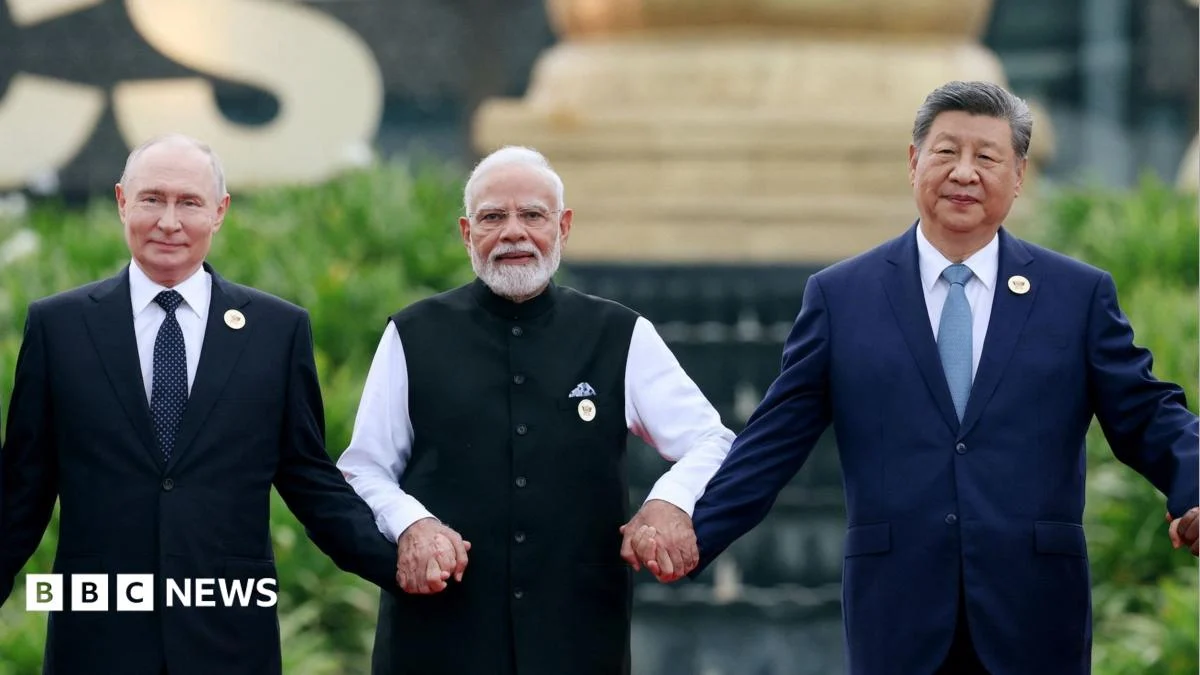
This weekend, Delhi became the epicentre of a significant geopolitical gathering as some of the world’s most influential leaders converged around a vast circular table, signalling a collective ambition to redefine the contours of international governance. Indian Prime Minister Narendra Modi, hosting the summit, articulated a potent vision for the assembled nations, urging them to increasingly become "rule-shapers" rather than mere "rule-takers" in the evolving global landscape. The sentiment underscored a growing desire among non-Western powers to exert greater influence over international norms, institutions, and economic frameworks, challenging a unipolar order that has prevailed for decades.
Among the prominent figures present were key members of the Brics group – Brazil, Russia, India, China, and South Africa – alongside newly admitted nations and invitees. The attendees included Chinese President Xi Jinping, Russian President Vladimir Putin, Iran’s President Masoud Pezeshkian, Abu Dhabi’s Crown Prince Sheikh Khaled bin Mohamed bin Zayed Al Nahyan, and South African President Cyril Ramaphosa. This diverse assembly, representing a significant portion of the global population and economic output, was notable not only for its collective heft but also for the deep-seated historical and contemporary divergences among its members.
A Convergence of Divergent Interests: The Challenge of "Unnatural Allies"
The very composition of the Brics summit highlighted the inherent complexities of its mission. These nations, often described as "unnatural allies," have histories marked by border disputes, economic competition, and even military confrontations. The most glaring example remains the deadly clash between India and China along their disputed Himalayan border in 2020, which resulted in casualties on both sides and significantly strained bilateral relations. Similarly, Iran and the United Arab Emirates have long been on opposing ends of regional conflicts in the Middle East, with Tehran’s past actions, including missile and drone launches, sending ripples of instability across the global economy and oil markets. The ability of India to bring these leaders together in person, particularly amid such geopolitical tensions, was lauded as a diplomatic triumph in itself, underscoring New Delhi’s growing diplomatic reach and its strategic importance as a neutral convener. The summit also provided a critical, albeit cautious, platform for these nations to reassess and recalibrate their relationships in light of ongoing regional conflicts.
However, the ambition of agreeing on a unified vision for a new global order and achieving clear, tangible outcomes proved to be a far more arduous task. This inherent tension between aspiration and reality permeated the entire weekend’s proceedings.
The Delhi Declaration: Consensus Through Omission
Despite the significant divisions among its members, which had led to the failure of two earlier Brics ministerial meetings this year to produce a joint statement, the Delhi summit remarkably succeeded in delivering a joint declaration. This consensus, however, was largely achieved by carefully sidestepping the most contentious issues, resulting in a document more notable for what it didn’t explicitly state than for its bold pronouncements.
The "New Delhi Declaration," adopted on the first day of the summit, provided a framework for cooperation but conspicuously avoided assigning blame or taking definitive stances on pressing global crises. Regarding the protracted conflict in the Middle East, the declaration confined itself to urging "maximum restraint" and condemning "attacks on civilian infrastructure and peaceful nuclear facilities," without attributing responsibility to any specific party. It reiterated support for a two-state solution, a long-standing international consensus, and opposed the forced displacement of Palestinians or actions that could "legitimise or prolong occupation," carefully framing these points around existing UN resolutions. This cautious language reflects the divergent interests and alliances within Brics, where some members maintain strong ties with various actors in the Middle East, making a unified, assertive stance impractical.
Perhaps the most striking omission was the complete absence of any mention of Russia’s war in Ukraine, a significant departure from previous Brics declarations that had, at times, alluded to international law or called for peaceful resolution, even if indirectly. This silence underscores the bloc’s internal divisions, with India and China maintaining complex relationships with both Russia and Western nations, while Russia itself is a direct belligerent. For Russia, the Brics platform offers a crucial avenue for diplomatic engagement and economic partnerships amidst Western sanctions, making any direct criticism from within the bloc highly improbable.
Similar caution was observed on matters of global trade. The declaration listed concerns over "indiscriminate rising tariffs" and condemned unilateral sanctions but meticulously avoided naming the United States, the primary architect of such measures against several Brics members. This strategic ambiguity is likely intended to avoid drawing the ire of Washington, particularly given past statements by figures like former President Donald Trump, who has previously labelled Brics’ proposals, including potentially linking central-bank digital currencies for cross-border trade, as "anti-American." Many Brics members, while seeking to diversify their economic partnerships and reduce reliance on dollar-denominated trade, would be loath to provoke direct confrontation with the world’s largest economy.
Praveen Donthi, a senior analyst at the International Crisis Group, observed that the declaration’s nuanced approach, particularly its reluctance to name specific countries even when condemning conflicts, "bears the hallmark of India’s diplomatic style." He added, "I was pleasantly surprised that there was a strong reference to tariffs, because India could have wanted to be less direct about it, but perhaps this was a chance to convey their displeasure." This highlights the careful balancing act undertaken by the host nation to forge consensus amidst competing interests.
Timeline of Engagement: From Tensions to Tentative Thaw
The Delhi summit, held from [Assuming a date, e.g., September 9-10], unfolded against a backdrop of heightened global instability and a growing desire among non-Western nations to assert their collective voice.
- Early 2023: Two Brics ministerial meetings failed to yield joint statements, highlighting internal discord.
- August 2023: Brics leaders convene in Johannesburg, South Africa, where they announce the expansion of the bloc to include Argentina, Egypt, Ethiopia, Iran, Saudi Arabia, and the United Arab Emirates, effective January 1, 2024. This expansion underscores the bloc’s ambition to represent a broader spectrum of the Global South.
- September 8, 2023: Leaders begin arriving in Delhi. Indian Prime Minister Narendra Modi holds bilateral meetings.
- September 9, 2023 (Day 1 of Summit):
- Opening remarks by PM Modi, emphasizing the "rule-shapers" concept.
- Adoption of the "New Delhi Declaration."
- Significant bilateral meetings, including the historic interaction between Iran’s President Pezeshkian and Abu Dhabi’s Crown Prince Sheikh Khaled bin Mohamed bin Zayed Al Nahyan.
- Chinese President Xi Jinping holds talks with PM Modi.
- September 10, 2023 (Day 2 of Summit):
- Further discussions on economic cooperation, trade, and multilateralism.
- Concluding remarks and departure of leaders. Notably, President Xi Jinping departed after less than 24 hours, skipping a gala dinner hosted by Modi, a detail that was observed by diplomatic circles.
Economic Imperatives and Bilateral Diplomacy
The summit’s convening was deeply rooted in economic imperatives. In the wake of global trade disruptions, the reverberations of the Middle East conflict, and the ongoing war in Ukraine, reshaping the global economic order has become a vital need for many member economies. The Brics bloc, representing roughly 40% of the world’s population and approximately 25% of global GDP, seeks to create alternative financial and trade mechanisms that are less vulnerable to unilateral sanctions and geopolitical pressures. The discussions, though cautious in their public declarations, focused on enhancing intra-Brics trade, promoting local currency usage in bilateral transactions, and strengthening development banks.
Beyond the formal declarations, the summit provided a crucial platform for bilateral meetings that would have been difficult to imagine just months prior. The face-to-face talks between Iran’s President Pezeshkian and Abu Dhabi’s Crown Prince Sheikh Khaled bin Mohamed bin Zayed Al Nahyan marked the highest-level direct engagement known between the two countries since the Middle East war began. This interaction offered Tehran a significant opportunity to demonstrate that it does not stand isolated amid sustained US and Israeli military actions and economic pressure.
Iran, grappling with stringent US sanctions and Washington’s "Operation Economic Outcast" – an intensive campaign of financial pressure and a naval blockade on its ports – actively pressed for deeper economic ties with Brics members, including Malaysia, India, and Ethiopia. For Iran, Brics membership and strengthened economic linkages offer a potential lifeline, enabling it to bypass Western financial systems and secure markets for its oil and non-oil exports.
For China, the summit marked President Xi’s first visit to Delhi in seven years. The relationship between China and India has been fraught with deep mistrust since the 2020 border dispute. While tensions have eased somewhat, a significant trade imbalance persists, with the deficit tilting heavily in China’s favour. Despite the cordial handshake between Xi and Modi – a contrast to Modi’s signature embrace – and Xi’s relatively brief stay, the weekend was still a significant moment for these two Asian giants. Official readouts indicated that the leaders agreed to strengthen business ties, improve transport links, and address existing barriers to trade. Analysts like Trigunayat believe this signifies a gradual warming of relations, suggesting a mutual willingness to cooperate. However, whether these discussions will translate into substantial progress remains to be seen. "I always say we have to trust, but verify first," he cautioned, reflecting the lingering skepticism born from past friction.
Broader Impact and Implications: A Multipolar Future?
The Delhi summit underscored the growing momentum behind the idea of a multipolar world order, where power is diffused among multiple centres rather than concentrated in a single hegemonic state or bloc. The Brics expansion, which is set to integrate nations like Saudi Arabia and the UAE (major oil producers) and Egypt and Ethiopia (key African economies), significantly enhances the bloc’s economic and geopolitical weight. This expansion signals a collective desire among these nations to build institutions and mechanisms that reflect their interests and provide alternatives to the existing Western-dominated frameworks, such as the G7, the World Bank, and the International Monetary Fund.
However, the summit also exposed the inherent challenges in translating this shared aspiration into cohesive action. The "New Delhi Declaration’s" cautious language on major conflicts and trade issues highlights the delicate balance required to maintain unity among members with diverse foreign policy alignments and economic interests. While the aspiration to be "rule-shapers" is strong, the path to achieving this goal is fraught with the complexities of forging consensus among nations that are often economic competitors or historical adversaries.
The very act of bringing such a diverse group together, facilitating crucial bilateral dialogues like that between Iran and the UAE, and issuing a joint declaration – however carefully worded – represents a significant diplomatic achievement. It demonstrates that platforms like Brics can serve as vital conduits for dialogue and limited cooperation even when broader geopolitical landscapes are deeply fractured.
In the long term, the Delhi summit’s legacy may not lie in groundbreaking policy shifts but rather in its reaffirmation of the Brics bloc as a significant, albeit evolving, force in global governance. It reinforced the notion that a substantial portion of the world is actively seeking a rebalancing of power, and that even disparate nations can find common ground in their collective desire for a more inclusive, albeit complex, international system. The journey from "rule-takers" to "rule-shapers" for these nations will be gradual and marked by continuous negotiation, compromise, and the delicate management of their own internal differences, but the Delhi summit unmistakably signalled their intent to embark on that path.