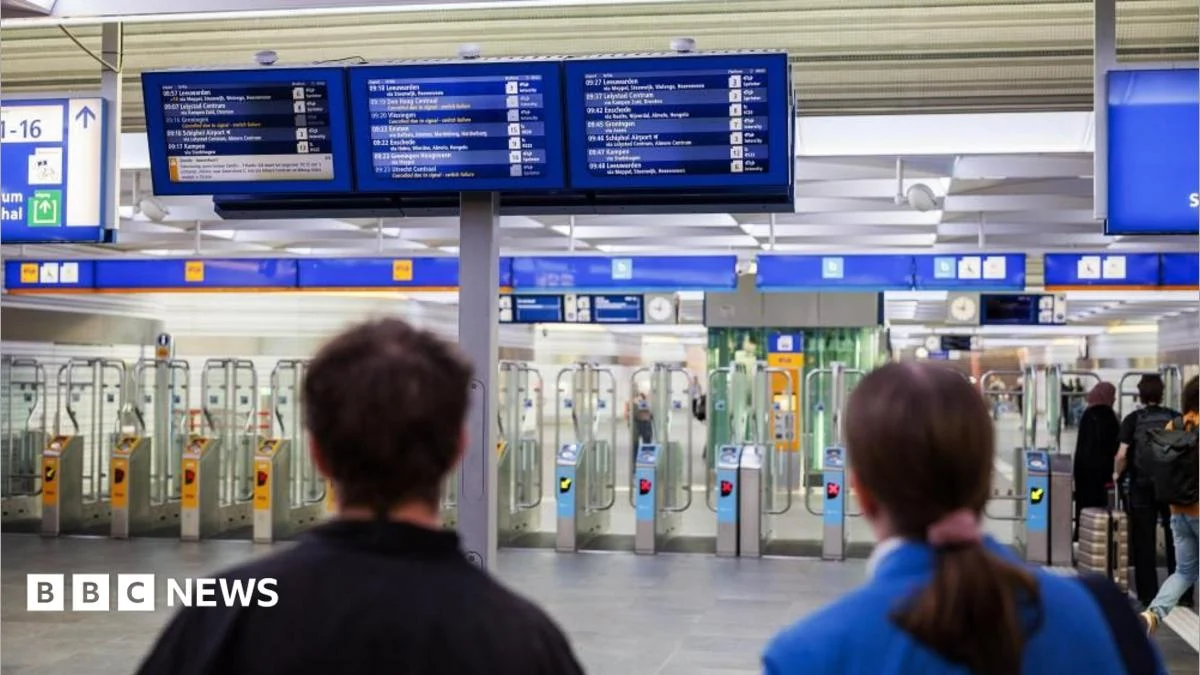
Parts of the Netherlands, including the bustling capital city of Amsterdam and other vital transport hubs, were plunged into significant disarray on Tuesday following widespread rail disruption attributed by the national railway infrastructure operator, ProRail, to suspected sabotage. The unprecedented incident, involving the deliberate placement of pipes and cables on railway tracks at multiple, seemingly coordinated locations across the country, triggered a swift and extensive response from authorities, launching a criminal investigation into what has been described as an "intentional disruption caused by human action."
Unfolding Crisis: A Day of Chaos on Dutch Rails
The disruption began to manifest in the early hours of Tuesday, with initial reports of unexpected obstacles on railway lines. As dawn broke, the scale of the problem became alarmingly clear. ProRail, responsible for the maintenance and management of the extensive Dutch rail network, issued urgent warnings to passengers across the central and northern regions of the country, advising them to anticipate severe cancellations and prolonged delays throughout the day. The ripple effects extended beyond train services, with the necessary closure of several level crossings impacting road traffic and adding to the nationwide logistical challenges.
Local media outlets, citing initial assessments from railway personnel, reported that the deliberate placement of various objects, specifically mentioning pipes and cables, on the tracks was the root cause. This pointed immediately towards a malicious act rather than an accidental occurrence. In a formal statement released shortly after the discoveries, ProRail articulated its assessment, stating, "the incident appeared to be an intentional disruption… caused by human action." This critical classification immediately elevated the matter from a maintenance issue to a serious security incident.
The Dutch police quickly confirmed the launch of a full criminal investigation. "Objects were found on railway tracks at several locations across the country, causing major disruption to rail traffic," a police statement affirmed, underscoring the severity and widespread nature of the alleged sabotage. As of the latest updates, no suspects have been apprehended, and the motives behind these coordinated acts remain entirely unclear, leaving investigators with a complex puzzle to solve.
Chronology of a Nationwide Disruption
The timeline of Tuesday’s events paints a picture of escalating challenges and a coordinated response:
- Pre-Dawn Hours (approx. 04:00 – 06:00 CET): First reports emerge from various locations regarding unusual objects detected on railway lines. ProRail maintenance crews are dispatched to investigate.
- Early Morning (approx. 06:00 – 08:00 CET): As the scope of the incidents becomes clearer, ProRail begins to understand the deliberate nature of the obstructions. Initial warnings are issued to commuters, advising of significant delays and cancellations. Train traffic is halted or rerouted in affected areas to ensure safety.
- Mid-Morning (approx. 08:00 – 10:00 CET): The full extent of the nationwide impact becomes apparent. ProRail publicly declares the incident as "intentional disruption" and notifies police. Nederlandse Spoorwegen (NS), the primary passenger train operator, confirms widespread cancellations affecting major routes, including those to Schiphol Airport and Utrecht, as well as services around Zwolle, Deventer, and Amersfoort. The network’s website records at least 15 separate disruptions.
- Late Morning (approx. 10:00 – 12:00 CET): The police formally announce a criminal investigation into the suspected sabotage. NS communicates the unprecedented nature of the disruption, stating that its scale makes it "not possible" to provide comprehensive bus replacement services, exacerbating passenger woes.
- Afternoon (approx. 12:00 – 17:00 CET): ProRail crews work intensively to clear the tracks and conduct safety inspections at all affected sites. NS begins the gradual process of resuming services, though with significant lingering delays and cancellations as the system slowly recovers. Passengers are advised to continue checking travel information.
- Evening (17:00 CET onwards): While some services are restored, residual delays and cancellations persist. The police investigation continues, with forensics teams examining the sites for clues. The focus shifts to identifying perpetrators and understanding their intent.
Supporting Data and Context: The Lifeline of Dutch Railways
The impact of such an incident is magnified by the vital role rail transport plays in the Netherlands. The Dutch railway network is one of the densest and most intensively used in Europe, renowned for its efficiency and reach. Each day, an estimated 1.3 million passengers rely on NS services, commuting between cities, connecting to international flights via Schiphol, and facilitating business travel. The network comprises over 7,000 kilometers of track, managed by ProRail, connecting nearly 400 stations.
Amsterdam Centraal, Utrecht Centraal, and Schiphol Airport are not merely local hubs but critical nodes in both the national and international transport infrastructure. Schiphol, one of Europe’s busiest airports, heavily relies on rail links to transport passengers to and from cities across the Netherlands and even neighboring countries. A disruption affecting these key arteries has cascading effects on hundreds of thousands of individuals and various sectors of the economy. The inability to provide bus replacement services, as stated by NS, highlights the sheer volume of affected passengers and the logistical nightmare posed by such widespread, simultaneous incidents.
Furthermore, the Netherlands is a highly urbanized country with a strong emphasis on sustainable transport, making its robust public transport system, particularly trains, a cornerstone of daily life and economic activity. Any deliberate interference with this critical infrastructure is thus not merely a nuisance but a direct assault on the nation’s operational fabric.
Official Responses and Calls for Vigilance
The official responses from the key stakeholders underscored the gravity of the situation:
ProRail: In their communications, ProRail emphasized the immediate priority of passenger safety and the swift efforts to assess and rectify the damage. A spokesperson reiterated the unusual nature of the incident: "This was not an accident or a technical fault; it was a deliberate act to disrupt our network. Our teams worked tirelessly to secure the sites, remove the foreign objects, and meticulously inspect the tracks for any further damage before safely resuming operations. The safety of our passengers and staff is paramount, and we treat any interference with our infrastructure with the utmost seriousness." The infrastructure operator also highlighted its close cooperation with law enforcement to aid the ongoing investigation.
Dutch Police: The national police force confirmed that a comprehensive criminal investigation is underway. A police representative stated, "We are treating this as a serious criminal offense. Interfering with critical national infrastructure carries severe penalties, and we are deploying all necessary resources to identify the individuals responsible. Our investigation will involve forensic analysis of the objects found, examination of surveillance footage, and gathering witness testimonies. We urge anyone with information, no matter how minor it may seem, to come forward." The police also noted the potential for charges related to endangering public safety and property damage.
Nederlandse Spoorwegen (NS): NS, as the operational arm, focused on managing the immediate crisis for passengers. A spokesperson for NS expressed regret over the widespread disruption: "We deeply apologize to all our passengers whose travel plans were severely impacted today. The scale and nature of this disruption were exceptional, making it impossible to implement our usual alternative transport measures like bus services for all affected routes. Our focus has been on providing real-time information, managing passenger flows at stations, and working with ProRail to gradually restore services as soon as it was safe to do so. We understand the frustration and inconvenience this has caused and are grateful for the patience shown by many travelers."
Ministry of Infrastructure and Water Management (Inferred): While specific ministerial statements were not immediately released in the initial reports, it is highly probable that the Ministry of Infrastructure and Water Management is closely monitoring the situation. Such an incident would undoubtedly prompt concern at the highest levels of government. It can be inferred that the Ministry would express full support for the police investigation and commend the swift actions of ProRail and NS in managing the crisis. A broader message emphasizing the resilience of Dutch infrastructure and the government’s commitment to public safety and security against such threats would also be expected.
Broader Impact and Implications
The suspected sabotage carries significant implications that extend far beyond the immediate travel delays:
- Economic Consequences: The disruption to rail services, particularly those connecting major economic centers and Schiphol Airport, undoubtedly caused a ripple effect throughout the Dutch economy. Commuters missed work, business meetings were postponed or canceled, and logistical chains for goods transport faced delays. While the precise financial cost will take time to assess, lost productivity and direct costs to railway operators for repairs and recovery are substantial. The incident also risks damaging the reputation of the Netherlands’ otherwise highly reliable public transport system, potentially affecting tourism and foreign business perception.
- Security Vulnerability of Critical Infrastructure: This incident starkly highlights the vulnerability of critical national infrastructure to malicious acts. Railways, by their very nature, are open and extensive, making complete protection against determined individuals incredibly challenging. The use of simple, readily available materials like pipes and cables to cause such widespread disruption raises questions about existing security protocols and the need for enhanced surveillance, intelligence gathering, and rapid response mechanisms to deter future attempts. It prompts a re-evaluation of security strategies for other vital networks, including energy grids, telecommunications, and water supplies.
- Psychological and Social Impact: Beyond the logistical and economic costs, such acts of suspected sabotage can sow unease and anxiety among the public. The deliberate nature of the disruption can erode public trust in the safety and security of everyday services. For thousands of passengers, the experience was one of frustration, uncertainty, and lost time, impacting their daily routines and potentially causing stress.
- Challenges of Investigation: Identifying the perpetrators and their motives presents a formidable challenge for law enforcement. Without immediate suspects or claims of responsibility, investigators must piece together clues from multiple, dispersed crime scenes. The lack of an identified motive—whether political, extremist, or simply malicious vandalism—further complicates the task. This requires extensive forensic work, analysis of digital footprints, and potentially cross-referencing with other intelligence data. The ongoing nature of the investigation means that clarity on the "who" and "why" might not emerge quickly.
- Review of Protocols and Resilience: In the aftermath, ProRail and NS will undoubtedly conduct thorough internal reviews of their incident response, communication strategies, and security measures. This may lead to new protocols for track monitoring, increased collaboration with security services, and investments in technology to detect unusual activity more rapidly. The incident serves as a stark reminder of the importance of infrastructure resilience and the need for robust contingency planning against unforeseen and malicious events.
As train services gradually resume across the Netherlands, a palpable sense of unease lingers. The immediate crisis of disrupted travel may be subsiding, but the deeper questions surrounding the security of critical infrastructure and the intent behind these deliberate acts will undoubtedly remain a central focus for authorities and the public alike in the days and weeks to come. The criminal investigation continues, with the nation awaiting answers to what led to Tuesday’s unprecedented railway chaos.