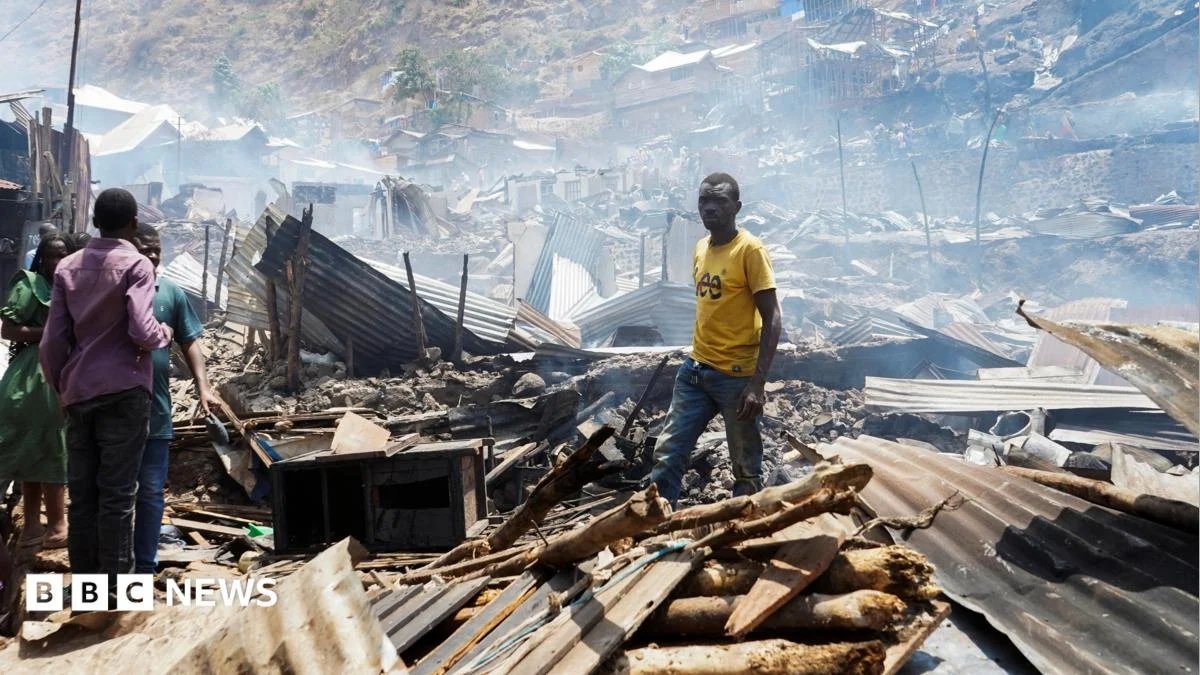
The devastating incident, which occurred in the densely populated Kadutu commune of Bukavu, the capital of South Kivu province, has sent shockwaves through the war-torn region. Initial reports confirmed the deaths of at least 24 schoolchildren, but authorities fear that a greater number of fatalities, including adults, may emerge as rescue efforts continue and the full extent of the tragedy becomes clear. The fire, whose origin remains unknown, not only claimed lives but also razed an estimated 300 houses, leaving hundreds, if not thousands, displaced and exacerbating an already dire humanitarian situation in a city grappling with ongoing conflict and instability.
The Catastrophic Event Unfolds: Fire, Stampede, and Devastation
The tragedy unfolded on Thursday evening when a raging inferno rapidly consumed two educational institutions within the Kadutu commune. The speed and intensity of the fire, coupled with the densely packed nature of the area, created a terrifying scenario. As flames engulfed the structures, panic ensued among the students and staff. Eyewitness accounts suggest a desperate scramble for safety, leading to a stampede as individuals tried to escape the encroaching blaze. It was during this chaotic attempt to flee that many of the young lives were tragically lost, crushed or suffocated amidst the desperate surge.
The provisional death toll of 24 schoolchildren was released by rebel-appointed authorities late on Thursday evening, confirming earlier unverified reports. However, the scene on the ground painted a grim picture, with aid workers and local residents expressing grave concerns that this figure represents only a fraction of the total casualties. Social media platforms quickly became saturated with harrowing images depicting young children lying motionless on the ground, a stark testament to the ferocity of the disaster.
Survivors, many suffering from burns, smoke inhalation, and injuries sustained in the stampede, were rushed to nearby hospitals and clinics. Footage from these medical facilities showed overcrowded conditions, with injured children lying on hospital floors, receiving urgent but often limited care. The medical infrastructure in Bukavu, like much of eastern DR Congo, is fragile and ill-equipped to handle mass casualty events of this scale, placing immense strain on already stretched resources.
By afternoon on the day of the incident, the fire had reportedly been brought under control, but a Reuters news agency witness described smoke still billowing from the charred remains of buildings, twisted corrugated metal, and smouldering rubble. The destruction of 300 houses in addition to the schools signifies a catastrophic loss of shelter and livelihoods for a community already living on the margins. The sudden displacement of so many families adds another layer of complexity to the emergency response, demanding immediate provision of food, water, and temporary accommodation.
A City Under Strain: Bukavu’s Vulnerabilities
Bukavu, situated on the eastern shores of Lake Kivu, is one of the Democratic Republic of Congo’s most crowded hillside cities. Its topography, characterized by steep slopes and narrow winding streets, contributes to its high population density and often chaotic urban planning. This geographical reality, combined with years of underdevelopment and recurrent conflict, creates a fertile ground for such disasters to escalate rapidly. Informal settlements, often built with highly flammable materials, are prevalent in areas like Kadutu, making them particularly vulnerable to fires.
Adding to Bukavu’s complex socio-political landscape is its status as a rebel-held territory. The city was captured by the M23 rebel group in February of last year, a significant development in the ongoing conflict that has plagued eastern DR Congo for decades. The presence of non-state armed groups creates a fragmented governance structure, often impeding the delivery of essential public services, including robust urban planning, building code enforcement, and efficient emergency response systems. While rebel-appointed authorities issued the provisional death toll and are likely involved in immediate relief efforts, the overarching governance vacuum can complicate coordination with national and international humanitarian actors, potentially slowing down critical aid.
The lack of clarity regarding the cause of the fire further underscores the systemic challenges. Whether it was an electrical fault, an accidental fire from cooking, or something more sinister, the rapid spread highlights fundamental weaknesses in infrastructure and safety standards within the commune. Schools, in particular, should be bastions of safety for children, yet the outcome of this event suggests a dire need for improved fire safety protocols, emergency exits, and regular drills, especially in areas with high population density and vulnerable building structures.
Humanitarian Crisis and Medical Response
The immediate aftermath of the fire has plunged Bukavu into a profound humanitarian crisis. Beyond the tragic loss of life, the scale of injuries and displacement is immense. Hospitals, already operating with limited capacity and resources, are struggling to cope with the influx of burn victims and those suffering from trauma. Many survivors will require extensive medical treatment, rehabilitation, and psychological support to deal with the physical and emotional scars of the event. The sight of children suffering on hospital floors underscores the urgent need for medical aid, including specialized burn treatment units, essential medicines, and trained medical personnel.
For the hundreds of families whose homes were incinerated, the future is uncertain. Displaced and often having lost all their possessions, they face immediate needs for shelter, food, clean water, and sanitation. The Kadutu commune, already one of Bukavu’s most impoverished areas, now grapples with an even greater burden. Humanitarian organizations, both local and international, are expected to mobilize rapidly to provide emergency relief, but access and coordination can be challenging in rebel-held territories. The long-term implications for these families, including potential increased food insecurity and heightened vulnerability to disease, are significant.
Official Responses and Calls for Action
In the wake of the disaster, reactions have emerged from various levels of authority, reflecting both immediate grief and broader concerns about public safety. The rebel-appointed authorities in Bukavu were the first to release a provisional death toll, indicating their role in the initial assessment and response on the ground. Their communication, though limited, serves as the primary local information source in a fragmented administrative landscape.
Meanwhile, the national government in Kinshasa, though geographically distant and in a complex political relationship with the M23-controlled territory, also issued a statement through its Ministry of National Education and New Citizenship. Released on X (formerly Twitter), the statement expressed "deep sorrow over the deadly fire" and acknowledged the "several lives lost and many injured," confirming that the "toll remains provisional." The ministry extended condolences to the affected families, affirmed solidarity, and, crucially, ordered "assessments of affected schools to ensure learning continuity." This commitment, while necessary, faces significant logistical and political hurdles given the region’s rebel control.
This tragedy follows closely on the heels of another fatal incident in Kinshasa just the previous weekend, where residents died in a stampede at a wedding banquet hall. The proximity of these two stampede-related fatalities has galvanized the national government into action. In response, the Kinshasa authorities have announced strict safety measures and deployed teams nationwide to enforce standards at public gathering places. This proactive stance, though triggered by a different type of incident, highlights a growing awareness within the government of systemic public safety failures across the country, especially in urban environments. The challenge, however, will be extending these enforcement efforts to regions like Bukavu, where national government authority is contested.
Broader Implications: Safety, Governance, and Education
The Bukavu school fire and stampede serves as a stark reminder of the multifaceted challenges facing the Democratic Republic of Congo, particularly its eastern provinces.
Public Safety and Infrastructure: The incident exposes critical deficiencies in urban planning, building codes, and fire safety regulations. In densely populated areas, especially informal settlements, structures are often built without proper oversight, using flammable materials, and lacking adequate emergency exits or fire suppression systems. The rapid spread of the fire and the resulting stampede are direct consequences of these vulnerabilities. There is an urgent need for comprehensive safety audits, improved infrastructure, and community-level fire prevention education programs.
Governance and Accountability: The dual administrative reality in Bukavu, with rebel-appointed authorities operating alongside a national government whose writ is challenged, complicates accountability and coordinated response. Who is ultimately responsible for ensuring school safety? Who enforces building codes? Who coordinates humanitarian aid effectively? These questions remain largely unanswered, creating a vacuum that leaves citizens, especially children, vulnerable. The tragedy underscores the imperative for a stable and legitimate governance structure capable of providing basic public services and upholding safety standards.
Educational Impact: The destruction of two schools represents a significant blow to the education sector in Bukavu. For children in a conflict zone, schools often provide not just learning but also a semblance of normalcy, safety, and routine. The loss of these institutions will disrupt the education of potentially hundreds, if not thousands, of students, further hindering their development and future prospects. Rebuilding efforts must prioritize creating safe, resilient, and accessible learning environments.
Psychological Trauma: Beyond the immediate physical injuries, the psychological toll on survivors, witnesses, and the wider community will be immense. Children who survived the stampede or witnessed the horrific scenes will require long-term psychosocial support to cope with trauma, grief, and potential post-traumatic stress. The mental health infrastructure in DR Congo is severely lacking, making this a particularly challenging aspect of recovery.
The Path Forward: Recovery and Prevention
The path to recovery for Bukavu will be long and arduous. Immediate priorities include providing comprehensive medical care for the injured, offering humanitarian assistance to the displaced, and conducting a thorough investigation into the fire’s cause. Beyond the immediate crisis, there is an urgent need for a concerted effort to address the systemic issues that contributed to this disaster.
This includes investing in safer urban planning, enforcing stringent building codes, particularly for schools and public gathering places, and developing robust emergency response mechanisms. International humanitarian organizations, in collaboration with local authorities (both national and regional), will be crucial in providing resources, expertise, and support for both immediate relief and long-term reconstruction. Furthermore, fostering stability and legitimate governance in eastern DR Congo is paramount to ensuring that communities like Bukavu can develop resilient infrastructure and effective public services, thereby preventing future tragedies of this devastating scale. The children of Bukavu deserve safe spaces to learn and thrive, free from the dual threats of conflict and preventable disasters.