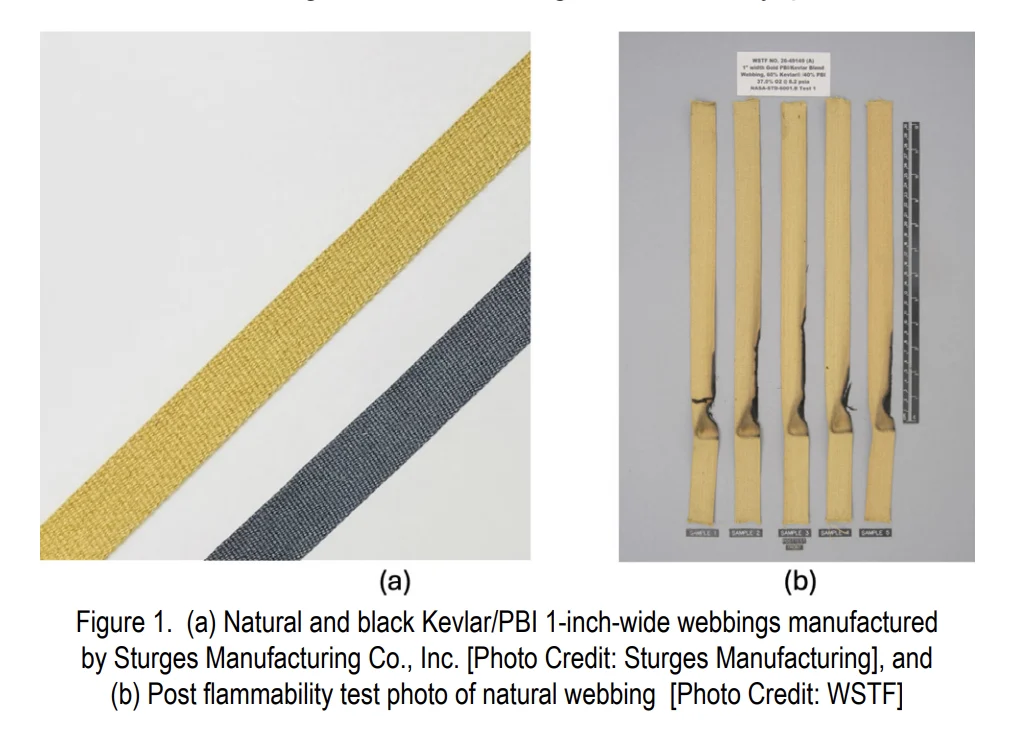
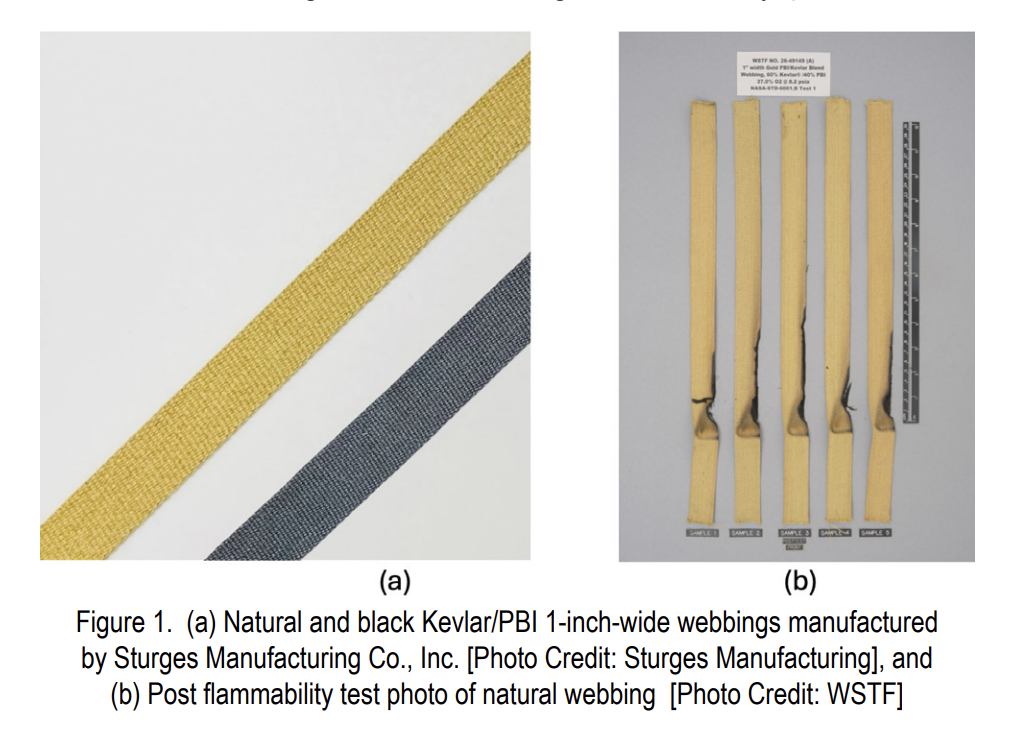
A significant advancement in material science for human spaceflight has been reported, identifying a commercial-off-the-shelf (COTS) webbing that successfully meets stringent NASA flammability requirements for the elevated oxygen environments anticipated on future lunar and Martian missions. The breakthrough material, a natural-colored webbing composed of 60% Kevlar® and 40% polybenzimidazole (PBI) manufactured by Sturges Manufacturing Company, Inc., has passed rigorous flammability testing under conditions simulating these challenging extraterrestrial atmospheres. This development marks a crucial step forward in securing the safety and operational efficiency of astronauts as humanity ventures deeper into the solar system.
The webbing underwent NASA-STD-6001B Test 1, utilizing a surface ignition in a J-configuration, at an environment of 37% oxygen and 8.2 psia. This specific blend of conditions is critical, as it directly reflects the planned atmospheric composition for habitats and crewed vehicles designed to minimize pre-breathe time for extravehicular activities (EVAs) on the Moon and Mars. The successful outcome, coupled with favorable offgassing data also provided for the material, positions this natural, gold-colored webbing as a highly promising candidate for a wide array of softgoods applications in future flight hardware. However, the findings are preliminary, and final performance and wear characteristics will necessitate validation within full system configurations.
The Imperative of Fire Safety in Space Exploration
The drive for fire-resistant materials is rooted in the fundamental challenges of spaceflight. Fire in a microgravity or confined, elevated-oxygen environment poses an exponentially greater threat than on Earth. The absence of natural convection means flames behave unpredictably, spreading differently and producing smoke that doesn’t rise, but rather disperses throughout the cabin, quickly obscuring vision and posing severe respiratory hazards. Furthermore, extinguishing a fire in space is exceptionally difficult, with limited resources and the potential for toxic byproducts to contaminate the air system.
Historically, fire has been a constant concern for space agencies. The tragic Apollo 1 fire in 1967, which claimed the lives of three astronauts during a ground test, underscored the catastrophic risks associated with flammable materials in high-oxygen environments. While subsequent generations of spacecraft and habitats have implemented vastly improved fire prevention and suppression systems, the push for human exploration to the Moon and Mars introduces new variables, particularly the desire for elevated oxygen environments.
This elevated oxygen atmosphere, planned for future crewed missions, serves a vital physiological purpose: to significantly reduce the pre-breathe time required for astronauts before transitioning to the lower-pressure environment of a spacesuit for an EVA. On Earth, divers ascend slowly to avoid decompression sickness; similarly, astronauts decompress gradually from a standard cabin pressure (typically ~14.7 psia, 21% O2) to a spacesuit pressure (e.g., ~4.3 psia, 100% O2). This "pre-breathe" period, involving breathing pure oxygen at cabin pressure, can last several hours, consuming valuable mission time and astronaut energy. By increasing the cabin’s oxygen concentration and reducing its total pressure (e.g., 37% oxygen at 8.2 psia), the partial pressure of nitrogen in the astronaut’s body is lowered more rapidly, shortening or even eliminating the pre-breathe period. While beneficial for operational efficiency and crew health, this enriched oxygen environment inherently elevates the flammability risk, making the selection of truly fire-resistant materials paramount.
NASA’s Strategic Approach to Material Qualification
Recognizing this heightened risk, the NASA Engineering and Safety Center (NESC) spearheaded a comprehensive strategy to ensure the availability of textile materials capable of meeting NASA’s stringent flammability requirements in these future operational environments. This proactive initiative aims to provide the aerospace community with certified "building blocks" for softgoods flight hardware, rather than waiting for specific mission needs to arise.
The implementation of this strategy is a collaborative effort, primarily driven by the Mars Campaign Office and Johnson Space Center (JSC), with critical support from the NESC. Their joint endeavor focuses on the systematic evaluation of various materials, beginning with the first phase: testing commercial-off-the-shelf (COTS) textiles that exhibit high potential to meet the newly defined flammability criteria. The use of COTS materials, whenever feasible, offers significant advantages in terms of cost-effectiveness, supply chain availability, and reduced development timelines compared to custom-engineered solutions. However, their qualification process is equally rigorous, ensuring they meet the unique demands of spaceflight.
Narrow woven fabrics, commonly referred to as webbing or woven tape, are ubiquitous in softgoods applications within spacecraft and habitats. These include essential components such as crew mobility aids (e.g., handholds, foot restraints), restraint nets for cargo and crew, storage bag handles, and various structural elements within habitats and modules. The challenge has been that conventional materials typically used for these applications, such as standard meta-aramid or nylon webbings, do not possess the necessary fire resistance to meet the elevated oxygen flammability requirements. This deficiency necessitated the extensive testing and qualification effort now yielding promising results.
Rigorous Testing Protocols at White Sands Test Facility
The evaluation of webbing candidates was meticulously conducted at NASA’s White Sands Test Facility (WSTF), a premier center for high-hazard testing and evaluation. The specific test employed was NASA-STD-6001B Test 1, designed to determine the Maximum Oxygen Concentration (MOC) at which a material will not propagate a flame. For this study, the testing was performed at a fixed pressure of 8.2 psia, mirroring the projected operational environment.
The MOC test is a critical safety parameter, indicating the highest oxygen concentration at which a minimum of five tested samples successfully pass the NASA-STD-6001B criteria, which typically involves non-ignition or self-extinguishment without sustained burning. The tests were performed in an unshielded J-configuration, a standard setup where the igniter impinges on the front surface of the material, including its lateral free edge, but the cut edge of the webbing is not directly exposed to the flame. This configuration is crucial for understanding how a material would react to a surface ignition event, which is a common fire initiation scenario. It is important to note that this phase of testing did not assess flammability performance after wear and tear, a factor that will need to be addressed in subsequent validation stages.
Two variations of the Sturges Manufacturing webbing were subjected to testing: a natural (gold-colored) version and a black version, both composed of the 60% Kevlar® and 40% PBI blend. These one-inch-width samples were representative of the broader product line, which is available in widths ranging from ¼ inch to 8 inches. The choice of Kevlar®, a para-aramid fiber known for its exceptional strength-to-weight ratio and thermal stability, combined with PBI (polybenzimidazole), a synthetic fiber renowned for its outstanding thermal and chemical resistance and non-flammable properties, underscores the strategic material selection aimed at achieving superior fire performance.
Analysis of Results and Initial Implications
The test results demonstrated a clear success for the natural webbing. It achieved an MOC of 37% oxygen at 8.2 psia, meaning it successfully passed the flammability criteria at the target oxygen concentration for future missions. The black webbing, while also performing commendably, exhibited a slightly lower MOC of 35% oxygen at 8.2 psia. This subtle difference between the natural and black versions could be attributed to various factors, including the presence of dyes, finishing treatments, or minor variations in manufacturing processes, all of which can influence a material’s flammability characteristics. In addition to flammability, offgas testing was also performed on the natural webbing, per NASA-STD-6001B, ensuring that the material does not release harmful volatile organic compounds (VOCs) or other toxic substances into the confined cabin environment, which is equally critical for crew health.
These findings are immensely valuable for material selection, providing aerospace engineers with a validated option for incorporation into final softgood products. However, the report explicitly cautions that these individual textile results do not guarantee the performance of the finished assembly. The flammability characteristics of a final product are a complex interplay of all its constituent components, including the webbing, threads, fasteners, coatings, and any other materials used in its construction. Therefore, the complete flight hardware, or "end item," must be rigorously tested in its final configuration to ensure it meets all requirements.

Variations in the webbing itself, such as dimensions, weave type, yarn size, density, applied treatments, color, fiber blend ratios, edge finishing techniques, the addition of features like hook-and-loop fasteners, and the effects of wear and tear, all have the potential to alter flammability characteristics. Each such variation would necessitate re-evaluation before use to maintain the highest safety standards.
A Chronology of Progress and Future Outlook
The journey to identifying and certifying such materials is a multi-year endeavor. It began with NASA’s long-term vision for sustained human presence on the Moon under the Artemis program, and eventually on Mars, which necessitated a re-evaluation of all onboard materials in the context of new operational environments.
- Early 2020s: NESC begins developing the strategic framework for material qualification in elevated oxygen environments, recognizing the need for proactive material development.
- Mid-2020s: The Mars Campaign Office and Johnson Space Center join forces with NESC to implement this strategy, focusing on identifying promising COTS textiles.
- Late 2020s (leading up to July 2026): Extensive laboratory and facility-level testing commences at WSTF, evaluating numerous candidate materials against the NASA-STD-6001B Test 1 under specific atmospheric conditions.
- July 31, 2026: The publication of these results marks a significant milestone, officially identifying the 60% Kevlar®/40% PBI natural webbing as a qualified material for flammability in the target environment.
- Late 2020s and Beyond: The focus shifts to integrating this webbing into prototype softgoods assemblies, followed by full configuration testing to validate the performance of the complete systems. This will precede its eventual incorporation into flight hardware for upcoming Artemis missions to the lunar surface and Gateway station, and eventually for crewed missions to Mars.
Broader Impact and Implications for Space Exploration
The successful qualification of this fire-resistant webbing holds profound implications for the future of human spaceflight. It not only addresses a critical safety concern but also facilitates the adoption of operational strategies, such as reduced pre-breathe times, that enhance crew efficiency and well-being during ambitious exploration missions.
Officials at the NASA Engineering and Safety Center (NESC) have consistently underscored the proactive nature of this material development, emphasizing that it is foundational to building safe and reliable space systems for the next era of exploration. A spokesperson from the Mars Campaign Office highlighted the critical role of robust, fire-resistant textiles in ensuring crew safety and mission success for ambitious future endeavors, noting that every component, no matter how small, contributes to the overall safety margin. Experts at Johnson Space Center emphasized the meticulous validation process required before any material can be deemed flight-ready, reinforcing that while these initial results are highly encouraging, the journey from component qualification to flight certification is comprehensive.
Beyond NASA, this research and the resulting material qualification could have ripple effects across the broader aerospace industry, benefiting commercial spaceflight companies and international partners involved in lunar and Martian initiatives. The advanced material science demonstrated by the Sturges Manufacturing Company’s webbing, blending the strengths of Kevlar and PBI, could also find applications in other extreme environments on Earth, such as firefighting equipment, industrial safety gear, or high-performance protective clothing.
The ongoing commitment to rigorous material science, collaborative testing, and proactive safety measures remains paramount as humanity prepares to establish a sustained presence beyond Earth. The identification of this advanced fire-resistant webbing represents a tangible step towards making the dream of living and working on the Moon and Mars a safer and more attainable reality. This achievement underscores NASA’s unwavering dedication to protecting its astronauts while pushing the boundaries of human exploration.