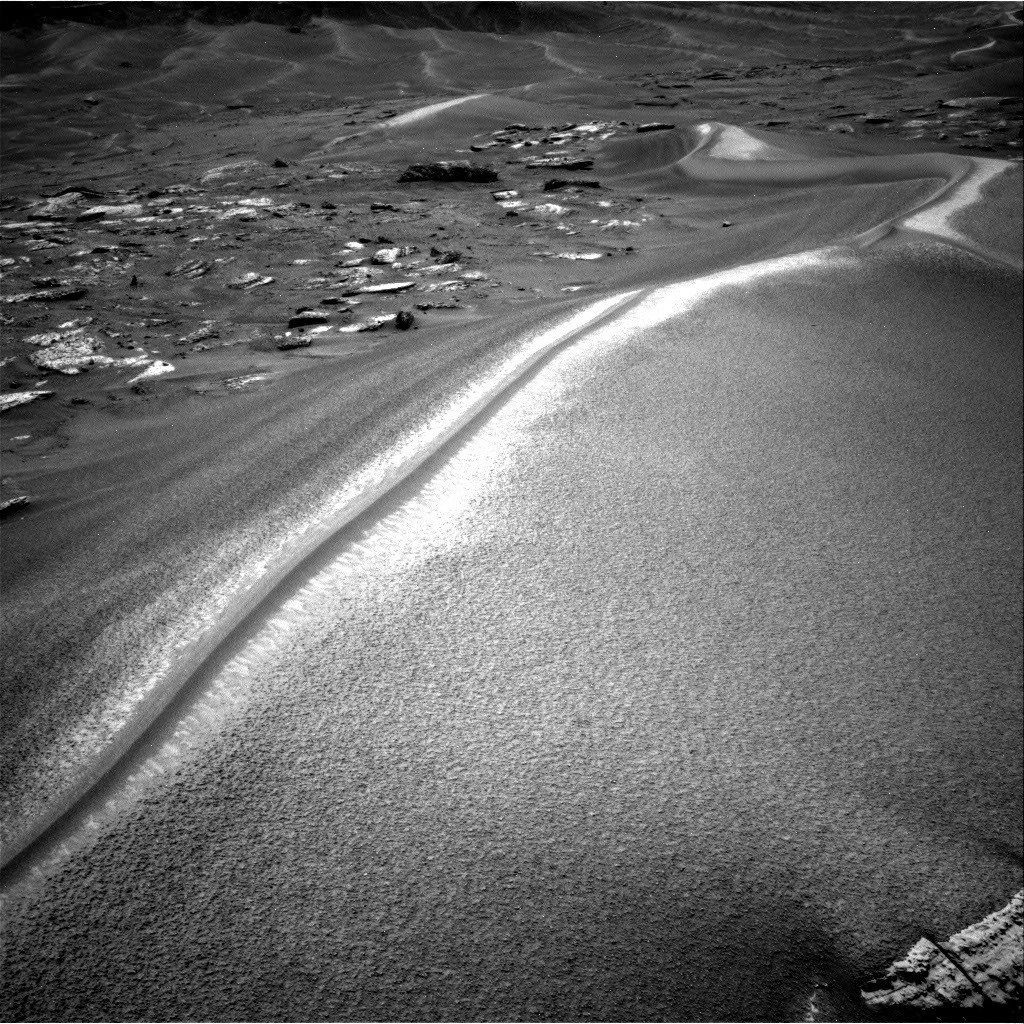
The Mars Science Laboratory (MSL) Curiosity rover has marked a period of significant achievement, celebrating both a remarkable elevation gain of one kilometer from its landing site within Gale Crater and the extraordinary milestone of 5,000 Martian days, or sols, operating on the Red Planet. These dual accomplishments underscore the mission’s enduring success and the dedication of the international team of engineers and scientists guiding its exploration. Concurrently, the rover is engaged in a focused scientific investigation of a distinctive wind-formed ripple named "Chocolatal," probing the dynamics of Martian surface processes at higher elevations on Mount Sharp.
A Monumental Climb: Scaling Mount Sharp
On Friday, August 28, 2026, Earth planning date, a pivotal achievement for Curiosity was officially recognized: the rover successfully surpassed a 1-kilometer (approximately 0.62 miles) elevation gain from its original landing spot on the floor of Gale Crater. This makes Curiosity a world-class "mountaineer" in the context of Martian exploration, a testament to its robust design and the strategic planning of its traverse. For comparison, the Spirit rover, part of the earlier Mars Exploration Rover mission, garnered significant excitement in August 2005 when it reached the summit of Husband Hill in Gusev Crater, a climb of 106 meters (about 348 feet). Curiosity’s ascent dwarfs this prior achievement by nearly tenfold, demonstrating the ambitious scope and sustained execution of the MSL mission.
The primary objective of this arduous climb up Mount Sharp (officially Aeolis Mons) is to investigate the mountain’s layered geology, which acts as a vast chronological record of Mars’s environmental history. Each stratum represents a different epoch, potentially revealing clues about the planet’s past habitability, the presence of ancient water, and shifts in its climate over billions of years. By traversing these layers, Curiosity gathers crucial data that helps scientists reconstruct the evolution of Mars from a potentially warmer, wetter world to the cold, arid planet it is today. The higher elevations accessed by Curiosity offer insights into younger geological periods, allowing for a more complete understanding of Martian history. This persistent upward trajectory allows the rover to sample diverse rock compositions, sediment types, and mineralogies that speak to varying environmental conditions, including ancient lakes, rivers, and atmospheric interactions.
Five Thousand Sols of Discovery: An Enduring Legacy
The celebration of Curiosity’s longevity continued on Saturday, August 29, 2026, as the rover officially completed 5,000 Martian days (sols) since its dramatic landing on August 6, 2012, Earth time. Given that a Martian day lasts approximately 24.6 Earth hours, 5,000 sols equate to more than 5,137 Earth days of continuous operation. This remarkable endurance far exceeds the rover’s initial two-year primary mission duration, a testament to the meticulous engineering, diligent maintenance, and adaptive planning by the teams at NASA’s Jet Propulsion Laboratory (JPL) and partner institutions.
The extended mission has allowed Curiosity to achieve an unprecedented depth of scientific inquiry. Over these 5,000 sols, the rover has traveled over 30 kilometers (nearly 19 miles) across the Martian surface, drilled into dozens of rocks, analyzed atmospheric samples, and captured hundreds of thousands of images. Key discoveries include finding evidence of ancient lakebeds with chemical ingredients necessary for life, identifying complex organic molecules within Martian rocks, and characterizing the radiation environment on the surface—critical data for future human missions. The sustained operation of Curiosity, alongside its sibling rovers like Opportunity (which operated for over 14 years) and Perseverance (currently active), showcases the robustness of robotic exploration and the strategic value of long-term planetary missions. The accumulated data forms an invaluable repository for understanding Mars’s geological, climatic, and astrobiological history.
Probing Martian Winds: The Enigma of "Chocolatal"
Beyond these significant milestones, Curiosity remains actively engaged in its core scientific mission. The rover is currently focused on an intriguing geological feature: a prominent, wind-formed ripple designated "Chocolatal." Scientists are examining this structure to determine if it can be classified as a "transverse aeolian ridge" (TAR). TARs are ubiquitous across the Martian surface, identified through extensive orbital imaging, and are characterized by their long axes being oriented perpendicular to the local predominant wind direction.
While Curiosity has encountered potential TARs at lower elevations within Gale Crater, "Chocolatal’s" position higher on the slopes of Mount Sharp presents a unique scientific opportunity. Its elevated location raises crucial questions: Will its composition of granular materials be consistent with those found in lower-lying TARs? Or will it exhibit a different range of grain sizes, layering patterns, or mineralogical characteristics influenced by the varied geological strata of Mount Sharp? Investigating "Chocolatal" is vital for understanding the current atmospheric conditions and wind patterns on Mars. Scientists aim to determine how this ridge formed, whether it is an active feature still migrating, or if it has stabilized over time, and if so, how. These insights are fundamental to deciphering the processes of sediment transport and deposition on Mars, which shape its surface and influence its climate.
Detailed Scientific Investigations: A Week in the Life of Curiosity
The planning week leading up to these milestones and the "Chocolatal" investigation was meticulously structured, demonstrating the multi-faceted approach of the Curiosity science team.
-
Initial Approach and Bedrock Analysis: At the beginning of the planning week, Curiosity was en route to the "Chocolatal" sand ripple. Along its path, the rover encountered several compelling science targets. A two-sol plan for Monday focused on in-situ examinations of light-toned bedrock sections, which often indicate different mineral compositions or alteration processes. Some rocks adjacent to the rover exhibited dark-toned, thick coatings or remnant layers, suggesting weathering or depositional events. These features were precisely targeted for chemical analysis using Curiosity’s Chemistry and Camera (ChemCam) Laser Induced Breakdown Spectroscopy (LIBS instrument. ChemCam LIBS fires a pulsed laser at targets and analyzes the light emitted from the resulting plasma, providing elemental composition. Concurrently, Mastcam (the rover’s main color cameras) and ChemCam Remote Micro Imager (RMI) mosaics were planned to capture high-resolution imagery of layered buttes along the rover’s path, as well as more distant sets of sand ripples, providing geological context and broader aeolian landscape views.
-
Midweek Maneuvers and Initial Ripple Contact: A midweek planning session capitalized on the rover’s efficient drive, bringing Curiosity within a few meters of "Chocolatal." This proximity allowed for immediate scientific engagement. ChemCam was deployed to target sand directly at the base of "Chocolatal," as well as nearby bedrock, to compare their chemical signatures. High-resolution image mosaics of the ripple were also acquired using Mastcam in a stand-off capacity, allowing for detailed morphological studies without direct contact. The strategic drive planned midweek involved the rover making brief contact with "Chocolatal" using one of its wheels, followed by a slight reversal. This maneuver created a small trench or "scuff" in the ripple, preparing the site for "contact science" investigations in the subsequent planning session. This technique is crucial for exposing subsurface materials, which may reveal different grain sizes, layering, or compaction than the surface.
-
Sol 5000 and "Contact Science" on "Chocolatal": The final planning session of the week, which extended through the landmark Sol 5000, focused on intensive "contact science" within the newly trenched region of "Chocolatal." The Mars Hand Lens Imager (MAHLI), mounted on the rover’s robotic arm, was used to capture detailed mosaics of the right wall of the trench. These MAHLI mosaics are particularly important for discerning any fine-scale layering within the ripple and assessing variations in grain size—critical indicators of formation processes and wind dynamics. Poignantly, these MAHLI mosaics are being named in honor of the late Paul Geissler, a renowned expert in the study of Martian TARs and a valuable contributor to the MAHLI team, whose untimely passing earlier in the year was a loss to the scientific community.
Further "contact science" involved the Alpha Particle X-ray Spectrometer (APXS), also on the robotic arm, which was positioned to take in-situ measurements of the coarse-grained surface of the ripple, providing elemental composition data. ChemCam LIBS measurements were also planned for multiple points on "Chocolatal": specifically, on the very top of the ripple, which presented a sinuous feature described as resembling a "mohawk" haircut; on a distinct dark band observed on its flank; and at the back of the scuff/trench. These varied targets aim to characterize any compositional differences across the ripple’s structure. Complementing these detailed investigations, the three-sol plan included broader observational activities: Mastcam mosaics for contextual imaging, an early morning (AM) Navcam dust-devil survey to monitor atmospheric activity, a Navcam suprahorizon survey for atmospheric opacity measurements, and APXS atmospheric measurements to gauge argon and krypton abundances.
Broader Implications and Future Outlook
The recent achievements and ongoing scientific work of Curiosity hold significant implications for our understanding of Mars and for future space exploration endeavors. The successful ascent of one kilometer on Mount Sharp demonstrates the rover’s capability to operate in challenging, varied terrain, a crucial precursor for future human missions that may need to traverse complex landscapes. The longevity of the mission, now exceeding 5,000 sols, provides an unparalleled dataset for planetary scientists, informing models of Martian climate, geology, and potential habitability. It also showcases the remarkable durability of space hardware and the effectiveness of remote operational strategies.
The detailed study of "Chocolatal" and other aeolian features is more than an academic exercise. Wind-driven processes are fundamental to shaping the Martian surface today, influencing everything from the distribution of dust and sand to the formation of larger dunes and ridges. Understanding these features helps scientists interpret orbital images more accurately and provides vital "ground truth" for deciphering Mars’s atmospheric dynamics. This knowledge is essential for predicting weather patterns, identifying potential hazards for future human missions (like dust storms or mobile sand fields), and locating resources.
The enduring success of Curiosity is a testament to the collaborative spirit of the international science and engineering teams. Their adaptability, problem-solving skills, and unwavering dedication have enabled the rover to overcome numerous challenges, from technical glitches to navigating treacherous terrain. As the Curiosity science and engineering team looks forward, they express optimism and enthusiasm for the "next 5,000 sols," anticipating continued groundbreaking discoveries that will further unravel the mysteries of our neighboring planet. The journey of exploration continues, with each sol bringing new data, new questions, and new insights into the captivating history of Mars.