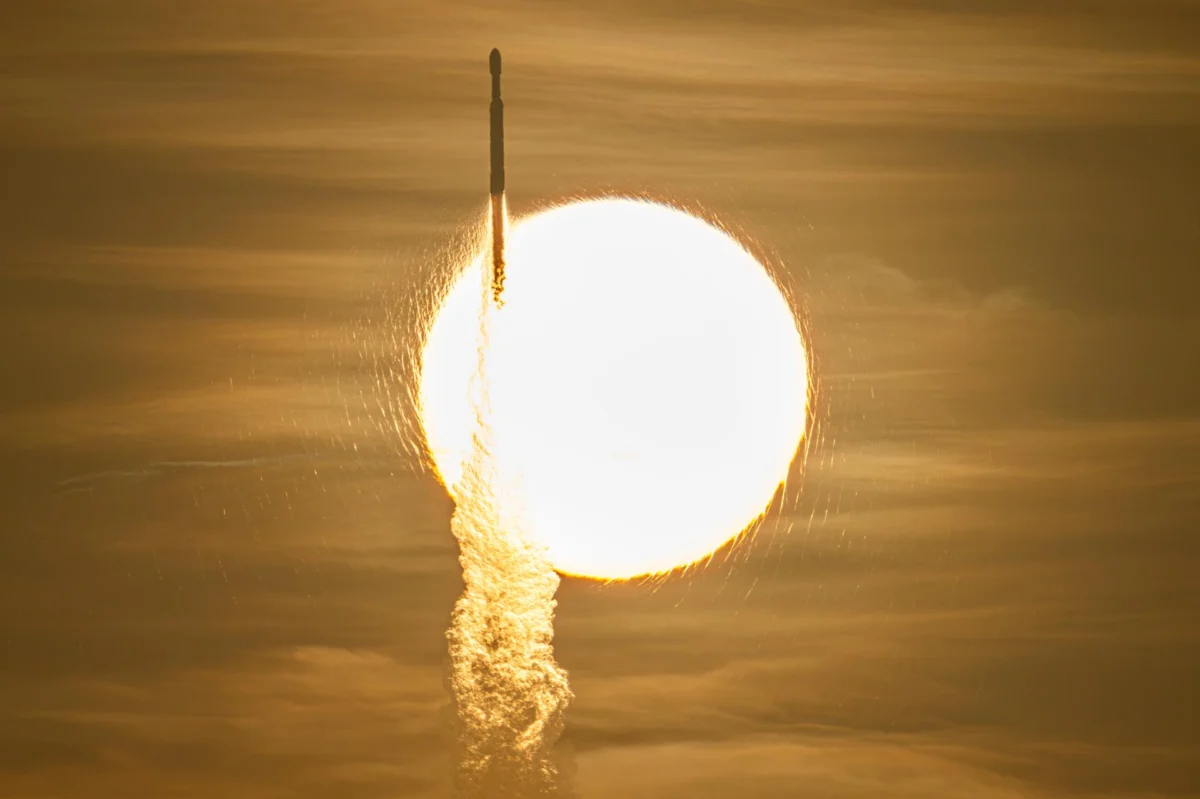
NASA’s Nancy Grace Roman Space Telescope, a next-generation observatory poised to revolutionize our understanding of the cosmos, has successfully commenced its three-month, million-mile journey to its final orbital destination. The mission launched precisely at 7:26 a.m. EDT on Sunday aboard a powerful SpaceX Falcon Heavy rocket from Launch Complex 39A at the agency’s Kennedy Space Center in Florida. This landmark event marks the beginning of a new era in astrophysics, promising to unveil the enigmatic properties of dark matter and dark energy, and to chart a new course in the discovery of exoplanets beyond our solar system.
A Monumental Launch and Initial Deployments
The launch itself was a spectacle of modern rocketry. The SpaceX Falcon Heavy, one of the world’s most capable operational rockets, performed flawlessly, carrying the precious Roman observatory skyward with immense thrust. Just seven minutes after liftoff, ground control teams at NASA’s Goddard Space Flight Center in Greenbelt, Maryland, began receiving vital telemetry data from Roman, confirming the health and status of the spacecraft. The intricate ballet of separation saw the Falcon Heavy rocket detach from the observatory 31 minutes into the flight. Demonstrating SpaceX’s commitment to reusability and efficiency, the rocket’s two side boosters, after expending their initial fuel, executed a synchronized return to the launch site, touching down safely for future refurbishment.
The crucial early stages of Roman’s journey have proceeded without incident. Approximately an hour and 23 minutes post-launch, the mission team confirmed the successful deployment of the observatory’s vital solar panels, which will provide the necessary power for its operations, and the lower instrument sun shade, a critical component for maintaining the telescope’s cold operating temperatures. Over the coming days, further key deployments are scheduled, including Roman’s high-gain antenna, essential for high-bandwidth communication with Earth, and its visor-like deployable aperture cover, which protects the sensitive optics during transit and will later be retracted to allow light into the telescope. Ground controllers are also preparing to initiate the first of two mid-course corrections, precisely nudging Roman onto its intended trajectory toward the second Sun-Earth Lagrange point (L2). Additionally, the Coronagraph Instrument, a cutting-edge technology demonstrator, will power on, marking a significant step toward directly imaging exoplanets.
The Vision of Roman: Unveiling Cosmic Mysteries
The Nancy Grace Roman Space Telescope is designed to be a "discovery machine," combining an unprecedentedly large field of view with exquisite infrared vision. This unique pairing will allow it to survey vast swathes of the sky with remarkable speed and depth, peering deeply into cosmic history to address some of humanity’s most profound questions about the universe’s origin, evolution, and composition.
At the core of Roman’s scientific quest are the mysteries of dark matter and dark energy. These elusive components are believed to constitute approximately 95% of the universe’s total mass and energy, yet they remain largely invisible and poorly understood. Dark energy, a mysterious repulsive force, is thought to be responsible for the accelerating expansion of the universe, a phenomenon first observed in the late 1990s. Roman will probe dark energy by precisely measuring the distances to millions of distant galaxies and observing how their distribution has changed over cosmic time. It will utilize techniques such as weak gravitational lensing, where the gravity of massive structures distorts the light from background galaxies, and baryon acoustic oscillations (BAO), the imprints of primordial sound waves in the distribution of matter. By mapping the large-scale structure of the universe with unprecedented detail, Roman aims to constrain different models of dark energy and shed light on its fundamental nature.
Similarly, dark matter, an invisible substance that interacts gravitationally but does not emit or absorb light, forms the scaffolding upon which galaxies and galaxy clusters are built. Roman’s weak lensing surveys will provide comprehensive maps of dark matter distribution, helping scientists understand how this mysterious substance influences galaxy formation and evolution. The telescope will also study Type Ia supernovae, cosmic standard candles whose brightness can be used to measure cosmic distances, providing another independent probe of the universe’s expansion history and the influence of dark energy.
Beyond these cosmological enigmas, Roman will embark on an ambitious campaign to discover and characterize exoplanets – worlds orbiting stars other than our Sun. While missions like Kepler and TESS have revolutionized exoplanet discovery using the transit method, Roman will primarily employ gravitational microlensing. This technique leverages the gravitational bending of light predicted by Einstein’s theory of general relativity. When a foreground star (or even a planet) passes in front of a more distant background star, its gravity can temporarily magnify and brighten the background star’s light. Roman’s wide field of view and high cadence observations are ideally suited to detect these rare and fleeting microlensing events, allowing it to discover thousands of exoplanets, including many Earth-sized worlds in the outer regions of their stellar systems – regions that are difficult to probe with other methods. This will provide a statistical census of planetary systems, offering crucial insights into the prevalence and diversity of worlds throughout our galaxy.
A New Atlas of the Universe: Roman’s Technological Edge
Roman’s scientific prowess stems from its cutting-edge instrumentation and design. Its primary instrument, the Wide Field Instrument (WFI), is a 300-megapixel infrared camera equipped with 18 4K detectors. Each detector, roughly the size of a saltine cracker, is exquisitely sensitive to infrared light, allowing Roman to peer through cosmic dust clouds that obscure visible light and observe the faintest, most distant galaxies. This capability is critical for studying the early universe and for mapping dark matter and dark energy across vast cosmic distances.
The WFI boasts a field of view 100 times larger than that of the Hubble Space Telescope’s primary infrared instrument, the Wide Field Camera 3 (WFC3). This immense field of view means Roman can image a much larger patch of sky in a single observation, enabling it to survey the universe approximately a thousand times faster than Hubble. This speed and breadth are essential for collecting the vast statistical samples required to constrain cosmological models and discover thousands of exoplanets. Furthermore, the observatory’s rigid design and stable optical performance allow it to rapidly scan the sky without needing substantial time between separate observations, further boosting its survey efficiency.
Another groundbreaking component is the Coronagraph Instrument. While the WFI focuses on wide-field surveys, the Coronagraph is a technology demonstration designed to directly image faint exoplanets by blocking the overwhelming glare of their host stars. This instrument will take a giant step forward by snapping pictures of Jupiter-like planets, paving the way for future missions like NASA’s Habitable Worlds Observatory concept, which could potentially image Earth-like planets and search for biosignatures in their atmospheres. The Coronagraph employs a series of mirrors and masks to precisely cancel out starlight, allowing the faint light from orbiting planets to be detected.
Journey to L2 and Commissioning
Roman’s journey to the Sun-Earth L2 point is a carefully choreographed sequence of events. Initially, during launch and early orbit, the Near Space Network’s ground stations and relay satellites facilitate communication, exchanging tracking, telemetry, and command data with ground controllers. Approximately 70 minutes after launch, the Deep Space Network (DSN) takes over, guiding Roman toward its distant destination, about one million miles (1.5 million kilometers) from Earth.
The L2 point is a gravitationally stable location in space where the gravitational forces of the Sun and Earth balance, allowing a spacecraft to remain relatively stationary with minimal fuel expenditure. It also provides an excellent environment for infrared astronomy, offering a stable thermal environment and an unobstructed view of the cosmos, shielded from the heat and light of both the Sun and Earth. Roman’s initial connection to the DSN was through the Canberra Deep Space Communication Complex in Australia. Approximately six hours later, communications transferred to the Madrid Deep Space Communication Complex in Spain, and then to the Goldstone Deep Space Communication Complex in California, ensuring continuous contact throughout the long voyage.
The three-month commissioning period will involve a meticulous series of calibrations and tests to ensure all instruments are operating optimally. After the remaining deployments, the Wide Field Instrument will activate a few weeks into the voyage. Scientists will then put Roman through its paces, fine-tuning its detectors and optics. NASA anticipates releasing Roman’s highly anticipated first images by early 2027, following this comprehensive commissioning and calibration phase.
The Legacy of Nancy Grace Roman
The telescope bears the name of Dr. Nancy Grace Roman, often hailed as the "Mother of Hubble." Dr. Roman was a pioneering astronomer and NASA executive who played a pivotal role in planning and developing the Hubble Space Telescope, transforming it from a theoretical concept into a reality. Her vision and relentless advocacy for space-based astronomy laid the groundwork for many of today’s most ambitious missions. By naming this next-generation observatory after her, NASA honors her enduring legacy and her profound impact on the field of astrophysics. Just as Hubble redefined our view of the visible universe, Roman is poised to do the same for the infrared, extending Dr. Roman’s legacy into the realm of dark energy, dark matter, and exoplanets.
Collaboration and Data Deluge
The Roman mission is a testament to international and inter-agency collaboration. Managed at NASA Goddard Space Flight Center, it involves significant participation from NASA’s Jet Propulsion Laboratory in Southern California, Caltech/IPAC in Pasadena, California, the Space Telescope Science Institute in Baltimore, and a broad team of scientists from various research institutions. Crucial industrial partners include BAE Systems Inc., L3Harris Technologies, and Teledyne Scientific & Imaging. Furthermore, contributions to Roman have been made by international partners such as the European Space Agency (ESA), the Japan Aerospace Exploration Agency (JAXA), the French space agency CNES (Centre National d’Études Spatiales), and the Max Planck Institute for Astronomy in Germany, highlighting the global scientific effort behind this ambitious endeavor.
One of Roman’s defining characteristics will be its unprecedented data output. The observatory is designed to send back an astounding 1.4 terabytes of data every single day, making it the highest data rate of any NASA astrophysics mission to date. This immense volume of information will pose both a challenge and an opportunity. To sift through this deluge of cosmic data and identify significant findings, the mission will heavily rely on advanced techniques, including machine learning and artificial intelligence. Moreover, citizen scientists will play a crucial role, helping astronomers classify objects and flag intriguing anomalies, democratizing discovery and engaging a global community in the scientific process.
Future Implications and Beyond
The Nancy Grace Roman Space Telescope represents a monumental leap forward in our quest to understand the universe. Its findings are expected to have profound implications for cosmology, potentially confirming or challenging existing models of dark energy and dark matter, and providing crucial clues to their ultimate nature. In exoplanet research, Roman will provide a statistical backbone for understanding planetary system formation and evolution, guiding future searches for habitable worlds.
Beyond its direct scientific output, Roman serves as a crucial technological pathfinder. The success of its Coronagraph Instrument will be vital for the development of future, even more ambitious missions designed to directly image Earth-like exoplanets and search for signs of life. The experience gained in managing its high data rate will also inform the design and operation of future observatories.
As NASA Administrator Jared Isaacman noted, "Roman is exactly the kind of success story we want to see across NASA. Delivered ahead of schedule and on budget, this mission reflects more than a decade of dedication from the NASA workforce and our industry partners. Now, Roman will give us a new atlas of the universe, push the boundaries of discovery, and demonstrate what is possible when America’s space program pairs bold ambition with disciplined execution." This sentiment was echoed by Nicky Fox, associate administrator for the Science Mission Directorate at NASA Headquarters, who stated, "Roman will be a discovery machine that will bring us closer than ever before to answering humanity’s most profound questions about our cosmic history. With its large field of view and fast survey speeds, Roman will usher us into a new era of discovery and make the invisible visible, setting the foundation for humanity’s search for life beyond our solar system."
The early completion of the telescope, allowing for an accelerated launch date in collaboration with SpaceX’s Launch Services Program, underscores the efficiency and dedication of the teams involved. As Julie McEnery, Roman’s senior project scientist at NASA Goddard, aptly summarized, "We’ve never been able to view the universe with eyes like Roman’s before. There’s no telling what more we’ll know and have seen by this time next year." The scientific community worldwide now eagerly anticipates the groundbreaking discoveries that this revolutionary observatory is destined to make, fundamentally reshaping our understanding of the universe.