


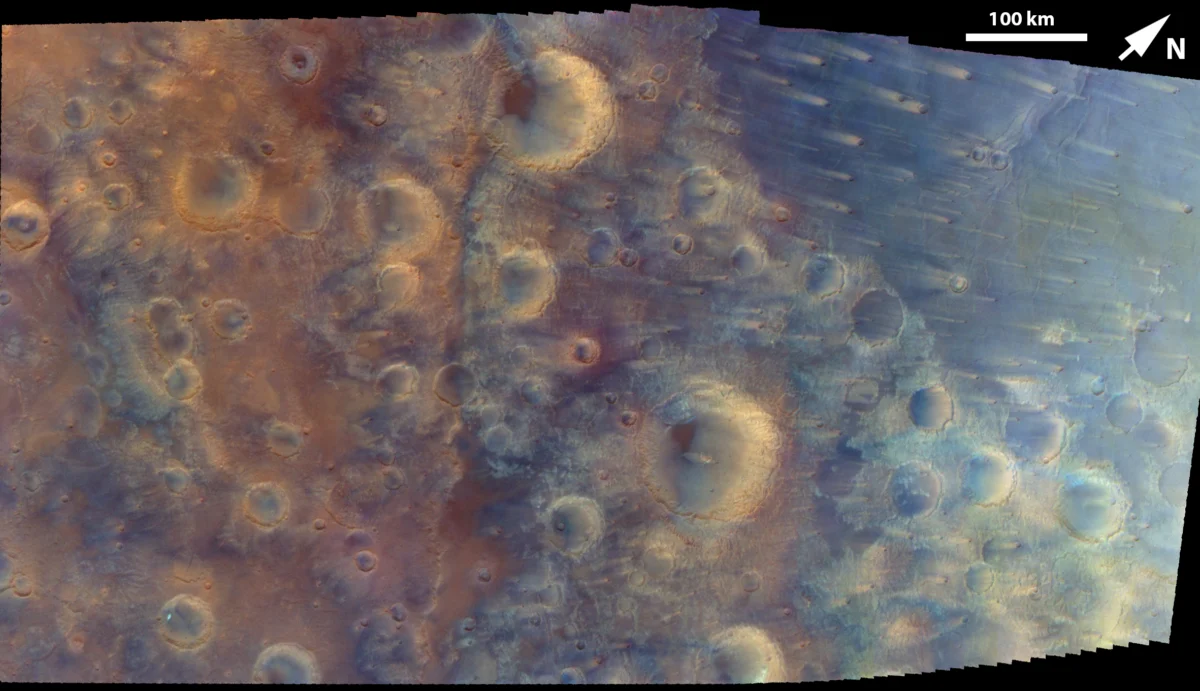
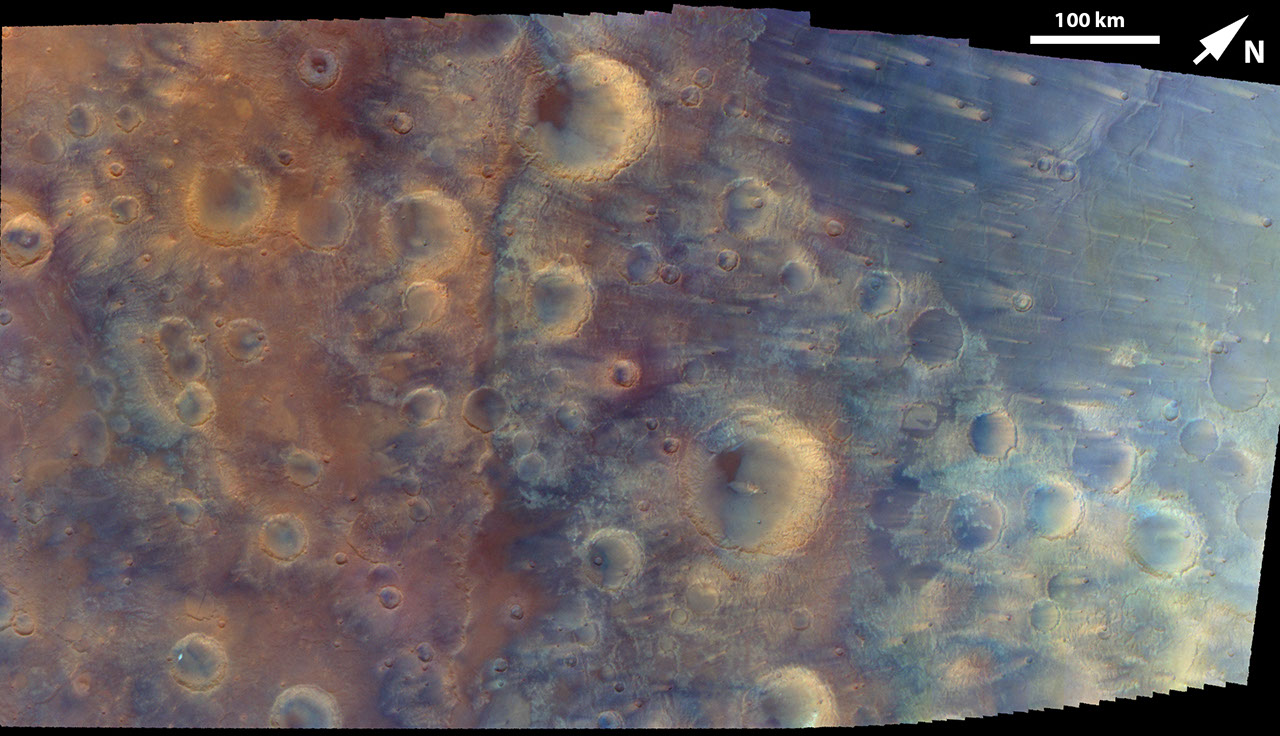
The vast, ancient Martian landscape, scarred by eons of cosmic impacts and shaped by geological forces, has been unveiled in unprecedented detail through a new enhanced-color mosaic captured by NASA’s Psyche mission. This remarkable composite image, created from four individual frames acquired on May 15, 2026, during the spacecraft’s critical Mars flyby, serves as both a testament to the mission’s technical prowess and a tantalizing glimpse into the Red Planet’s complex history. The data, collected by the Psyche mission’s multispectral imager instrument, offers invaluable insights into the diverse geological features of Mars, while simultaneously validating the operational readiness of the spacecraft’s scientific payload as it journeys towards its ultimate destination: the metal-rich asteroid 16 Psyche.
The mosaic, meticulously stitched together and rendered in enhanced color, reveals a dramatic transition zone across Mars’s rugged southern highlands, specifically encompassing a segment of the Iapygia region. This area, spanning approximately 62 degrees east to 78 degrees east longitude and 4 degrees north to 14 degrees south latitude, is a testament to the planet’s tumultuous past. The images vividly depict a panorama of highly contrasting craters, sinuous ridges, enigmatic wind streaks, and expansive volcanic plains materials, all illuminated by the imager’s keen sensitivity to near-infrared, green, and blue wavelengths. This multispectral approach allows scientists to discern subtle compositional differences on the Martian surface that would be invisible to the human eye, providing clues about the mineralogy and geological history of the captured terrain.
During the six-minute imaging sequence, the Psyche spacecraft traversed the Martian sky from right to left, corresponding to a trajectory from the northeast to the southwest across the planet’s surface. This dynamic movement resulted in a slight variation in pixel scale resolution across the mosaic, ranging from a sharp 381 meters per pixel on the right side of the image to 440 meters per pixel on the left. Such high-resolution imagery, even from a flyby, provides valuable cartographic and geological data that complements ongoing studies by orbiting spacecraft like NASA’s Mars Reconnaissance Orbiter and Mars Odyssey, contributing to a holistic understanding of Martian surface processes.
Among the myriad features revealed, the most prominent is Fournier Crater, a colossal impact basin situated just below the mosaic’s center. Measuring approximately 71 miles (114 kilometers) in diameter, Fournier stands as a stark reminder of the intense bombardment Mars endured in its early history. Impact craters like Fournier are crucial chronological markers for planetary scientists, their density and degradation levels allowing for the relative dating of different Martian surfaces. The morphology of Fournier, including its rim structure and any potential central peaks or terraced walls, would offer further insights into the mechanics of large impact events on rocky bodies.
Extending vertically through the mosaic, slightly to the left of its center, is a striking linear feature identified as part of Oenotria Scopuli. This long, irregular cliff or scarp system is not an isolated phenomenon but rather an integral component of the vast, circular structure of the Isidis impact basin. Located northeast of the imaged area, Isidis Planitia is one of Mars’s largest and most ancient impact basins, a colossal depression spanning approximately 930 miles (1,500 kilometers) in diameter. The presence of Oenotria Scopuli as part of its periphery suggests significant tectonic deformation associated with the immense forces unleashed during the Isidis impact event, or subsequent geological processes that reactivated these ancient structural weaknesses. The Isidis basin itself is of immense scientific interest, having been identified as a potential site for past aqueous activity and a target for various orbital missions, notably near the landing site of NASA’s Perseverance rover in Jezero Crater, which lies on its western rim. The observation of features like Oenotria Scopuli from Psyche’s imager provides a unique perspective, potentially revealing previously unobserved details about the basin’s complex geological evolution.
The Psyche Mission: A Journey to a Metallic Heart
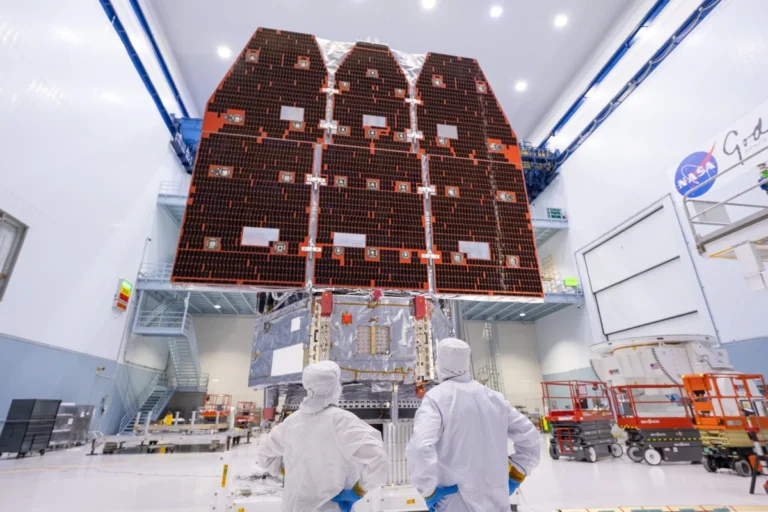
The Mars flyby was a pivotal milestone for the Psyche mission, an ambitious endeavor launched by NASA on October 13, 2023, from Launch Complex 39A at Kennedy Space Center aboard a SpaceX Falcon Heavy rocket. The primary objective of the mission is to explore 16 Psyche, a unique asteroid located in the outer main asteroid belt, approximately 230 million miles (370 million kilometers) from Earth. Unlike most asteroids, which are rocky or icy, 16 Psyche is believed to be largely metallic, potentially comprising the exposed nickel-iron core of an early planetesimal that failed to fully form. This makes it an unparalleled target for scientific investigation, offering a direct window into the building blocks of terrestrial planets, including Earth.
Scientists hypothesize that 16 Psyche could be the remnant of a protoplanet whose outer rocky layers were stripped away by violent collisions during the tumultuous early solar system. By studying 16 Psyche, researchers hope to gain fundamental insights into planetary formation processes, how cores separate from mantles, and the conditions prevalent in the nascent solar nebula. The data collected by the Psyche spacecraft is expected to help answer crucial questions about the origin of planetary cores, which are otherwise inaccessible for direct study. The mission’s journey is a long one, with the spacecraft slated to arrive at 16 Psyche in mid-2029, after several years of deep-space travel.
The Crucial Mars Gravity Assist
The Mars flyby on May 15, 2026, was not merely an opportunity for instrument testing; it was a critical gravity assist maneuver essential for the Psyche spacecraft’s trajectory. Gravity assists, also known as planetary swing-bys, are common techniques in interplanetary travel, using the gravitational pull of a planet to accelerate a spacecraft and alter its trajectory, thereby saving vast amounts of fuel and reducing travel time. For Psyche, the Red Planet provided the necessary slingshot effect to propel the spacecraft further into the solar system, putting it on course for its encounter with the metallic asteroid.
Executing a successful gravity assist requires meticulous planning and precise navigation. The spacecraft must pass Mars at a specific altitude and velocity to achieve the desired change in momentum. The successful completion of this maneuver on schedule and with the expected trajectory correction signifies the excellent performance of the Psyche navigation team and the spacecraft’s propulsion systems. This critical step ensures that the mission remains on track for its 2029 rendezvous with 16 Psyche, demonstrating the robust engineering behind the deep-space probe.
Beyond the navigational imperative, the Mars flyby offered an invaluable opportunity for in-flight calibration and testing of Psyche’s suite of scientific instruments. The spacecraft carries three primary instruments: the Multispectral Imager, a Gamma-Ray and Neutron Spectrometer, and a Magnetometer. Observing a well-characterized body like Mars allowed the mission team to thoroughly assess the performance of the Multispectral Imager under operational conditions, verifying its optical integrity, sensitivity, and data processing capabilities. This "test drive" of the instruments against a known planetary target ensures that they are fully optimized and ready to collect high-quality data once Psyche reaches its primary asteroid target.
Unveiling Martian Geology: The Multispectral Imager’s Role
The Multispectral Imager on the Psyche spacecraft is a sophisticated camera system designed to capture high-resolution images across various wavelengths, including visible and near-infrared light. Its ability to collect data in different spectral bands is fundamental to understanding the surface composition of celestial bodies. Different minerals and materials reflect and absorb light at distinct wavelengths, creating unique spectral signatures. By analyzing these signatures, scientists can create detailed maps of mineral distribution, identify different rock types, and infer geological processes.
For the Mars flyby, the use of near-infrared, green, and blue filters was instrumental in creating the enhanced-color mosaic. While natural color images replicate what the human eye would see, enhanced-color composites artificially boost the differences in spectral reflectance, making subtle variations in surface materials more apparent. In the case of Mars, this technique effectively highlights contrasting features such as the reddish-brown dusty plains, indicative of oxidized iron (rust), and areas of more bluish or grayish tones, which might signify basaltic volcanic rocks or areas with different mineralogical compositions. The clear delineation of wind streaks points to ongoing eolian (wind-related) processes shaping the Martian surface, demonstrating the dynamic nature of its thin atmosphere. The sharp visibility of ridges and volcanic plains further underscores the imager’s capability to resolve diverse geological structures, providing confidence in its ability to map the potentially complex and enigmatic surface of 16 Psyche.
Beyond Mars: The Road to 16 Psyche
With the successful Mars flyby now complete, the Psyche spacecraft continues its deep-space journey, relying on its advanced ion propulsion system to steadily accelerate towards its ultimate destination. This innovative propulsion system, which uses electricity to ionize and accelerate xenon atoms, provides a continuous, gentle thrust that is highly efficient for long-duration missions. The next phase of the mission will involve continued cruise operations, including periodic trajectory corrections and further instrument health checks, as the spacecraft traverses the vast emptiness between the orbits of Mars and the main asteroid belt.
The anticipation among the scientific community for Psyche’s arrival at 16 Psyche is palpable. The asteroid, estimated to be about 140 miles (226 kilometers) in diameter, represents a rare opportunity to study a metallic body directly. Unlike meteorites, which are fragments of asteroids that fall to Earth, 16 Psyche offers a chance to explore a celestial body in its original context, providing insights into its formation, internal structure, and surface characteristics. The data from the Multispectral Imager, once trained on 16 Psyche, will be crucial for mapping its surface geology, identifying any potential craters or topographical features, and discerning variations in its metallic composition.
Implications for Planetary Science and Exploration
The successful Mars flyby and the spectacular images it yielded carry significant implications for planetary science and future space exploration. Firstly, it validates the operational readiness of a key scientific instrument, the Multispectral Imager, which is paramount for achieving the primary science goals at 16 Psyche. This successful test ensures that the data collected once the spacecraft arrives at its target will be of the highest scientific quality, minimizing risks associated with unproven hardware.
Secondly, even as a secondary objective, the Mars imagery contributes valuable data to the broader understanding of the Red Planet. Each new perspective, particularly high-resolution multispectral data, helps refine existing geological maps, identify new features, and provide context for ongoing and future Mars missions. The detailed views of Fournier Crater and Oenotria Scopuli, for example, could spur further investigations into these specific regions by other Martian orbiters.
Finally, the entire Psyche mission, including its successful navigation through the solar system and instrument testing, represents a triumph of engineering and scientific collaboration from NASA, JPL-Caltech, and Arizona State University. It underscores humanity’s relentless drive to explore the cosmos and unravel the mysteries of planetary formation. The journey to 16 Psyche is not just about understanding a single asteroid; it’s about piecing together the grand narrative of how our solar system, and indeed our own planet, came to be. The Mars flyby was a critical, visually stunning chapter in this ongoing scientific odyssey, setting the stage for even more profound discoveries awaiting at the metallic heart of 16 Psyche.