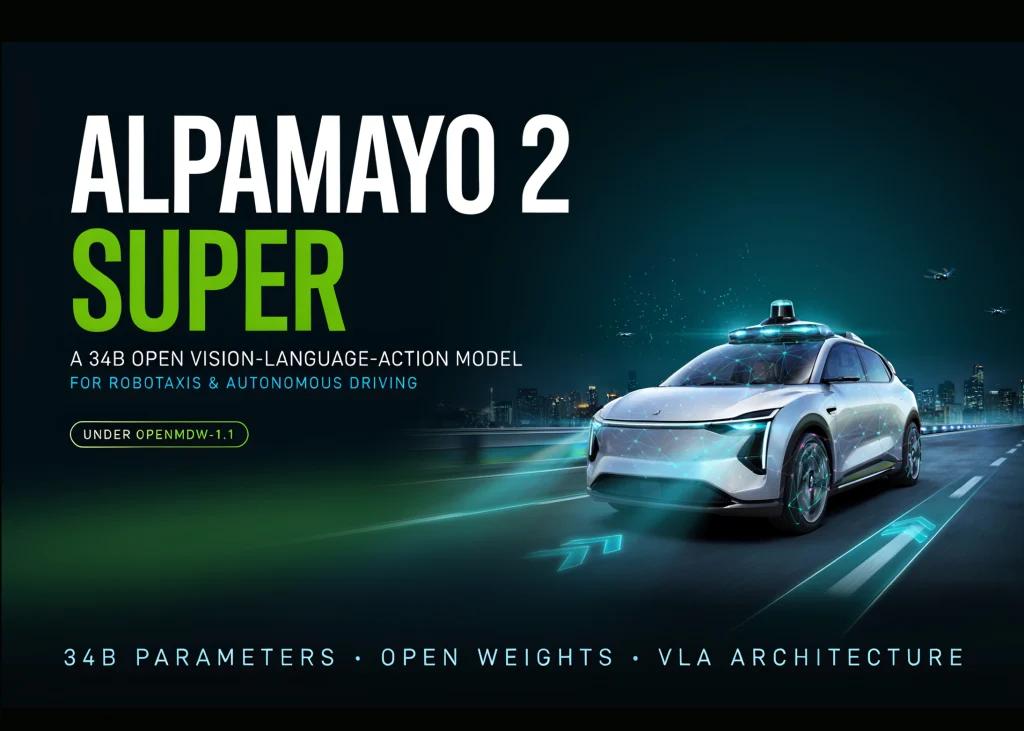
NVIDIA has officially announced the release of Alpamayo 2 Super, a sophisticated 34-billion-parameter vision-language-action (VLA) model designed specifically to advance the capabilities of autonomous driving systems. This release marks a significant milestone in the field of Physical AI, as NVIDIA has opted to provide the model under an open commercial license, specifically targeting the resolution of "long-tail" events—those rare, complex, and often unpredictable multi-agent scenarios that have historically challenged conventional autonomous vehicle (AV) software stacks. By integrating high-level reasoning with precise physical action, Alpamayo 2 Super represents a shift toward end-to-end neural architectures in the automotive sector.
The architecture of Alpamayo 2 Super is a hybrid composition, pairing a 32-billion-parameter Vision-Language Model (VLM) backbone with a 2.3-billion-parameter diffusion-based action decoder. The VLM backbone is built upon the NVIDIA Cosmos 3 Super Reasoner, which has undergone extensive post-training using reinforcement learning to enhance its decision-making logic. The diffusion decoder then translates these high-level cognitive processes into actionable trajectories. This dual-structure approach allows the model to process full-surround camera video in a single pass, simultaneously generating a planned driving trajectory, a causal explanation for that trajectory, and a categorized meta-action such as "yielding" or "changing lanes."
Bridging the Gap in Autonomous Navigation
The primary design philosophy behind Alpamayo 2 Super is the mastery of the "long tail." In the context of autonomous driving, the long tail refers to the infinite variety of rare edge cases—such as a construction worker using unconventional hand signals, a multi-vehicle accident blocking specific lanes, or a pedestrian behaving erratically—that traditional detection-and-prediction systems often struggle to interpret. Traditional stacks rely on discrete modules for perception, tracking, and prediction, which can lead to "information bottlenecks" or compounding errors between layers.
Alpamayo 2 Super addresses these limitations by functioning as a VLA model. It does not merely identify objects; it understands the semantic context of the scene. By utilizing a unified neural network, the model maintains a holistic view of the environment, allowing it to reason through complex interactions between multiple agents. This reasoning capability is vital for navigating dense urban environments where the "rules of the road" are often supplemented by social cues and situational logic.
Open-Source Strategy and Commercial Accessibility
In a strategic move to accelerate industry-wide adoption, NVIDIA has released the Alpamayo 2 Super weights under the Open Model Distribution License (OpenMDW-1.1), a permissive framework established by the Linux Foundation. The underlying source code is available under the Apache 2.0 license. This licensing structure is a departure from the restrictive "research only" licenses common in high-parameter AI models. It explicitly permits commercial redistribution, fine-tuning, and the creation of derivative models, allowing automotive manufacturers and software developers to integrate Alpamayo 2 Super into production-ready vehicles from day one.
Furthermore, NVIDIA has retroactively applied this open licensing standard to the entire Alpamayo family. Previous iterations that were originally introduced for research and development purposes are now cleared for commercial deployment. This move is expected to lower the barrier to entry for smaller AV startups and research institutions that lack the multi-billion-dollar compute resources required to train models of this scale from scratch.
Technical Specifications: Inputs and Data Architecture
The operational efficiency of Alpamayo 2 Super is rooted in its ability to process a diverse array of data streams. The model’s input architecture is designed for "omni-directional awareness," utilizing multi-camera RGB video, natural language instructions, and historical egomotion data. In validated profiles, the model typically processes feeds from six cameras—covering the front, rear, and sides of the vehicle—while referencing four historical frames per camera to maintain temporal consistency.
Egomotion inputs are highly granular, consisting of 3D translation data and a 3×3 rotation matrix across multiple timesteps. This allows the model to understand the vehicle’s own movement relative to the environment with high precision. On the output side, the model’s trajectory API is designed for smooth vehicle control. It generates 64 distinct waypoints covering a time horizon of 6.4 seconds at 0.1-second intervals. Each waypoint includes ego-frame XYZ coordinates and a corresponding 3×3 rotation matrix, providing a comprehensive blueprint for the vehicle’s pathing and orientation.
The training of Alpamayo 2 Super involved a massive dataset, reflecting the scale of NVIDIA’s compute infrastructure. The model was trained on approximately 115,000 hours of multi-camera driving video, annotated with egomotion and trajectory data. Perhaps more importantly, the training set included 3.7 million Chain-of-Causation (CoC) traces. These traces are structured, causally linked explanations that teach the model not just what to do, but why to do it. The total image training data surpassed one billion individual frames, ensuring the model’s visual encoder is robust against varying weather conditions, lighting, and geographic locations.
Benchmark Performance and Comparative Analysis
To validate the efficacy of Alpamayo 2 Super, NVIDIA subjected the model to a series of rigorous benchmarks, comparing it against both general-purpose large language models and specialized vision-language models. On the LingoQA benchmark—a standard for evaluating the linguistic and visual reasoning of autonomous systems—Alpamayo 2 Super achieved a "Lingo-Judge" score of 79.2. This performance secured the top rank among nearly 40 evaluated models.
In direct head-to-head comparisons, Alpamayo 2 Super significantly outperformed broader industry leaders. It surpassed Alibaba’s Qwen2.5-VL 72B by 17.0 points, Google’s Gemini 2.5 Pro by 15.1 points, and OpenAI’s GPT-4o by 23.2 points. These results suggest that specialized VLA models, when trained on domain-specific driving data, offer superior performance for physical navigation tasks compared to larger, more generalized models.
In terms of planning and control, NVIDIA utilized two key metrics:
- Closed-Loop Evaluation (AlpaSim): Using the PhysicalAI-AV-NuRec dataset, the model was tested in a simulated environment where its actions influenced the next state of the world. It achieved an AlpaSim score of 1.50 ± 0.13.
- Open-Loop Evaluation (minADE): On 937 challenging samples from the PhysicalAI-AV dataset, the model recorded a Minimum Average Displacement Error (minADE) of 0.911 meters at the 6.4-second horizon. This metric measures the deviation between the model’s predicted path and the actual ground-truth trajectory, with lower numbers indicating higher precision.
The Five-Output Framework: Transparency and Safety
One of the most innovative aspects of Alpamayo 2 Super is its multi-modal output system. For every driving scenario, the model generates five distinct outputs:
- Planned Trajectory: The physical path the vehicle will follow.
- Chain-of-Causation (CoC) Trace: A linguistic explanation of the decision-making process (e.g., "Slowing down because a pedestrian is approaching the crosswalk from the right").
- Meta-Action: A high-level classification of the intent, such as "lane change," "stop," or "proceed."
- Reasoning Auto-labels: Automated metadata that describes the scene for future training cycles.
- Visual Question Answering (VQA) with 2D Grounding: The ability to answer specific questions about the scene while visually highlighting relevant objects.
This combination is designed to solve the "black box" problem inherent in many deep learning systems. By providing a CoC trace, the model offers transparency, allowing human supervisors or safety auditors to understand the logic behind a sudden braking event or a steering maneuver. This integration is compatible with NVIDIA Halos safety-validation workflows and aligns with ISO/PAS 8800 standards for AI safety in road vehicles.
Industry Implications and the Future of Autolabeling
Beyond its use as an on-vehicle "driver," NVIDIA highlights the model’s utility as a powerful autolabeler. For companies maintaining large fleets of test vehicles, the process of manually annotating thousands of hours of video data is a significant bottleneck. NVIDIA claims that using Alpamayo 2 Super to automatically label proprietary fleet data can compress annotation cycles from months to just a few days. This acceleration of the data flywheel is expected to significantly reduce the cost of developing autonomous systems.
The release of Alpamayo 2 Super signals a broader trend in the automotive industry toward "World Models"—AI systems that can simulate and predict the physical realities of the road. By providing these tools under an open license, NVIDIA is positioning itself not just as a hardware provider, but as the foundational software architect for the next generation of autonomous mobility. As the industry moves closer to Level 4 and Level 5 autonomy, the ability of models like Alpamayo 2 Super to reason through the complexity of the real world will be the deciding factor in the safety and reliability of self-driving technology.