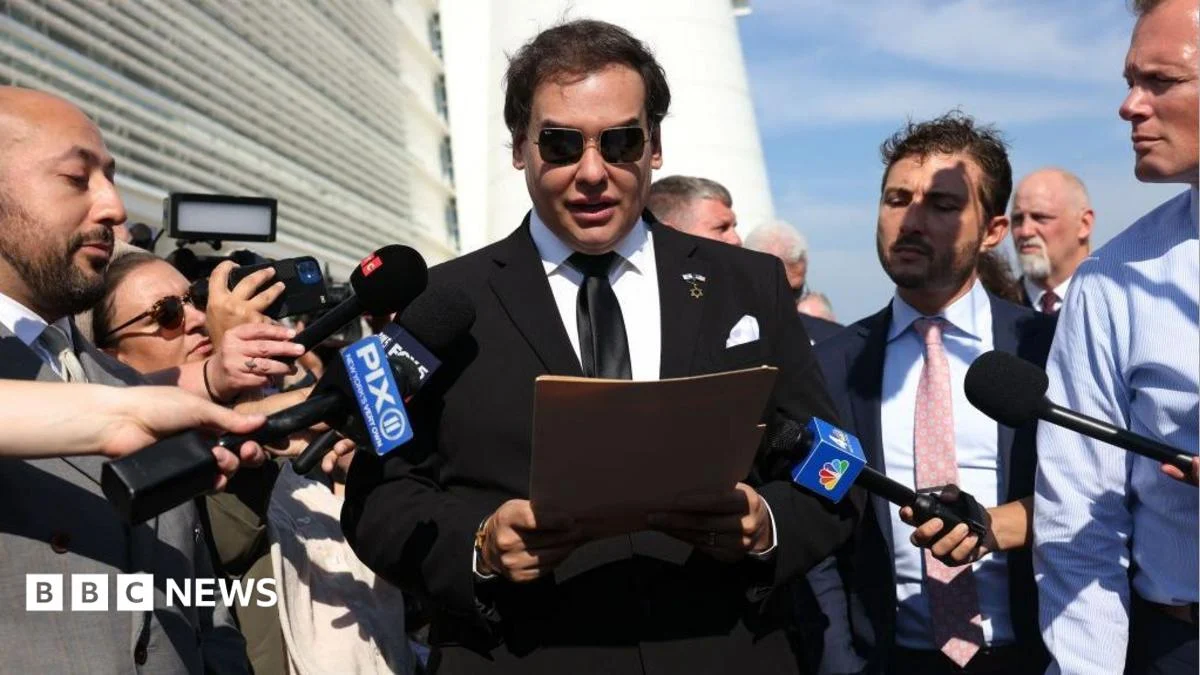
Prediction-market operator Kalshi has permanently barred former US congressman George Santos from trading on its platform, a landmark decision stemming from allegations of insider dealing related to his own attendance at a high-profile political event. The company’s move, announced recently, underscores the escalating challenges faced by burgeoning prediction markets in maintaining market integrity and complying with regulatory expectations, particularly in the sensitive realm of political outcomes.
Allegations of Insider Trading and Kalshi’s Swift Action
According to a detailed notice of disciplinary action issued by Kalshi, Santos, who was infamously expelled from Congress following a litany of fraud and identity-theft charges, allegedly placed a series of bets in February related to his attendance at US President Donald Trump’s State of the Union address. Kalshi’s compliance team, after an exhaustive internal review, concluded that Santos’s activity exhibited clear signs of insider dealing, leveraging non-public information—namely, his own intentions and actions—to manipulate market outcomes for personal gain. This prompted the immediate and irreversible lifetime ban.
Kalshi emphasized that its decision to impose the ban was taken independently, without awaiting external enforcement action from federal authorities. This proactive stance highlights the platform’s commitment to upholding its terms of service and fostering a fair trading environment, even as the broader regulatory landscape for prediction markets remains in flux. The company’s internal systems were reportedly instrumental in flagging the suspicious behavior linked to Santos’s account, leading to an initial referral to federal authorities earlier this summer, long before the public announcement of the ban.
The case specifically centered on trades Santos made in a market designed to predict whether he would attend Trump’s address—an event over which he, as the subject, possessed direct and absolute influence. Kalshi’s investigation revealed that Santos placed a series of sizeable bets between February 2 and February 25. Crucially, the compliance team found evidence that some of these trades were predicated on false or misleading public statements made by Santos regarding his plans. These public pronouncements, strategically timed, were observed to directly influence contract prices on the platform, allowing him to ultimately earn $17,839.57 from the illicit trades. This calculated manipulation of market sentiment through deceptive public statements while simultaneously betting on the outcome represents a textbook case of insider trading within the unique context of a prediction market.
Santos’s Defiant Reaction and Broader Legal Entanglements
In response to the lifetime ban, George Santos took to X (formerly Twitter) to express his defiance, stating, "Let’s see how much longer you guys are around for." This cryptic and somewhat confrontational remark suggests a lack of contrition and perhaps a veiled threat, further solidifying his public image as a figure embroiled in controversy. The BBC, a prominent news organization, has reportedly contacted Santos for further comment, though any additional response remains to be seen.
This incident on Kalshi is not an isolated event in Santos’s long and winding saga of legal and ethical transgressions. His financial dealings, particularly those that blur the lines between legitimate activity and self-serving manipulation, have been under intense scrutiny for an extended period. In July, Santos agreed to pay a substantial $35,000 to settle a federal investigation by the Commodity Futures Trading Commission (CFTC) specifically into his State of the Union trades. The CFTC, as the primary regulator for commodity futures and options markets in the United States, viewed these prediction market activities as falling under its purview, signaling a growing interest in regulating these novel financial instruments. This settlement, predating Kalshi’s public ban, underscores the seriousness with which federal authorities are approaching potential misconduct in this emerging sector. In addition to the CFTC settlement, Kalshi itself issued a substantial internal penalty of $71,356 (approximately £38,000) against Santos, reflecting the company’s assessment of the damages and the need for punitive action beyond merely recouping illicit gains.
A Chronology of Deception and Legal Woes
George Santos’s public and legal troubles have unfolded in a dramatic fashion, forming a backdrop against which the Kalshi incident must be understood:
- 2022 Election Cycle: Santos, then a political newcomer, secured a seat in the U.S. House of Representatives. His campaign was later revealed to be built upon a foundation of extensive fabrications and embellishments regarding his education, professional experience, family background, and financial assets. These biographical deceptions quickly became a national scandal.
- Early 2023: Following widespread media reports and mounting pressure, federal prosecutors initiated investigations into Santos’s finances and campaign activities. He was subsequently indicted on multiple counts of fraud, money laundering, theft of public funds, and making false statements to Congress.
- February 2-25 (Specific Year Undisclosed, but likely 2024 based on the narrative): Santos engaged in the prediction market trades on Kalshi regarding his attendance at the State of the Union address, which would later be flagged as insider dealing.
- Early Summer (Specific Year Undisclosed): Kalshi’s internal systems detected suspicious activity, leading the company to refer the case involving Santos’s trades to federal authorities for further investigation.
- Late 2023/Early 2024: Amidst growing calls for his resignation and an Ethics Committee investigation, George Santos was expelled from the U.S. House of Representatives. This historic vote made him only the sixth lawmaker in US history to be removed from Congress by a vote of his peers, a testament to the severity and scope of his alleged misconduct.
- July (Specific Year Undisclosed, but likely 2024): Santos agreed to a $35,000 settlement with the Commodity Futures Trading Commission (CFTC) over the insider trading allegations on prediction markets. This marked a significant federal intervention into prediction market activities.
- Recent Past (Specific Year Undisclosed): Kalshi announced its permanent ban on George Santos, coupled with a $71,356 internal penalty, explicitly citing insider trading on his State of the Union attendance.
- Pre-2025 (Specific Year Undisclosed, but implies current or near future): Santos faced legal proceedings, eventually pleading guilty to wire fraud and aggravated identity theft, among other charges. He was sentenced to a seven-year prison term.
- 2025: After serving only three months of his seven-year sentence, former US President Donald Trump ordered the commutation of George Santos’s sentence, granting him an early release. This commutation, occurring in the context of Trump’s own political aspirations and influence, added another layer of complexity and controversy to Santos’s ongoing narrative.
Santos has consistently denied wrongdoing in various matters, though he did admit to stealing the identities of nearly a dozen people, including next of kin, as part of his plea agreement for wire fraud and aggravated identity theft. His history is thus punctuated by admissions of serious crimes alongside persistent denials of other allegations, creating a public perception of pervasive dishonesty.
The Evolving Landscape of Prediction Markets and Regulatory Scrutiny
The disciplinary actions taken against George Santos arrive at a critical juncture for prediction markets. These platforms, which enable users to wager on outcomes ranging from political elections and legislative actions to economic indicators and scientific breakthroughs, are currently facing unprecedented scrutiny from regulators worldwide. Once considered niche or experimental, prediction markets are rapidly gaining traction, attracting a broader user base and moving closer to mainstream financial products.
Both Kalshi and its prominent rival, Polymarket, have publicly reported an uptick in unusual trading patterns across their platforms. This surge in suspicious activity has compelled these companies to significantly strengthen their monitoring systems and adopt more aggressive measures to identify and respond to potential misconduct, including market manipulation, fraud, and insider trading. The very nature of prediction markets—allowing individuals to bet on events that can be influenced by actors with privileged information—inherently creates a fertile ground for such abuses.
Regulators, including the CFTC in the United States, have increasingly signaled that as the industry matures and expands, prediction market platforms will be expected to adhere to higher standards of compliance, transparency, and market integrity. This is particularly true when the markets involve political or economic events that can have significant real-world implications. The Commodity Exchange Act, which grants the CFTC broad authority over commodity futures and options markets, is being increasingly interpreted to encompass prediction markets, especially those offering contracts on economic or political events.
The Kalshi episode involving George Santos serves as a stark illustration of the growing compliance burden confronting prediction markets. As these platforms attract more users and financial capital, they are increasingly vulnerable to sophisticated attempts at manipulation. The case underscores the necessity for robust Know Your Customer (KYC) and Anti-Money Laundering (AML) protocols, sophisticated algorithmic surveillance, and rapid response mechanisms to detect and deter illicit activities. It also highlights the ethical dilemmas inherent in allowing individuals to profit from events they can directly influence, particularly in political contexts.
Broader Implications and Future Outlook
The permanent ban on George Santos by Kalshi carries several significant implications, both for the platform itself and for the broader prediction market industry.
- For Kalshi: The decisive action reinforces Kalshi’s commitment to market integrity and fairness. By acting independently and swiftly, the company sends a strong message to potential bad actors that it will not tolerate insider trading or manipulation. This proactive approach could enhance user trust and confidence in the platform’s legitimacy, potentially attracting more reputable traders. However, it also highlights the ongoing challenge of policing such markets, especially when dealing with high-profile individuals who might attempt to exploit loopholes.
- For the Prediction Market Industry: This case sets a crucial precedent. It signals to other platforms that lax oversight of insider trading, particularly concerning political figures betting on their own actions, will not be tolerated by the industry itself, let alone by external regulators. The incident will likely intensify pressure on all prediction market operators to implement even more stringent compliance frameworks, invest further in sophisticated surveillance technologies, and clarify their policies regarding political figures and events. It could also accelerate the development of clearer regulatory guidelines from bodies like the CFTC, moving prediction markets further into the realm of traditional financial regulation.
- For Regulatory Bodies: The CFTC’s earlier settlement with Santos, combined with Kalshi’s internal actions, demonstrates a growing, multi-pronged approach to regulating this nascent sector. The case provides concrete evidence of how insider trading can manifest in prediction markets, offering valuable data points for regulators to refine their definitions of market manipulation and their enforcement strategies. It reinforces the argument that these markets, despite their novelty, require robust oversight to protect participants and maintain market integrity.
- Ethical and Societal Considerations: The Santos affair brings into sharp focus the ethical quandaries associated with prediction markets, particularly when they touch upon political events. The ability of individuals to profit from information they alone control, or from outcomes they can directly influence, raises fundamental questions about fairness, transparency, and the potential for these markets to be weaponized for personal gain or to undermine public trust in institutions. The blurring lines between political participation and financial speculation demand careful consideration.
As prediction markets continue their trajectory toward mainstream acceptance, cases like George Santos’s will serve as critical learning experiences. They underscore the delicate balance between fostering innovation in financial markets and ensuring robust consumer protection and market integrity. The industry’s ability to self-regulate effectively, coupled with judicious oversight from governmental bodies, will ultimately determine its long-term viability and its role in the evolving global financial landscape. The message from Kalshi is clear: even in the dynamic and often speculative world of prediction markets, the fundamental principles of fair play and honest dealing remain non-negotiable.