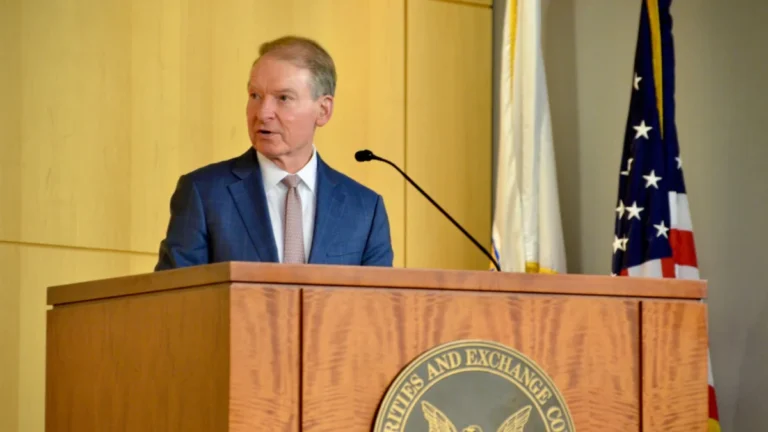
Patrick Witt, the executive director of the President’s Council of Advisors for Digital Assets, has launched a vigorous defense of the administration’s legislative strategy following the recent failure of the Digital Asset Market Clarity Act in the U.S. Senate. Speaking at high-profile events in Washington, D.C., including the Financial Markets Quality conference at Georgetown University and a policy forum hosted by CoinDesk, Witt characterized the opposition’s focus on President Trump’s personal crypto interests as a disingenuous political maneuver designed to stall essential regulatory progress. Witt’s remarks underscore a deepening divide in Washington over how to regulate the trillion-dollar digital asset industry while navigating the unprecedented ethical complexities of a sitting president with direct ties to a nascent financial sector.
The Ethics Impasse and the "Unprecedented" Concessions
At the heart of the legislative breakdown is a fierce debate over ethics provisions that critics say were designed specifically to target President Trump’s involvement in the crypto space. The Digital Asset Market Clarity Act, which sought to establish a comprehensive framework for market structure and stablecoin oversight, became bogged down in negotiations regarding the financial disclosures and divestment requirements of senior government officials.
Witt revealed that the White House had gone to extraordinary lengths to satisfy Democratic demands, offering concessions that he described as "unprecedented in nature." According to Witt, the President was prepared to submit to rules that would have mandated the divestment of his cryptocurrency holdings or the placement of such assets into a blind trust. Furthermore, Witt disclosed that the administration was willing to allow state attorneys general to pursue the federal government if it failed to adequately police ethical lapses—a provision Witt characterized as the most "far-reaching and restrictive" ever agreed to by a U.S. president.
"Democrats made it a political issue," Witt stated during his appearance at Georgetown University. He pointed to the recent passage of a major housing bill as evidence of a double standard. Witt argued that despite the President’s extensive history and ongoing interests as a real-estate developer, the housing legislation did not face the same "stringent, draconian ethics division" that halted the crypto bill. He suggested that the focus on crypto ethics was less about transparency and more about leveraging the President’s business ties to obstruct the administration’s policy goals.
The Legislative Timeline and the Senate Stalemate
The failure of the Digital Asset Market Clarity Act marks a significant setback for proponents of crypto regulation who had hoped for a breakthrough before the end of the current congressional session. The bill had seen various iterations and months of bipartisan negotiation, aiming to provide the Securities and Exchange Commission (SEC) and the Commodity Futures Trading Commission (CFTC) with clearer jurisdictions over digital assets.
The timeline of the bill’s demise reached a critical point last week when the Senate failed to advance the legislation to a floor vote. This followed a period of relative optimism during which industry advocates believed a compromise on stablecoin regulation and market oversight was within reach. However, the "ethics hurdle" proved insurmountable.
Witt indicated that the administration has now shifted its focus away from the "lame duck" session of Congress. With the legislative path blocked for the remainder of the year, Witt suggested that the White House would prioritize executive action and work through federal regulators. "The core work now is shifting to the federal regulators, such as the Securities and Exchange Commission," Witt noted, signaling a transition from a legislative strategy to a regulatory and administrative approach.
Accusations of Banking Industry Sabotage
In a sharp critique of the financial establishment, Witt accused the banking lobby of playing a pivotal role in the bill’s defeat. He alleged that large financial institutions orchestrated a "wildfire" of opposition by convincing community banks that the rise of stablecoins posed an existential threat to traditional banking models.
The primary concern cited by bankers involves the competition between interest-bearing bank deposits and stablecoins that offer rewards or yields to holders. Banking lobbyists argued that if stablecoins were allowed to proliferate under a federal framework without stringent "bank-like" regulations, they could drain liquidity from the traditional banking system.
Witt dismissed these concerns as insincere, noting the irony of the banking industry’s celebration following the bill’s failure. "If that really is an existential threat to the community banking system, then I would expect them to be back on Capitol Hill demanding passage [of a regulated framework]," Witt argued. He contended that the banks were more interested in maintaining their monopoly on deposits than in creating a safe, regulated environment for digital assets.

The Broader Context: Trump’s Crypto Empire and Public Perception
The controversy is inextricably linked to the President’s recent forays into the digital asset space. The launch of World Liberty Financial, a decentralized finance (DeFi) project associated with the Trump family, has provided significant ammunition for political opponents. Critics argue that a president overseeing the agencies that regulate crypto while simultaneously profiting from a crypto-related business creates an inherent conflict of interest.
Democratic senators on the Banking and Finance committees have repeatedly called for strict guardrails to ensure that federal policy is not shaped to benefit the President’s personal portfolio. Witt, however, countered this by highlighting what he described as the hypocrisy of Congress. He pointed out that many senators who sit on committees regulating the financial services industry continue to hold and actively trade stocks in the very companies they oversee.
"It is somewhat ironic," Witt said, "given that we’re dealing with a lot of senators on banking committees who hold stocks and actively trade stocks in financial services companies that they regulate."
Supporting Data: The Growing Influence of Digital Assets
The urgency behind the Digital Asset Market Clarity Act is underscored by the rapid growth and institutionalization of the crypto market. As of late 2024, the total market capitalization of digital assets remains near the $2 trillion mark, with stablecoins alone accounting for over $170 billion in value. Stablecoins like USDT (Tether) and USDC (Circle) have become essential infrastructure for both retail and institutional trading, often serving as a bridge between fiat currency and the broader crypto ecosystem.
Data from the Federal Reserve and various financial think tanks suggest that while stablecoins currently represent a small fraction of the total U.S. money supply, their growth trajectory has alarmed traditional financial institutions. The concern that "private money" could compete with the U.S. dollar or traditional bank deposits is a central theme in the ongoing debate over a Central Bank Digital Currency (CBDC) and private stablecoin regulation.
Witt’s defense of the President’s ties comes at a time when the "crypto vote" has become a recognized demographic in U.S. politics. Advocacy groups like Stand With Crypto have mobilized millions of voters, making digital asset policy a key campaign issue. This political pressure has forced both parties to engage with the industry, though they remain sharply divided on the methods of oversight.
Implications for Future Regulation
The shift in focus from the halls of Congress to the offices of the SEC and CFTC carries significant implications for the industry. Under the current administration, the SEC has largely pursued a "regulation by enforcement" strategy, targeting major exchanges and token issuers for alleged securities violations. Witt’s comments suggest that the White House may attempt to steer these agencies toward a more collaborative approach, though the lack of a clear legislative mandate remains a hurdle.
Industry analysts suggest that without the Digital Asset Market Clarity Act, the U.S. risks falling behind other jurisdictions, such as the European Union, which has already implemented its Markets in Crypto-Assets (MiCA) regulation. The lack of legal certainty in the U.S. has led several major crypto firms to explore offshore expansions, citing the "hostile" regulatory environment in Washington.
Conclusion: A Polarized Path Forward
Patrick Witt’s "gloves-off" approach marks a new phase in the administration’s battle for crypto legitimacy. By framing the ethics debate as a political weapon and the banking lobby’s opposition as protectionism, Witt is attempting to reclaim the narrative surrounding the President’s digital asset ties.
However, the path forward remains fraught with difficulty. As long as the President maintains an active role in the crypto industry, any policy move—whether legislative or executive—will be viewed through a partisan lens. The failure of the Clarity Act serves as a stark reminder that in the current political climate, the technical merits of financial regulation are often secondary to the optics of government ethics and the influence of entrenched economic interests.
For now, the digital asset industry remains in a state of regulatory limbo. The focus now turns to the SEC and other federal bodies, where the next chapter of the American crypto story will likely be written through administrative rulemaking and ongoing legal challenges. Whether the administration can achieve "clarity" through executive means without the support of a divided Congress remains the defining question for the future of digital finance in the United States.