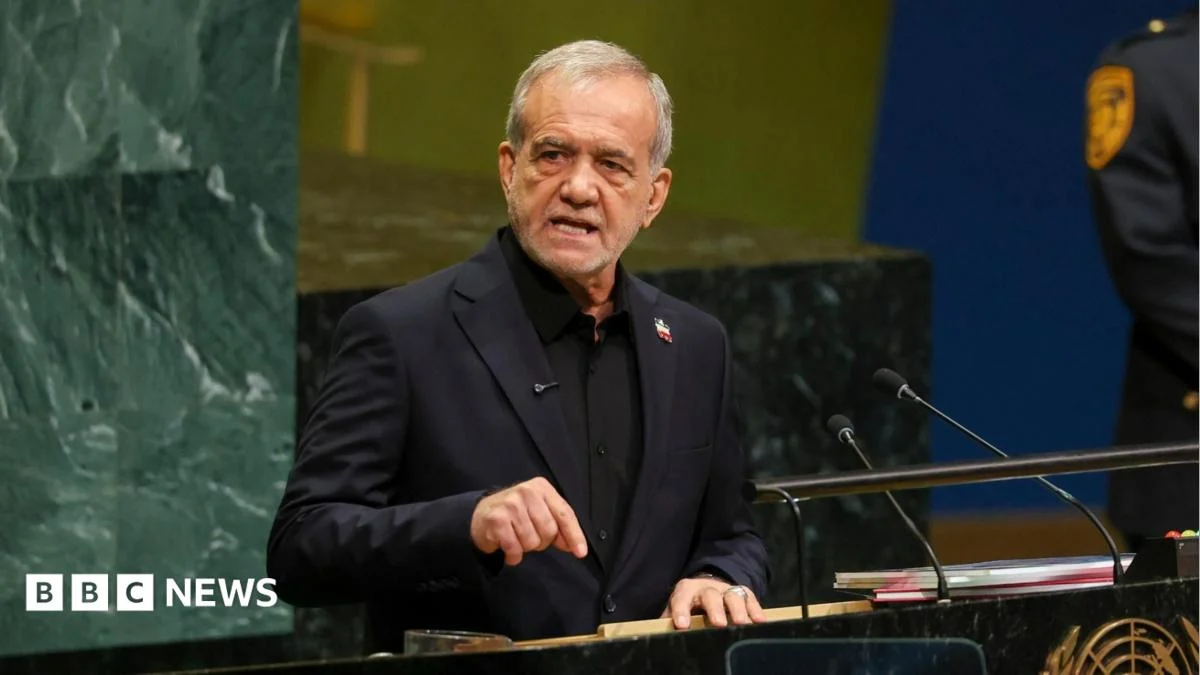
New York witnessed a dramatic confrontation at the United Nations General Assembly (UNGA) as Iranian President Pezeshkian vehemently accused the United States of state-sponsored terrorism, directly challenging President Trump’s prior characterization of Iran. Pezeshkian, in an impassioned address, presented stark evidence of civilian casualties resulting from recent US and Israeli military actions, asserting Iran’s right to self-defense amidst what he described as "cowardly attacks and aggressions." This diplomatic showdown unfolded against a backdrop of heightened military skirmishes in the Persian Gulf, including a fatal attack on a cargo ship in the critical Strait of Hormuz, and the precarious restart of indirect negotiations aimed at de-escalating a rapidly deteriorating regional crisis.
Iran’s Indictment at the UN: A Plea for Justice and Sovereignty
Addressing world leaders, President Pezeshkian launched a powerful counter-narrative to the US stance, stating, "The US president described us as terrorists. We have been the victims of terrorism." To underscore his claim, the Iranian leader held aloft a photograph of the country’s revered late Supreme Leader, Ayatollah Ali Khamenei, whose life was tragically cut short in a targeted strike on his residence in late February. This attack, a joint operation by US and Israeli forces, marked a significant escalation in the long-standing animosity between the nations, removing a figure of immense spiritual and political authority from Iran’s leadership.
Pezeshkian further presented harrowing images depicting the aftermath of missile strikes on a primary school in Minab and a sports complex in Lamerd, allegedly perpetrated on the same day as the attack on the Supreme Leader’s residence. Iranian authorities contend these strikes resulted in the deaths of more than 175 civilians, a devastating two-thirds of whom were children. "Our innocent people have been the targets of cowardly attacks and aggressions imposed on our country. And we defended ourselves with utmost strength," Pezeshkian declared, articulating a defense of Iran’s retaliatory actions as a necessary response to unprovoked aggression. The US, while denying any involvement in the Lamerd incident, has stated it is still investigating the events in Minab, indicating a complex and contested narrative surrounding the civilian toll.
Trump’s Ultimatum and Iran’s Defiant Resistance
Hours before Pezeshkian’s address, US President Trump delivered his own provocative statement to the UN General Assembly, presenting a stark binary choice for Iran: either negotiate a deal to rebuild their country or face the prospect of the "annihilation" of the Islamic Republic, to be executed "quickly." This aggressive rhetoric, consistent with Trump’s "maximum pressure" campaign, was met with immediate condemnation from Pezeshkian, who labeled it "a sign of a bullying mentality."
The Iranian president remained defiant, asserting, "[Trump] must know that the resistance of the Iranian people will only increase in the face of sanctions, increased pressure, increased bullying. We will never bow our head or bend the knee." However, despite this resolute stance, Pezeshkian also extended an olive branch, stating, "We are ready for dialogue and diplomacy and negotiations without accepting the language of force." He explicitly linked any potential agreement to the immediate cessation of the US blockade, emphasizing, "It cannot be the case that everyone benefits from the Strait of Hormuz while we are denied access to shipping through this waterway."
Furthermore, Pezeshkian unequivocally reiterated Iran’s right to pursue a civilian nuclear program, vehemently denying any ambition to develop nuclear weapons. "We say it clearly: no nuclear weapons and no limitations on peaceful nuclear technology," he affirmed, directly countering Trump’s assertion that the ongoing conflict had successfully prevented Iran from obtaining a nuclear bomb and his demand that Iranian leaders "relinquish their nuclear ambitions." The nuclear issue remains a central and deeply entrenched point of contention, with the collapse of the Joint Comprehensive Plan of Action (JCPOA) in 2018 having significantly exacerbated distrust and fueled Iran’s uranium enrichment activities beyond previous limits.
A Volatile Chronology of Escalation and Retaliation
The current crisis is the culmination of a series of intensifying events that have plunged the Middle East into a state of acute instability.
-
Late February: The Assassination of a Supreme Leader: The late February US-Israeli joint attack marked a critical turning point. The targeting and killing of Ayatollah Ali Khamenei, Iran’s Supreme Leader, at his residence in Tehran was not merely a military strike but a profound geopolitical shock. Khamenei, who succeeded Ayatollah Ruhollah Khomeini in 1989, had guided Iran through decades of complex regional and international challenges. His demise sent shockwaves through Iran’s political and religious establishment, triggering widespread mourning and vows of severe retaliation. The attack on his residence, considered sovereign territory, was viewed by Iran as an act of war and a grave violation of international law. Simultaneously, the missile strikes on a primary school in Minab and a sports complex in Lamerd, which Iranian authorities attribute to the same US-Israeli operation, underscored the devastating human cost of this escalation, particularly on innocent civilians.
-
February Retaliation: Iran Unleashes its Arsenal: In the immediate aftermath of the Supreme Leader’s death, Iran launched a massive retaliatory campaign. Deadly missile and drone attacks targeted Israeli interests and key US military bases across neighboring Gulf Arab states, including facilities in Saudi Arabia, the UAE, and Qatar. These precision strikes demonstrated Iran’s growing military capabilities and its willingness to project power across the region, sending a clear message that attacks on its leadership would not go unpunished. The retaliatory strikes temporarily closed airspace and disrupted commercial shipping lanes, further ratcheting up regional tensions.
-
The Strait of Hormuz: A Global Chokepoint Under Siege: Concurrently with its military retaliation, Iran intensified its pressure on the Strait of Hormuz, a narrow waterway through which approximately one-fifth of the world’s total oil and liquefied natural gas (LNG) shipments pass daily. Iran effectively moved to close the Strait by attacking commercial vessels in the Gulf, the Gulf of Oman, and the Arabian Sea. These attacks, often involving limpet mines or drone strikes on tankers, aimed to disrupt global energy supplies and exert economic leverage. The implications for global energy markets were immediate, with crude oil prices experiencing significant volatility, threatening to destabilize economies heavily reliant on consistent oil flows, such as those in Asia and Europe.
-
April: The US Imposes a Blockade: In response to Iran’s actions in the Strait, the US escalated its economic pressure by imposing a comprehensive naval blockade of Iranian ports and ships. This measure aimed to cripple Iran’s ability to export its oil and gas, its primary source of revenue, and to further isolate its economy. The blockade tightened the economic noose around Iran, leading to shortages of essential goods and a deepening humanitarian crisis.
-
June: A Fleeting Hope for De-escalation: In a brief glimmer of hope, the US and Iran reached a preliminary agreement in June, brokered by international mediators, to end the escalating conflict and reopen the Strait of Hormuz. However, this fragile accord collapsed within weeks. Iranian attacks on shipping lanes resumed, prompting the US to reinstate its blockade, effectively returning the situation to its previous volatile state. The swift breakdown highlighted the deep-seated mistrust and the formidable obstacles to achieving a lasting peace.
-
Wednesday: A Fatal Attack in the Strait: Adding to the week’s tensions, an attack on a cargo ship in the Strait of Hormuz on Wednesday resulted in the death of an Indian sailor, as reported by Agence France-Presse, citing Omani and Indian authorities. The identity of the perpetrators remained unconfirmed, but the incident further underscored the perilous nature of maritime passage through the strategic waterway. India’s foreign ministry swiftly condemned the attack, issuing a strong call for the unimpeded passage through the Strait to be restored, emphasizing the critical importance of the waterway for global trade and energy security.
The Strait of Hormuz: A Crucible of Global Economic and Geopolitical Importance
The Strait of Hormuz is not merely a geographic feature but a vital artery of the global economy. Its strategic importance cannot be overstated. Annually, an estimated 21 million barrels of oil, alongside significant volumes of liquefied natural gas, transit through this narrow passage, connecting the oil-rich Persian Gulf producers (Saudi Arabia, Iran, UAE, Kuwait, Iraq, Qatar) to markets worldwide. Major consumers like China, India, Japan, South Korea, and various European nations are heavily dependent on this route for their energy security. Any disruption, even temporary, sends immediate ripples through international oil markets, driving up prices and creating significant economic uncertainty.
Iran’s demand to retain some measure of control over the Strait and collect fees from vessels that use it is a long-standing point of contention, consistently rejected by the US and the international maritime community, which advocates for freedom of navigation under international law. The recent attacks and blockades have not only threatened energy supplies but also increased insurance premiums for shipping, adding costs to global trade and further straining an already fragile global economy.
Fragile Diplomacy Amidst Deep Distrust
Against this backdrop of military escalation and economic warfare, a sliver of diplomatic engagement emerged. On Tuesday, Iranian Foreign Minister Abbas Araghchi and US envoy Steve Witkoff held indirect talks on the sidelines of the UN General Assembly in New York. These discussions, brokered by Qatari mediators, represented the first direct engagement between the two adversaries since the collapse of the preliminary agreement in June.
Witkoff expressed cautious optimism, stating his hope that the discussions would "prove constructive and promising," and confirming that the Qatari mediators would continue their crucial work. However, Iran’s foreign ministry spokesman, Esmail Baqai, tempered expectations, describing the talks as "not anything new." Baqai reiterated Iran’s firm conditions for any meaningful progress, including the immediate end of the US blockade and the release of frozen Iranian assets, which are estimated to be tens of billions of dollars held in foreign banks due to US sanctions. This divergence in initial reactions highlights the profound chasm of distrust and the significant challenges that mediators face in bridging the gap between the two nations’ irreconcilable demands.
Broader Implications and the Path Forward
The current US-Iran standoff carries profound implications for regional stability and the global order. The direct targeting of a Supreme Leader represents an unprecedented escalation, moving beyond proxy conflicts into a direct confrontation with potentially catastrophic consequences. The high civilian death toll, particularly of children, underscores the humanitarian tragedy inherent in such conflicts, raising questions about international humanitarian law and the protection of non-combatants.
Economically, the sustained disruption in the Strait of Hormuz poses a severe threat to global energy markets and supply chains. Prolonged instability could lead to sustained high oil prices, impacting economic growth worldwide and potentially pushing vulnerable economies into recession.
The diplomatic path remains fraught with peril. While both sides express a willingness for dialogue, their fundamental conditions appear mutually exclusive. Iran demands an end to what it perceives as economic warfare and an acknowledgment of its sovereignty and regional influence, particularly over the Strait of Hormuz. The US, conversely, demands an end to what it views as Iran’s destabilizing regional activities and its pursuit of nuclear capabilities. The role of mediators like Qatar will be crucial, but their task is unenviable. The global community watches with bated breath, hoping that the calls for dialogue can somehow overcome the echoes of threats and the escalating violence, preventing a wider conflagration in an already volatile region. The "big decision" facing President Trump and the "resistance" promised by President Pezeshkian set the stage for a period of extreme uncertainty, with the specter of "annihilation" looming over any misstep.