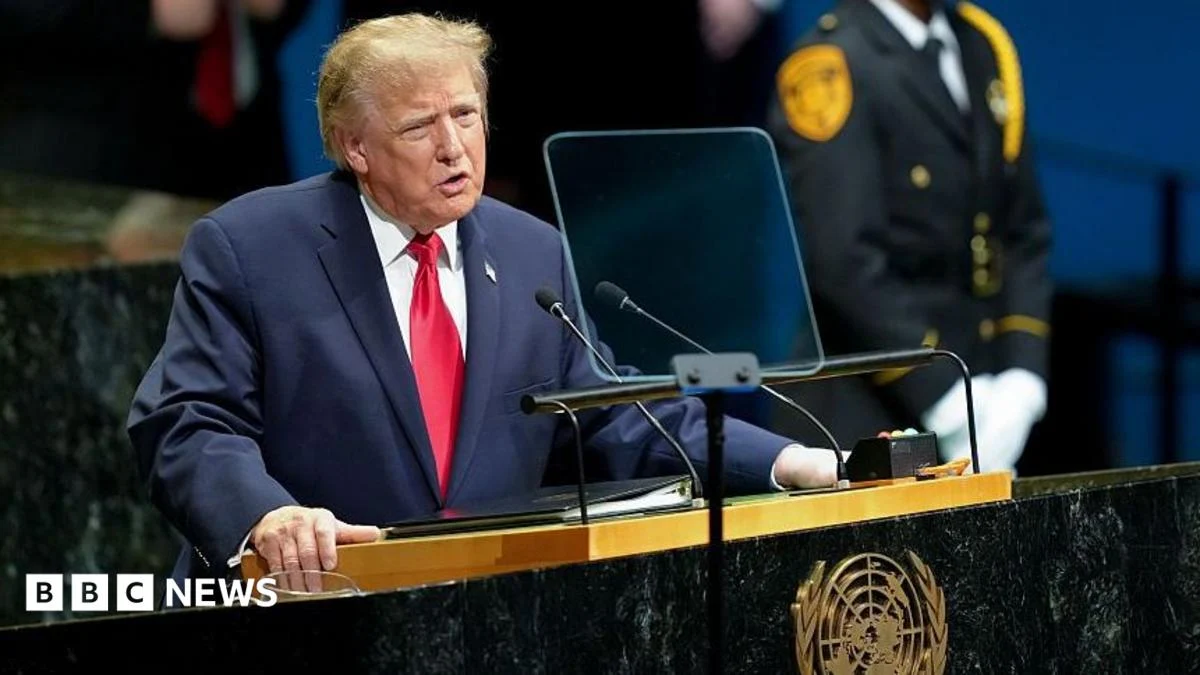
The US president, in a series of highly anticipated addresses and engagements at the United Nations General Assembly, articulated a foreign policy vision characterized by a blend of assertive rhetoric and pragmatic, albeit often coercive, diplomacy. Central to his discourse was the concept he termed "peace through strength," a doctrine emphasizing ultimatums and overwhelming force over traditional deal-making or compromise. This philosophy underscored his approach to various global challenges, from the Iranian nuclear program to the war in Ukraine and the burgeoning competition in artificial intelligence.
The Doctrine of "Peace Through Strength": A Reassertion of Unilateralism
Throughout his remarks, the president consistently championed national sovereignty and the formidable might of the American military, casting a skeptical eye on international institutions. He explicitly stated, "There is no global government," a direct challenge to the multilateral ethos embodied by the United Nations. This stance echoed his long-standing "America First" agenda, which prioritizes national interests above all else and often views globalist frameworks with suspicion. The "peace through strength" mantra, historically associated with Cold War-era deterrence strategies, was invoked as the rationale behind his administration’s foreign policy successes, particularly regarding Iran. He argued that sustained pressure and the implicit threat of force had been instrumental in preventing Tehran from acquiring a nuclear weapon, presenting this as a vindication of his approach. This perspective contrasts sharply with traditional diplomatic frameworks that emphasize negotiation, mutual concessions, and the establishment of international norms through collaborative institutions. The president’s articulation of this doctrine at the UNGA, a forum designed for multilateral dialogue, served as a powerful declaration of his administration’s continued commitment to a more unilateral and assertive global posture.
High-Stakes Diplomacy with Iran: Threats and Talks Amidst Nuclear Tensions
One of the most striking aspects of the president’s address concerned Iran, where his rhetoric reached an unprecedented level of intensity, bordering on the apocalyptic. He presented a stark dichotomy regarding the future of US-Iran relations: "Will a deal be made with Iran that lets them rebuild and create a far greater country than it ever was before? Or do I annihilate the Islamic Republic and do it quickly, never giving them a chance to kill and destroy people and countries again? Do I drive them into hell?" This provocative language, delivered on a global stage, underscored his administration’s "coercive diplomacy" strategy – a deliberate tactic of threatening overwhelming force while simultaneously keeping avenues for negotiation open.
This approach is rooted in the administration’s withdrawal from the Joint Comprehensive Plan of Action (JCPOA) in 2018, an international agreement designed to prevent Iran from developing nuclear weapons in exchange for sanctions relief. Following the withdrawal, the US reimposed and escalated sanctions under a "maximum pressure" campaign, severely impacting Iran’s economy. Tehran, in response, gradually rolled back its commitments under the JCPOA, increasing uranium enrichment levels and limiting international inspections. According to recent reports from the International Atomic Energy Agency (IAEA), Iran’s stockpile of enriched uranium and its enrichment purity have grown significantly, raising concerns among international observers about its "breakout time" to a nuclear weapon. The president’s claim that conflict had prevented Iran from obtaining a nuclear weapon implicitly referred to this sustained pressure, although critics argue it has pushed Iran closer to, rather than further from, nuclear capabilities.
Despite the fiery rhetoric, a significant development occurred on the sidelines of the General Assembly: American officials held a "very productive" three-hour meeting with the Iranian delegation. Iran state TV later confirmed that Iranian Foreign Minister Abbas Araghchi had met with US Special Envoy to the Middle East Steve Witkoff. While officials in Tehran offered no immediate comment, Witkoff’s visible "thumbs up" to reporters as he left the UN building suggested a degree of satisfaction from the American side. This juxtaposition of extreme threats and direct, albeit discreet, talks highlights the complex and often contradictory nature of the administration’s foreign policy. The president further indicated his belief that an Iran deal, which had previously eluded his administration, would materialize "right after November’s elections." This timing suggests a strategic calculus, potentially aiming to leverage any diplomatic breakthrough as a political asset or to postpone difficult concessions until after a potential re-election. The implications of such a deal, if achieved, would be profound, potentially reshaping the geopolitical landscape of the Middle East and the global nuclear non-proliferation regime. However, the deep mistrust and fundamental disagreements between Washington and Tehran, compounded by regional proxy conflicts, make any swift resolution highly challenging.
Addressing Global Conflicts: The War in Ukraine and Prospects for Peace
The ongoing conflict in Ukraine also featured prominently in the president’s statements. He expressed an optimistic outlook, predicting that his unique diplomatic efforts would bring an end to Russia’s war in Ukraine "more quickly than people understand." He asserted, "We’re working very closely with the leaders of Russia and Ukraine, and we will get that one done." This pronouncement comes at a time when the conflict, now in its third year, shows little sign of abating. The two sides continue to engage in brutal tit-for-tat missile and drone strikes, extending deep into each other’s territories, causing immense civilian casualties and infrastructure damage.
Previous attempts at mediation and peace talks have largely faltered, with both Moscow and Kyiv maintaining maximalist positions. Russia continues to demand recognition of its territorial gains and Ukraine’s neutrality, while Ukraine insists on the full restoration of its internationally recognized borders, including Crimea, and the withdrawal of all Russian forces. International efforts, including those led by Turkey, China, and various European nations, have failed to bridge this chasm. The United States, under the president’s previous administration and during his current tenure, has been a primary supplier of military aid to Ukraine, amounting to tens of billions of dollars in weaponry and financial assistance, critical for Kyiv’s defense. The president’s confidence in a swift resolution, given the entrenched positions and the scale of the ongoing hostilities, has been met with skepticism by many international observers and defense analysts who see no clear path to a rapid diplomatic breakthrough without significant concessions from one or both sides. The potential for such a resolution would undoubtedly alter global security dynamics, but the details of how this "quick" resolution would be achieved remain unclear.
The Future of Technology: Redefining "Super Intelligence" Amidst Global Competition
Beyond geopolitics, the president also addressed the rapidly evolving landscape of artificial intelligence (AI), seeking to redefine its very terminology and dismiss widespread fears. He argued that "artificial intelligence" should instead be known as "super intelligence," explaining, "The use of the word artificial makes it sound fake. It’s not fake, it’s actually amazing. But we have to be careful." This semantic shift reflects a desire to reframe public perception of AI, emphasizing its transformative potential rather than the anxieties often associated with its "artificial" nature.
His remarks also touched upon the intense global competition in AI development, particularly between the United States and China. He vowed that the US would not "surrender its lead to China" due to what he described as "alarmism" or a "globalist scheme" to control the technology. This statement underscores the geopolitical dimension of AI, where technological supremacy is increasingly viewed as a critical component of national power and economic competitiveness. The US and China are locked in a fierce race for AI dominance, with both countries investing massive resources into research, development, and deployment of AI technologies across various sectors, from defense to healthcare and finance. Concerns about AI range from ethical dilemmas, such as algorithmic bias and job displacement, to existential risks posed by autonomous weapons and superintelligent systems. The president’s dismissal of "alarmism" and "globalist schemes" suggests a preference for nationalistic control over international regulatory frameworks, contrasting with calls from many scientists, ethicists, and international bodies for a coordinated global approach to AI governance. His emphasis on American leadership in this field aligns with his broader strategy of asserting US technological and economic preeminence.
Bolstering Strategic Alliances: The Greenland Agreement and Arctic Geopolitics
In a significant move to reinforce strategic alliances and expand US military presence in a crucial region, the president signed an agreement with the leaders of Denmark and Greenland on the sidelines of the General Assembly. This deal aims to "beef up US military presence" on the North Atlantic island. The agreement explicitly reaffirms the sovereignty of Greenland, an autonomous territory of Denmark, while simultaneously granting the United States broad access to the island’s airspace and territory.
Greenland holds immense strategic importance, particularly in the context of the rapidly changing Arctic region. Its vast ice sheet, melting at an accelerating rate, is opening new shipping lanes and revealing access to untapped natural resources. This has intensified geopolitical competition, with Russia significantly increasing its military presence in the Arctic and China declaring itself a "near-Arctic state" and pursuing economic interests in the region. The US has a long-standing strategic interest in Greenland, notably through the Thule Air Base, a critical component of its global missile warning and space surveillance network, established during the Cold War. There have even been historical, albeit largely symbolic, discussions about the US purchasing Greenland, underscoring its perceived value. This new agreement signals a concrete step to enhance US operational capabilities in the High North, bolstering NATO’s northern flank and projecting American influence in a region becoming increasingly vital for global security and commerce. The deal is likely to be welcomed by Denmark, which relies on US security guarantees, and provides Greenland with renewed assurances of its sovereignty while facilitating investment and security cooperation. However, it will also be closely watched by rival powers seeking to expand their own footprints in the Arctic.
Multilateralism Under Scrutiny: UN Critiques and Extensive Bilateral Engagements
The president’s appearance at the UN General Assembly was also marked by his characteristic criticism of international institutions. He accused the UN of pursuing a "far-left agenda of globalist bureaucrats who nobody ever elected," a sentiment consistent with his "America First" philosophy. This critique stood in stark contrast to the farewell speech delivered earlier by UN Secretary-General António Guterres, who urged unnamed "superpowers" to recognize "that their power isn’t so super." Guterres highlighted the widening "fault lines" in the world, citing geopolitical rivalries, wars, climate change, and artificial intelligence as pressing global challenges requiring collective action.
The president’s emphasis on national sovereignty and "unmatched" American military power served as a direct counterpoint to Guterres’s call for humility and cooperation. He reiterated his administration’s commitment to using "unmatched military might to secure the vital national interests of the United States" if necessary. His schedule at the UNGA also reflected a preference for bilateral engagements over multilateral forums, meeting with a wide array of leaders. These included Ukrainian President Volodymyr Zelensky, British Prime Minister Andy Burnham, and leaders from key Gulf states: Saudi Arabia, the United Arab Emirates, Qatar, Kuwait, Bahrain, and Oman. These meetings underscored the president’s strategy of forging direct relationships and pursuing transactional diplomacy, often outside the confines of broader international consensus.
Furthermore, the president issued a stern warning against any threats establishing themselves anywhere in the Western Hemisphere, echoing the historical Monroe Doctrine. This doctrine, dating back to 1823, traditionally asserted US dominance in the Americas and opposed European colonialism. The modern reassertion of this principle signals a continued vigilance over regional security and a clear message to any external actors seeking to challenge US influence.
The Cuban Confrontation: A Diplomatic Walkout
A particularly dramatic moment occurred when the president turned his attention to Cuba. He launched accusations against Cuba’s communist government, alleging its cultivation of ties to "left-wing groups" within the United States, specifically naming the Communist Party USA, Antifa, and the Democratic Socialists of America (DSA). As he referred to the island nation as a "failed state," the Cuban delegation, in a clear act of diplomatic protest, appeared to walk out of the assembly chamber.
This public confrontation marked a significant escalation in US-Cuba relations, which had seen a brief thaw during a previous administration before reverting to a more confrontational stance. The US has maintained an economic embargo against Cuba for decades, and the president’s administration had previously tightened sanctions, citing Cuba’s human rights record and its support for the Venezuelan government. The accusation of cultivating ties with US domestic groups, particularly Antifa and DSA, which have been targets of conservative criticism, adds a new layer to the diplomatic dispute, intertwining foreign policy with internal political narratives. The Cuban delegation’s walkout served as a potent visual symbol of the deep ideological chasm and diplomatic tensions between the two nations, highlighting the president’s willingness to directly challenge adversaries on the global stage, even at the cost of diplomatic decorum.
In summary, the president’s presence at the United Nations General Assembly was a multifaceted display of his distinct foreign policy approach. It combined aggressive, often provocative, rhetoric with a readiness for selective engagement, all underpinned by a belief in "peace through strength" and the unwavering assertion of national interest. From high-stakes nuclear diplomacy with Iran to ambitious claims of resolving the Ukraine war, a redefinition of AI, strategic military expansions, and direct challenges to multilateral institutions and specific adversaries like Cuba, his agenda projected an image of an administration committed to reshaping global dynamics through a blend of unilateral power projection and targeted, often coercive, diplomacy.