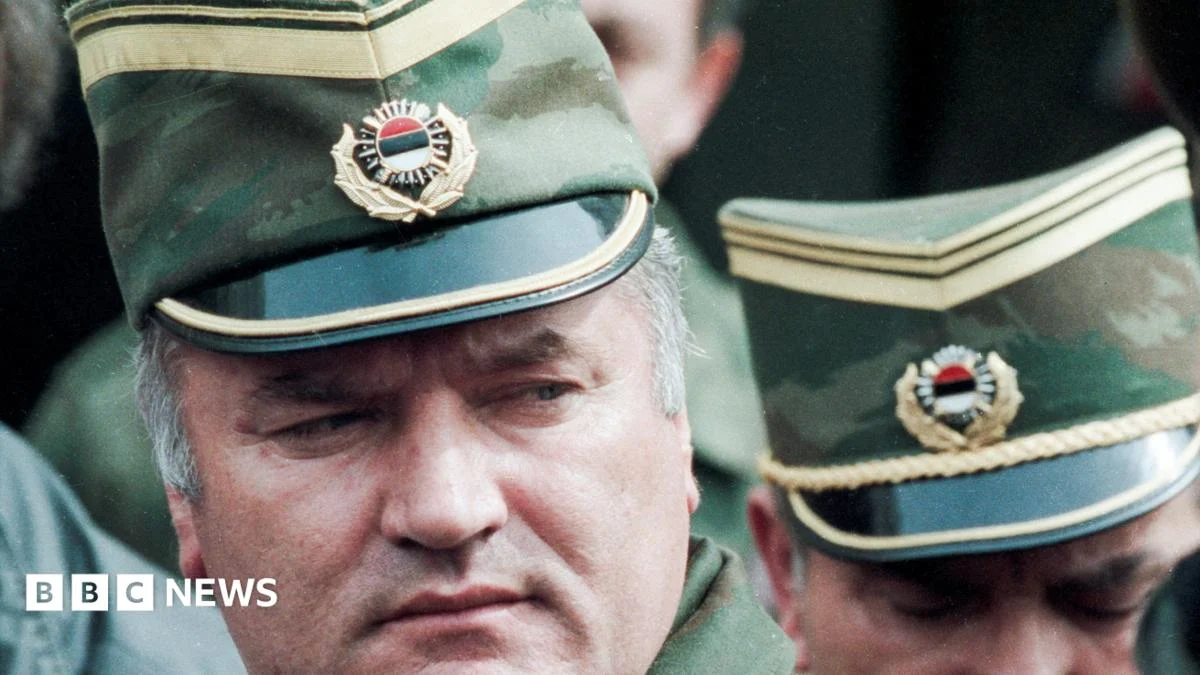
The notorious Bosnian Serb military commander, Ratko Mladić, a figure synonymous with the brutal ethnic cleansing and genocidal campaigns of the 1990s Balkan wars, has died in prison. His passing closes a dark chapter for many, yet the profound scars left by his actions continue to haunt the former Yugoslavia and underscore the enduring pursuit of international justice. Mladić, often referred to as the "Butcher of Bosnia" for his central role in atrocities including the Srebrenica genocide and the siege of Sarajevo, was serving a life sentence for genocide, war crimes, and crimes against humanity, handed down by the International Criminal Tribunal for the former Yugoslavia (ICTY) and later upheld by its successor, the International Residual Mechanism for Criminal Tribunals (IRMCT).
A Descent into Conflict: The Background of the Bosnian War
Mladić’s rise to infamy was inextricably linked to the violent dissolution of Yugoslavia in the early 1990s. The death of long-time communist leader Josip Broz Tito in 1980 had exposed deep-seated ethnic and political tensions that had been suppressed under a unifying ideology. As communism collapsed across Eastern Europe, nationalist sentiments surged in Yugoslavia’s constituent republics. Slovenia and Croatia declared independence in 1991, triggering brief but bloody conflicts with the Serb-dominated Yugoslav People’s Army (JNA).
Bosnia and Herzegovina, a multi-ethnic republic with a population mix of Bosniaks (Muslims), Serbs, and Croats, declared its own independence in March 1992, following a referendum largely boycotted by Bosnian Serbs. This declaration ignited the Bosnian War, as Bosnian Serbs, backed by Serbia and the JNA, sought to establish their own entity, Republika Srpska, and connect it to a "Greater Serbia." The conflict quickly devolved into a brutal campaign of ethnic cleansing aimed at creating ethnically homogenous territories, characterized by widespread atrocities against non-Serb populations.
The Architect of Terror: Mladić’s Role in the Conflict
Born in Božanovići, Bosnia and Herzegovina, in 1942, Ratko Mladić had a long career in the Yugoslav People’s Army, rising through its ranks. By 1991, he was deployed to Croatia, where he commanded forces involved in the siege of Knin. His experience there paved the way for his pivotal role in Bosnia. In May 1992, as the Bosnian War intensified, Mladić was appointed commander of the newly formed Army of Republika Srpska (VRS), a position from which he wielded immense power, directly overseeing military operations that would define the conflict.
The early months of the war saw a systematic campaign of terror unfold. At night, observers like BBC special correspondent Allan Little described watching "the fires of ethnic cleansing across the landscape," the flames providing "the only light under the night sky and the black valley would glimmer with flecks of orange." Villages were burned, populations were driven from their homes, and the demographic fabric of Bosnia was violently ripped apart. The imagery of men moving silently in shadows, armed with "ancient weapons salvaged from wars long ago," spoke to a deep-seated, generations-old fear that was now unleashed.
One poignant encounter recalled by Little illustrates the human cost of this brutal dehumanization. He witnessed a procession of some 40,000 men and women emerging from a forest, refugees who had fled their homes after a Serb advance. Among them, an 80-year-old man, close to collapse, spoke of being separated from his wife. When asked if he was a Croat or a Muslim, the man replied, "I am a musician." This simple, profound answer cut through the "convenient ethnic shorthand" that reduced individuals to labels, reminding the world that the victims were not just statistics or ethnic groups, but "musicians and scientists and doctors and plumbers and farmers and mothers and fathers and brothers and sisters and very often children."
The Siege of Sarajevo and a Meeting with the Commander
Mladić’s forces were responsible for the infamous Siege of Sarajevo, the longest siege of a capital city in modern warfare, lasting from April 1992 to February 1996. During this period, an average of 329 shells fell on the city daily, with a peak of 3,777 shells on July 22, 1993. Over 10,000 people, including 1,500 children, were killed, and tens of thousands more were wounded. Sniper Alley became a notorious symbol of the indiscriminate violence, where civilians faced constant threat simply by moving through their city.
It was during this first hot summer of the war that Allan Little met Mladić at Lukavica barracks, on the southern edge of Sarajevo. The barracks, "awash with weapons and the menacing strut of the paramilitaries," reflected the chaos and the lucrative black market for arms, where a Kalashnikov could be bought for $200 and a hand grenade for a mere dollar—the same price, Little noted, as a fresh egg in the besieged city. Mladić, fresh from the front line, was described as "pumped up by the exhilarating proximity of the fighting." He held Little’s hand "fast and pulled [him] in close," proclaiming himself "the great defender of brotherhood and unity in former Yugoslavia," and claiming to "dream of a world in which there would no guns and no war." Yet, Little immediately perceived him as "fanatical, dangerously so," a chilling premonition of the horrors to come.
The Srebrenica Genocide: Mladić’s Ultimate Crime
The culmination of Mladić’s campaign of terror was the Srebrenica genocide in July 1995. Srebrenica, a designated "UN safe area" in eastern Bosnia, was ostensibly under the protection of Dutch peacekeepers. However, Mladić’s forces, after overwhelming the lightly armed UN contingent, systematically separated Bosniak men and boys from women and children. Over the course of several days, more than 8,000 Bosniak men and boys were executed in a meticulously planned operation. Mass graves were later discovered, revealing the scale of the horror.
Mladić himself was famously filmed entering Srebrenica, declaring, "We are here, in Serbian Srebrenica. On the eve of yet another great Serb holiday, we give this city to the Serb nation. The time has come to take revenge on the Turks." This chilling statement, broadcast on Serbian television, left no doubt about the ethnic and genocidal motivations behind the massacre. The ICTY and the International Court of Justice (ICJ) both subsequently ruled the events at Srebrenica to be an act of genocide, the only such ruling for crimes committed during the Bosnian War.
Beyond Srebrenica, forces under Mladić’s command committed a litany of war crimes: mass murder, extermination, mass rape used as a weapon of war, forced expulsions, and the systematic destruction of cultural and religious sites. These acts "bequeathed to the lexicon of war a grim new euphemism – ethnic cleansing."
A Personal Toll: The Cost of Witnessing Atrocity
The war’s brutality was not confined to the victims; it also left an indelible mark on those who reported it. Two days after his encounter with the old musician, Allan Little experienced the war’s devastating personal toll when his cameraman, Tihomir Tunukovic, a 25-year-old talented filmmaker from Zagreb, was killed by a Serb gunner. Tunukovic’s death underscored the indiscriminate nature of the violence and the immense risks taken by journalists. "We broke our hearts at his funeral," Little recalled, adding that "the grief of it connected us to the sentiments of the war – the impulse to vengeance and counter vengeance – that were so much a feature of what we were witnessing." While Mladić did not personally pull the trigger, his command fostered an "atmosphere of wanton permissiveness which cost tens of thousands of lives," directly enabling such acts.
The Hunt, Capture, and Conviction of a War Criminal
Mladić was indicted by the ICTY in July 1995, shortly after the Srebrenica genocide and the siege of Sarajevo. The charges included genocide, complicity in genocide, persecution, extermination, murder, deportation, inhumane acts, terror, unlawful attacks on civilians, and hostage-taking. Despite the international warrant for his arrest, Mladić evaded capture for nearly 16 years. He lived openly in Serbia for years, protected by elements within the military and political establishment who viewed him as a national hero.
International pressure mounted on Serbia to apprehend Mladić and other indicted war criminals as a condition for closer ties with the European Union. Finally, on May 26, 2011, Mladić was arrested at a relative’s house in Lazarevo, Serbia, after years of living under various aliases. He was subsequently extradited to The Hague to face justice.
His trial at the ICTY began in 2012 and lasted more than five years, involving hundreds of witnesses and thousands of exhibits. Prosecutors presented overwhelming evidence, including Mladić’s own captured radio communications, video footage, and survivor testimonies, painting a clear picture of his direct command responsibility for the atrocities. On November 22, 2017, Mladić was found guilty on 10 of 11 counts, including genocide for Srebrenica, and sentenced to life imprisonment. He was acquitted of one count of genocide related to other municipalities in Bosnia.
Mladić appealed his conviction, but on June 8, 2021, the IRMCT upheld his life sentence, affirming his guilt beyond reasonable doubt. The court’s final judgment stated that Mladić "deliberately and systematically directed attacks on civilians, including women, children and the elderly, with the goal of ethnically cleansing Bosnia of non-Serbs."
Reactions and Lasting Legacy
Mladić’s death elicits diverse reactions across the region and internationally. For victims and survivors of the Bosnian War, particularly Bosniak communities, his death marks the end of a long, painful chapter, though it cannot erase the trauma. The Mothers of Srebrenica association, which fought tirelessly for justice, views his conviction as a crucial step towards accountability, even if some believe he should have faced justice for all counts of genocide across Bosnia. For them, his death in prison is a confirmation that justice, however slow, can prevail.
International bodies, including the United Nations and the IRMCT, will undoubtedly emphasize the importance of Mladić’s conviction as a testament to the international community’s commitment to fighting impunity for the gravest crimes. His case stands as a landmark in international criminal law, demonstrating that even high-ranking military commanders can be held accountable.
In parts of Serbia and among some Bosnian Serbs, Mladić continues to be revered as a national hero who defended his people. His supporters often dismiss the convictions as politically motivated and anti-Serb, highlighting the deep divisions and unresolved historical narratives that persist in the Balkans. This divergence in perception underscores the immense challenge of reconciliation and the need for honest confrontation with the past.
Mladić’s legacy is one of profound suffering, ethnic division, and the systematic dismantling of a multi-ethnic society. His actions contributed to the deaths of over 100,000 people and the displacement of millions. His death, while closing a legal chapter, does not erase the trauma or the political and social consequences of the war. The region continues to grapple with the aftermath, including the search for missing persons, the return of refugees, and the ongoing struggle for genuine reconciliation. The world, through the tragic lens of Bosnia, learned the devastating potential of extreme nationalism and the imperative of international justice to prevent such atrocities from recurring. Mladić’s life and death serve as a stark reminder of humanity’s capacity for cruelty and the unwavering fight for justice in its wake.