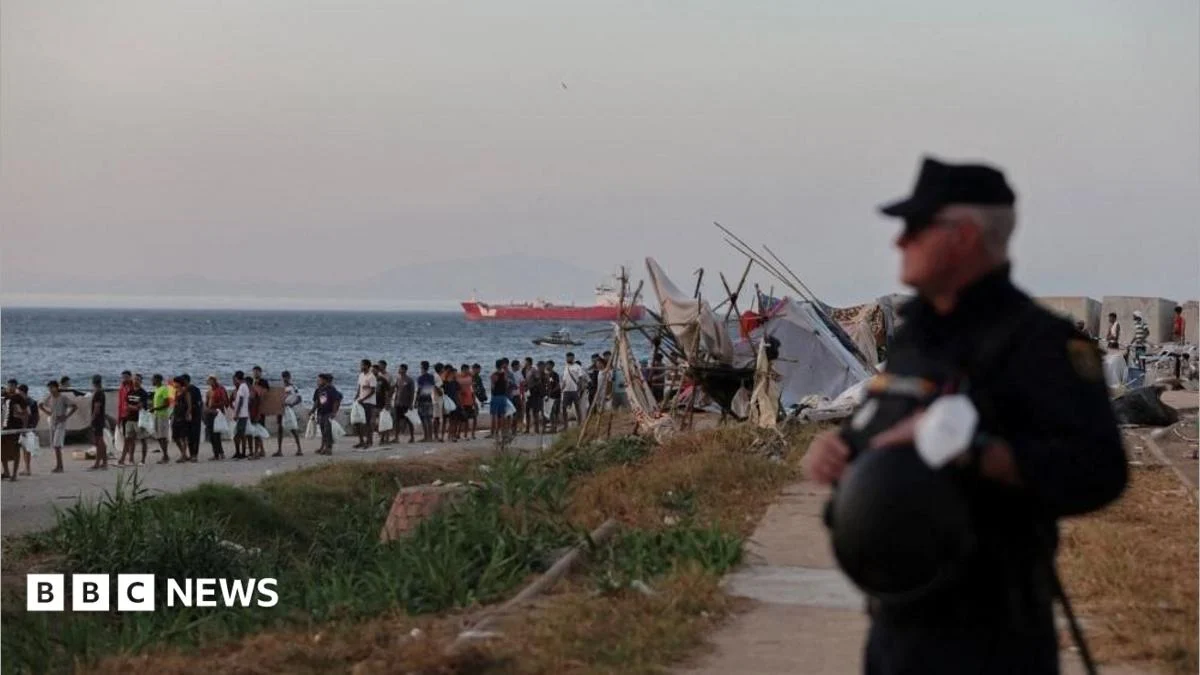
Newly released government documents have brought to light a critical pre-warning from Spain’s National Intelligence Service (CNI) regarding an imminent, large-scale migrant crossing into the autonomous city of Ceuta. This revelation directly challenges the Spanish government’s previous assertions that the unprecedented influx of tens of thousands of people in late July was impossible to foresee. The declassified papers indicate that intelligence services had alerted both Moroccan and Spanish authorities to social media calls for a mass movement across the border at least the day before the events unfolded, intensifying political pressure on Prime Minister Pedro Sánchez and raising serious questions about the handling of the crisis and the transparency of official communications.
The Intelligence Alert and Its Disregard
On July 29, just hours before an estimated 72,000 individuals began pouring into Ceuta, the CNI issued a stark warning. The intelligence agency informed its Moroccan counterparts and relevant authorities within Ceuta—including the central government’s representation and the Civil Guard—about widespread social media activity encouraging migrants to attempt the crossing on July 30. Specifically, WhatsApp and Facebook groups were identified as platforms promoting the endeavor, urging migrants to reach the Spanish exclave "both swimming and via the [border] fence." The CNI’s report highlighted that approximately 180,000 people were receiving these messages, one of which explicitly stated: "Whoever wants to cross has the last chance on Throne Day [30 July] at 8 the authorities will be distracted with the celebrations and parades." This granular detail, including the specific date, time, and rationale for the crossing, directly contradicts the narrative previously put forth by Prime Minister Sánchez and other government officials.
The declassified information, part of a larger tranche of over 40 security documents linked to the Ceuta crisis, emerged following persistent calls for greater transparency. Opposition parties and civil society groups had increasingly accused the government of withholding crucial details and failing to provide a comprehensive account of the events that led to one of the largest single migrant incursions into European territory in recent memory.
Background to the Border Crisis: Ceuta’s Geopolitical Significance
Ceuta, alongside Melilla, represents the European Union’s only land border with Africa. These two autonomous Spanish cities on the North African coast have historically been flashpoints for migration, attracting individuals from across Africa seeking a pathway into Europe. Their strategic location makes them critical points of contention in the complex relationship between Spain and Morocco, a relationship often characterized by diplomatic friction and strategic interdependence.
The context immediately preceding the July 2021 events was particularly tense. Diplomatic relations between Spain and Morocco had soured dramatically earlier in the year following Spain’s decision to provide medical treatment to Brahim Ghali, the leader of the Polisario Front, a Sahrawi nationalist liberation movement seeking independence for Western Sahara. Morocco considers Western Sahara its southern provinces and views the Polisario Front as a separatist group. Ghali’s presence in Spain without prior Moroccan consultation was seen as a significant diplomatic affront by Rabat, leading to a recall of its ambassador from Madrid and a period of heightened bilateral strain. Many analysts and critics have posited that Morocco’s alleged laxity at its border with Ceuta during the July influx was a direct retaliatory measure, a form of "migration pressure" wielded as a diplomatic tool against Spain. The CNI warning about "Throne Day" — a significant national holiday in Morocco (celebrating King Mohammed VI’s ascension to the throne) — adds another layer to this interpretation, suggesting a deliberate diversion of Moroccan border resources or at least a known opportunity for such a crossing.
A Detailed Chronology of Events and Escalations
The unfolding of the Ceuta crisis can be traced through a series of critical junctures:
- April 2021: The diplomatic spat between Spain and Morocco intensifies following Spain’s humanitarian decision to admit Brahim Ghali for COVID-19 treatment. Morocco views this as a hostile act.
- May 2021: Morocco recalls its ambassador from Madrid, signaling a deep rift in diplomatic ties. Tensions simmer, with concerns about potential Moroccan responses, including implications for border control.
- July 29, 2021: The CNI issues its critical intelligence warning. Via a note to Moroccan intelligence, it details the identification of WhatsApp and Facebook groups actively promoting a mass migrant crossing into Ceuta the following day. The CNI also transmits this warning to the central government’s representation in Ceuta and the Civil Guard via text messages, explicitly mentioning the planned crossing on "Throne Day" (July 30) and the expectation of distracted Moroccan authorities.
- July 30-31, 2021: The predicted mass crossing materializes on an unprecedented scale. Thousands of migrants, predominantly young men but also families and unaccompanied minors, begin to pour into Ceuta. Many swim around the breakwater fences, while others attempt to scale the land border. Spanish authorities, caught largely unprepared despite the warnings, struggle to manage the immense flow. Over two days, an estimated 72,000 individuals manage to enter the city. The mayor of Ceuta later reported that at least 100 people died during the perilous crossing, highlighting the tragic human cost of the event.
- Immediate Aftermath (Early August 2021): Spanish security forces rapidly begin the process of returning migrants to Morocco. While the vast majority are repatriated, as many as 5,000 individuals remain in Ceuta. These migrants find themselves in makeshift camps, on city streets, or on beaches, straining local resources and creating significant social tensions.
- Mid-August 2021: Local unrest erupts in Ceuta. Residents express heightened safety concerns, leading to instances where shelters for migrants are destroyed and aid supplies are blocked. The humanitarian situation for the remaining migrants becomes increasingly precarious.
- September-October 2021: Pressure mounts on the Spanish government for transparency regarding the events. Opposition parties demand a full account, questioning the government’s preparedness and initial statements. Allegations of Moroccan complicity in facilitating the crossings gain traction.
- Earlier this Month (Pre-Declassification): A leaked Spanish police report appears to corroborate claims of Moroccan involvement, suggesting that Moroccan police may have been implicated in the incident by failing to enforce border controls.
- Wednesday (Day of Declassification): The Spanish government, facing mounting pressure, declassifies the tranche of security documents, including the CNI warnings. This directly contradicts Prime Minister Sánchez’s repeated assertions that the events were unforeseen.
- Post-Declassification: The revelations spark a fresh wave of political condemnation, with opposition parties accusing the government of misleading the public and demanding accountability.
Official Responses and Political Fallout
The declassified documents have thrown a harsh spotlight on the Spanish government’s official narrative. Prime Minister Pedro Sánchez had previously told parliament that there was "no information that conveyed the magnitude" of the "crisis we were going to suffer" on the last two days of July, insisting that the events were "impossible to predict." Even shortly before the documents’ release, he maintained on Spanish television that "the mass arrival of migrants was not expected."
These statements now stand in direct opposition to the detailed CNI warnings. Opposition politicians were quick to seize on the discrepancy. Ester Muñoz of the conservative People’s Party declared, "They had the information, they are directly responsible for the invasion of Ceuta and for those who died." Jorge Buxadé, a prominent figure from the far-right Vox party, took to social media to assert that the documents demonstrated Sánchez "and his band of criminals should be brought before the Supreme Court for treason and security crimes." Such strong language underscores the severity of the political backlash.
The government, however, has sought to defend its actions and interpret the intelligence in a different light. Foreign Minister José Manuel Albares stated he was "not aware of any report that might have foreseen the magnitude of what happened on July 30." A government source, speaking anonymously, echoed this sentiment, arguing that the published documents "showed that the information available before the mass crossing did not make it possible to anticipate the scale that the crisis would reach or prepare with enough time the necessary response."
Perhaps the most direct rebuttal of the CNI warning came from Miguel Ángel Pérez Triano, the central government’s delegate in Ceuta, who was among those who received the CNI’s text message. He controversially dismissed the WhatsApp messages from July 29, claiming they "do not constitute an alert or a report." Instead, he characterized them as "nothing more than an exchange of information," an assessment that appears to downplay the explicit nature and detail of the CNI’s intelligence. This interpretation suggests either a failure in intelligence assessment and escalation protocols or a deliberate attempt to minimize the significance of the warnings in hindsight.
Broader Impact and Implications
The Ceuta crisis and the subsequent revelations carry far-reaching implications:
- Political Accountability and Trust: The contradiction between the CNI’s warnings and the government’s public statements severely damages public trust in Prime Minister Sánchez’s administration. Accusations of deception and a lack of transparency could have lasting political ramifications, potentially impacting future electoral performance and the government’s stability. It highlights a critical need for clearer lines of communication and accountability when intelligence warnings are received.
- Spain-Morocco Relations: The declassified documents, particularly the CNI’s notification to Moroccan intelligence, do not directly prove Moroccan complicity in facilitating the crossings. However, they intensify the existing suspicions and fuel the narrative that Morocco may have leveraged migration as a political tool. This episode further strains the already delicate relationship between the two nations, complicating future cooperation on border control, counter-terrorism, and other bilateral issues. The EU, which views Morocco as a crucial partner in migration management, will also be observing these developments closely.
- Humanitarian Crisis Management: The lingering presence of approximately 5,000 migrants in Ceuta continues to pose a humanitarian challenge. The local unrest and the destruction of aid infrastructure underscore the social tensions and the immense pressure on the city’s resources. Effective long-term solutions for integration, repatriation, or relocation are urgently needed, along with measures to address the concerns of the local populace.
- European Union Border Security: As an external EU border, Ceuta’s vulnerability has broader implications for European border security policy. The sheer scale of the July influx demonstrated the potential for mass crossings when border controls are relaxed or overwhelmed. This event will likely prompt renewed discussions within the EU about strengthening external borders, improving intelligence sharing among member states, and reviewing partnerships with third countries like Morocco to ensure stable migration management.
- Intelligence Gathering and Utilization: The episode raises fundamental questions about how intelligence warnings are processed, interpreted, and acted upon within the Spanish security apparatus and government. If explicit warnings detailing a specific date, method, and reason for a mass crossing were dismissed or miscategorized as mere "exchanges of information," it points to potential systemic failures in threat assessment and inter-agency coordination. This could necessitate a comprehensive review of Spain’s intelligence protocols to prevent similar lapses in the future.
- Social Cohesion in Ceuta: The influx and its aftermath have profoundly impacted the social fabric of Ceuta. The coexistence of long-term residents and a significant population of stranded migrants, coupled with security concerns and resource strain, presents a complex challenge to social cohesion. Addressing these underlying tensions will require sensitive policy interventions and community engagement.
In conclusion, the declassification of these CNI documents marks a significant turning point in the understanding of the July 2021 Ceuta migrant crisis. It transforms the narrative from one of an unforeseen natural disaster to a potentially foreseeable event where critical intelligence warnings may have been overlooked, misinterpreted, or deliberately downplayed. The political fallout for the Sánchez government is substantial, and the implications for Spain’s international relations, particularly with Morocco, and its approach to migration policy will undoubtedly continue to unfold. The episode underscores the critical importance of transparent governance and the diligent evaluation of intelligence in managing complex geopolitical and humanitarian challenges.