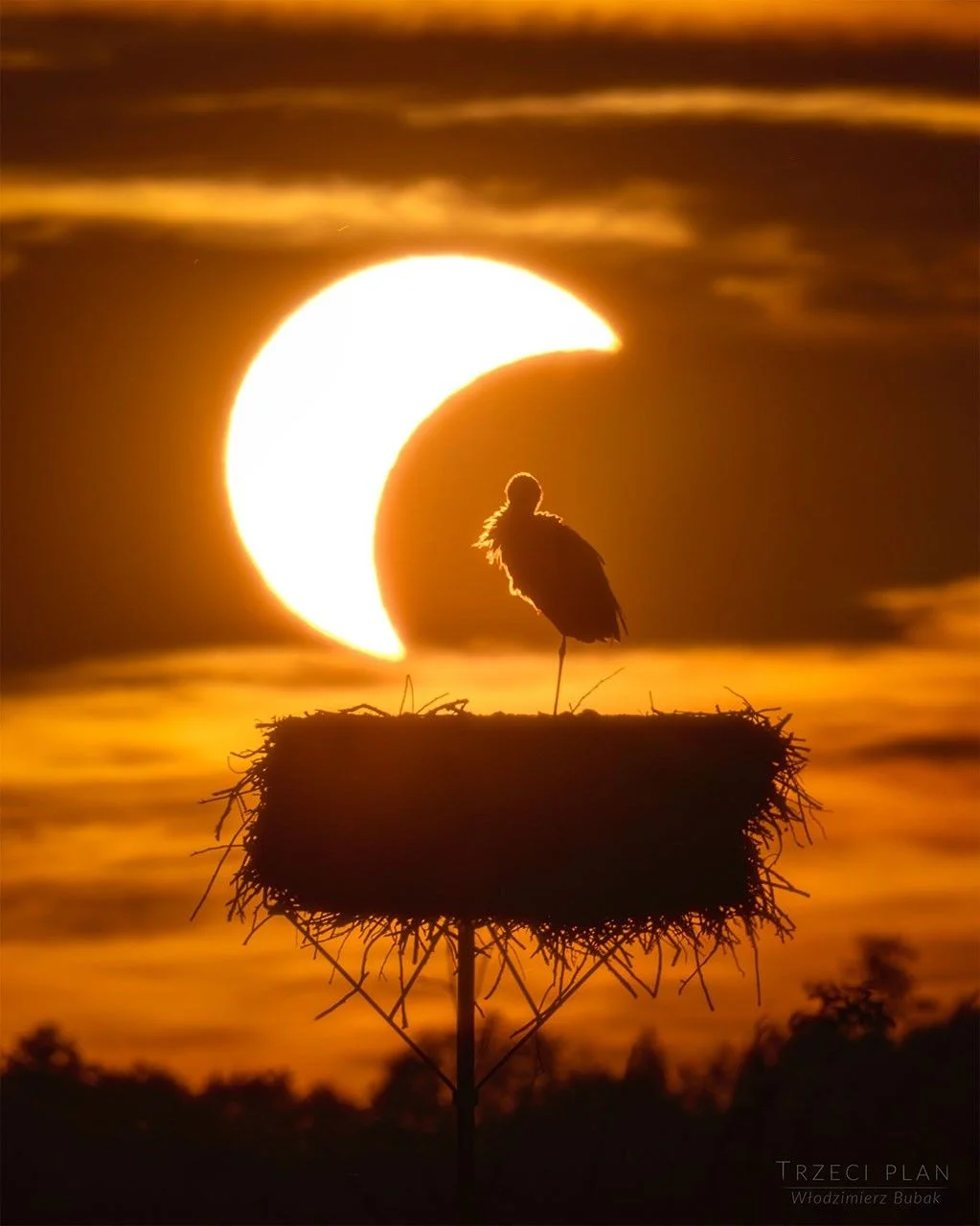
The Astronomy Picture of the Day (APOD) program, a daily staple for cosmic enthusiasts worldwide, recently featured a poignant image capturing a stork poised on its nest in Poland during a partial phase of the total solar eclipse that swept across parts of the Northern Hemisphere on August 12, 2026. This striking photograph, credited to Włodzimierz Bubak and highlighted by APOD on September 3, 2026, serves as a vivid reminder of the profound impact such rare celestial alignments can have not only on human observers but also on the natural world. The image, depicting a sunset view of the eclipse framed behind the solitary stork, underscores a fascinating area of scientific inquiry: how animals react to the sudden, artificial twilight of a total solar eclipse.
The Iconic APOD Feature: A Stork’s Serene Witness
The photograph, chosen by NASA’s renowned APOD initiative, portrays a majestic stork, standing on one leg, seemingly undisturbed by the dramatic celestial event unfolding behind it. While the stork itself appears calm, the context of the image—a partial solar eclipse—opens a broader discussion on the often-unpredictable and sometimes dramatic behavioral shifts observed in wildlife during totality. The image originates from Poland, a region that experienced a significant partial solar eclipse on August 12, 2026, as the path of totality traversed other European countries. This particular APOD selection, therefore, acts as both a visual spectacle and a scientific prompt, inviting viewers to ponder the subtle yet significant ecological repercussions of a solar eclipse.
APOD, or Astronomy Picture of the Day, has been a cornerstone of public astronomical education since its inception in 1995. Each day, a different image or photograph of our universe is featured, accompanied by a brief explanation written by a professional astronomer. This blend of stunning visuals and accessible scientific commentary has cultivated a global audience, fostering a deeper appreciation for space science and the myriad phenomena that shape our cosmos. The inclusion of an image focusing on earthly biological responses during a cosmic event exemplifies APOD’s commitment to showcasing the diverse interconnections within science.
Decoding Animal Responses: A Window into Circadian Rhythms
The core of the APOD explanation accompanying Bubak’s image delves into the intriguing question of animal behavior during total solar eclipses. This field of study, known as eclipse ethology, has captivated scientists and lay observers for centuries. The sudden onset of darkness, a sharp drop in ambient temperature, and changes in light spectrum during an eclipse can disrupt the established circadian rhythms of many species, leading to behaviors typically associated with dawn or dusk, or even deep night.
-
The Sudden Nightfall: A Symphony of Confusion
During the peak of totality, the environment undergoes a rapid transformation. The most commonly reported auditory phenomenon is the emergence of nighttime sounds. Crickets, renowned for their crepuscular and nocturnal chirping, begin their serenade. Frogs, usually quiet during the day, may also commence their croaking choruses. This auditory shift is a direct response to the perceived sudden onset of night, triggering their innate biological clocks to initiate nocturnal activities. Conversely, diurnal animals, particularly birds, often fall silent. Many species, especially songbirds, cease their daytime calls, entering a state of quietude that mirrors their nightly roosting behavior. -
Avian Adaptations and Equivocal Rest
Birds, being highly sensitive to light changes, exhibit some of the most noticeable reactions. Observations during previous total solar eclipses, such as the widely documented 2017 and 2024 North American events, revealed that many bird species, including ducks and other waterfowl, prepare for sleep. They may be seen standing on one leg, tucking their heads into their back feathers – a classic posture for avian rest. This behavior, though brief, signifies their internal clock’s misinterpretation of the eclipse as the true end of the day. The phenomenon extends to a wide array of avian species, from chickens returning to their coops to large raptors ceasing their hunts. The stork in Bubak’s image, while not in full sleep posture due to the partial nature of the eclipse in its location, still provides a glimpse into the broader context of avian responses. -
Mammalian and Insectile Observations
Beyond birds and amphibians, other animal groups also display curious behaviors. Fireflies, typically seen after sunset, have been observed to emerge and flash during totality, mistaking the darkness for nightfall. Domestic animals, such as dogs and cats, might exhibit confusion or anxiety, sometimes seeking comfort from their owners. Farm animals, like cows and horses, have been reported to head towards their barns or pastures, anticipating their nightly routines. Even zoo animals, accustomed to human presence and routines, can show altered behavior, with some species displaying increased agitation or seeking shelter. These collective observations highlight the intricate relationship between external environmental cues and internal biological clocks across the animal kingdom.
The 2026 Total Solar Eclipse: Path, Magnitude, and Scientific Opportunity
The total solar eclipse that occurred on August 12, 2026, was a celestial event of significant astronomical interest and a prime opportunity for scientific observation, including studies of animal behavior. The path of totality for this eclipse commenced over the Arctic, sweeping down across Greenland, Iceland, Spain, and a small portion of Portugal.
-
Europe’s Grandstand View
For observers in Europe, the 2026 eclipse offered a spectacular show. Iceland experienced totality, with its unique landscapes providing a dramatic backdrop for the cosmic alignment. Southern Spain and Portugal were also in the path, drawing significant crowds and scientific expeditions. While Poland, where the stork was photographed, was not in the path of totality, it experienced a deep partial eclipse, where a substantial portion of the Sun was obscured. This partial phase still led to noticeable dimming of daylight and a drop in temperature, sufficient to trigger some of the behavioral shifts observed in local wildlife. The experience of seeing a partially eclipsed sun at sunset, as captured by Bubak, is itself a unique atmospheric phenomenon, blending terrestrial beauty with cosmic mechanics.
-
Beyond the Visual: Scientific Expeditions
Astronomers and scientists from various disciplines organized expeditions along the path of totality to study a range of phenomena. Beyond capturing stunning images of the Sun’s corona, researchers focused on understanding the Earth’s ionosphere, measuring gravitational deflection, and, crucially, observing the biological responses of flora and fauna. The 2026 eclipse was particularly valuable due to its traverse over diverse ecosystems, from the remote Arctic to the populated Iberian Peninsula, offering varied environments for ethological studies. Data collected during such events contribute significantly to our understanding of how ecosystems respond to sudden environmental changes, even those of a temporary nature.
Ethological Research: Leveraging Eclipses for Discovery
The study of animal behavior during solar eclipses is not merely anecdotal; it is a legitimate field of ethological research. Scientists utilize these rare events to explore fundamental questions about animal sensory perception, circadian rhythms, and adaptive behaviors. The sudden, controlled environmental change provided by an eclipse acts as a natural experiment, allowing researchers to observe reactions that would be difficult to replicate in a laboratory setting.
-
Citizen Science and Global Participation
A crucial aspect of eclipse ethology is the role of citizen science. Given the vast geographical areas covered by eclipses and the diversity of animal life, professional scientists often rely on observations from the public. Initiatives encourage individuals to document animal reactions in their vicinity, recording details such as species, time of observation, specific behaviors, and environmental conditions. This collective data provides a rich, expansive dataset that helps identify patterns and species-specific responses. The APOD feature, by drawing attention to this phenomenon, implicitly encourages future citizen science participation during subsequent eclipses. For the 2026 eclipse, numerous scientific bodies and universities launched platforms for public reporting, aiming to gather comprehensive data from across Europe and the Arctic. -
Historical Accounts and Modern Methodologies
Observations of animal behavior during eclipses date back centuries. Ancient texts and historical records contain descriptions of animals reacting strangely during solar eclipses, often interpreted through cultural or superstitious lenses. Modern scientific inquiry began to systematically document these behaviors in the 19th and 20th centuries. Today, researchers employ advanced methodologies, including audio recording devices to capture subtle changes in animal vocalizations, motion-activated cameras to monitor movement patterns, and physiological sensors to track heart rates or body temperatures in some species. The 2026 eclipse provided an opportunity to deploy these tools in new geographical contexts, enhancing the global dataset of eclipse-induced animal behaviors.
The Enduring Legacy of Astronomy Picture of the Day (APOD)
The APOD program has cultivated a dedicated following over its nearly three decades of operation. Its simple yet powerful mission – to present a daily dose of cosmic wonder – has made it an indispensable resource for educators, amateur astronomers, and anyone with a curiosity about the universe. The consistent quality of its imagery and the clarity of its explanations, penned by professional astronomers like Robert Nemiroff and Jerry Bonnell, in collaboration with editors Cecilia Chirenti and Keighley Rockcliffe, have cemented its reputation as a reliable and inspiring source of astronomical information.
-
A Daily Dose of Cosmic Wonder
APOD’s strength lies in its ability to democratize astronomy. By making high-quality astronomical images accessible to everyone, free of charge, it transcends geographical and educational barriers. From nebulae to galaxies, planets to stellar phenomena, each day’s selection offers a new perspective on the vastness and beauty of space. The accompanying explanations provide concise scientific context, often linking the featured image to broader astronomical principles or recent discoveries. The program is a collaborative effort, a service of the Astrophysics Science Division (ASD) at NASA’s Goddard Space Flight Center (GSFC), NASA Science Activation, and Michigan Technological University. This institutional backing ensures its scientific integrity and continuity. -
Navigating the Digital Cosmos: APOD’s Platform Transition
In a significant development for the program, APOD’s main NASA site is undergoing a migration from its long-standing URL, apod.nasa.gov, to science.nasa.gov/apod. This transition, effective for the future APOD features, reflects NASA’s ongoing efforts to consolidate and modernize its online presence, ensuring greater accessibility and integration within its broader science portal. While the change in URL marks a new chapter, the core mission and daily delivery of captivating astronomical content are expected to remain unchanged, promising continued cosmic inspiration for generations to come.
Conclusion: A Harmonious Alignment of Nature and Science
The image of the stork observing the 2026 solar eclipse, as presented by APOD, encapsulates a unique intersection of astronomy, ethology, and public engagement. It reminds us that while celestial mechanics unfold on a grand scale, their effects ripple down to the most intimate aspects of life on Earth. The fleeting darkness of a total solar eclipse, a rare chance alignment of our Sun and Moon, offers an unparalleled opportunity to study how terrestrial life, from the smallest insect to the largest mammal, responds to sudden environmental shifts.
These observations not only deepen our scientific understanding of animal physiology and behavior but also foster a greater appreciation for the interconnectedness of our planet and the cosmos. As sunlight eventually returns at the end of totality, songbirds greet the new "morning" with their dawn songs, crickets and frogs fall silent, and animals and people alike resume their lives, only briefly disturbed by the spectacular and educational display of a solar eclipse. The continued work of APOD and the global scientific community ensures that these moments of cosmic wonder continue to inspire curiosity and discovery, bridging the gap between the distant stars and the familiar rhythms of life on Earth.