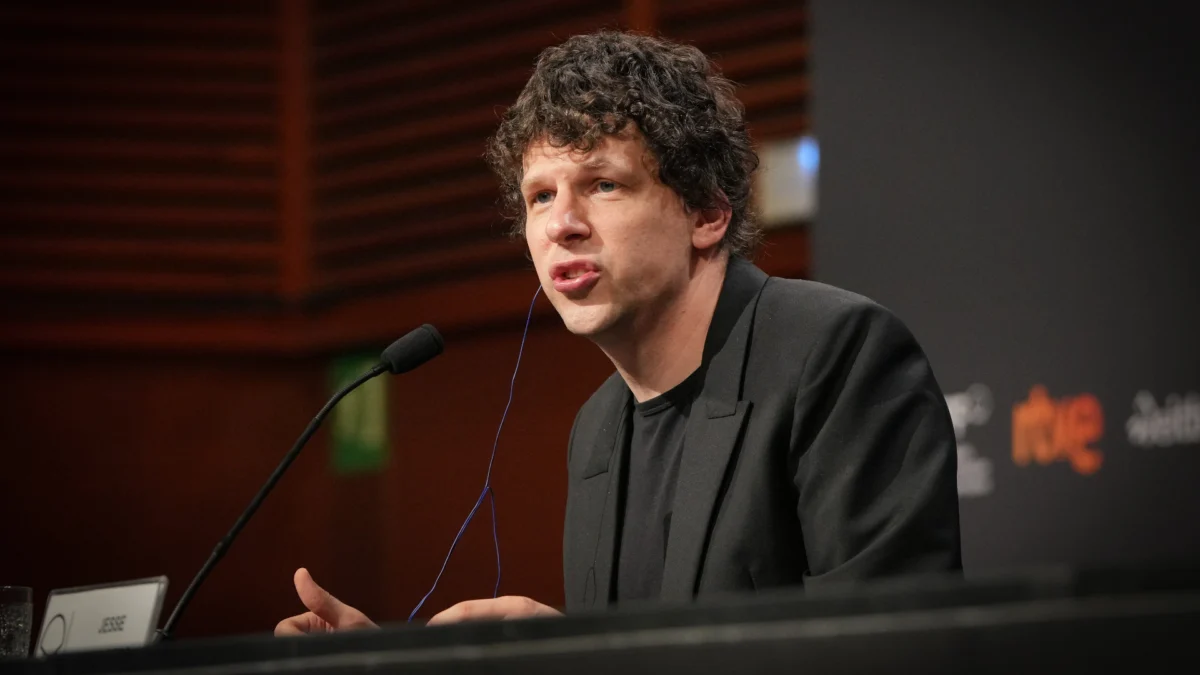
The glittering San Sebastian Film Festival, a cornerstone of the international film calendar, served as the launchpad for Jesse Eisenberg’s latest directorial and writing endeavor, The Debut. Premiering amidst the picturesque Basque coast, the film garnered significant attention not only for its star-studded cast, including Julianne Moore, Paul Giamatti, Halle Bailey, and Havana Rose Liu, but also for the deeply personal reflections shared by Eisenberg himself during a press conference held on Wednesday. Known for his sharp wit and often understated performances, Eisenberg offered a compelling narrative thread connecting his own formative experiences with the themes explored in his new feature.
The film centers on Mona Friedman, portrayed by the acclaimed Julianne Moore, a shy and introverted woman who finds herself unexpectedly thrust into the spotlight when she is cast in a local community theater production of an original musical. Under the charismatic and enigmatic direction of Giamatti’s character, Mona embarks on a journey of self-discovery, becoming increasingly immersed in the demanding and exhilarating world of amateur dramatics. The ensemble cast further boasts the talents of Bernadette Peters, Colton Ryan, Lilli Cooper, Maulik Pancholy, and Bonnie Milligan, promising a rich tapestry of performances.
Eisenberg, who also penned the screenplay for The Debut, revealed that the film draws heavily from his own childhood, specifically his early encounters with community theater in central New Jersey during the 1990s. His account to journalists was a poignant blend of humor and vulnerability, painting a vivid picture of a shy, socially isolated child finding solace and acceptance in an unexpected arena.
From Isolation to Acceptance: The Community Theater Crucible
"The movie takes place in 1990 in central New Jersey, and when I was in central New Jersey in 1990, I was like [Moore’s character] Mona Friedman," Eisenberg explained, his polite demeanor, punctuated by frequent "thank you so muchs" to reporters, a consistent presence throughout the conference. "I was so shy. I was depressed, and I didn’t have friends."
He continued, his voice tinged with a nostalgic melancholy, "And then I walked into this community theater when I was seven years old, and suddenly everybody was so nice, and they hugged me." This stark contrast between his school life and the welcoming environment of the theater was a pivotal moment. "Going from a kid who was made fun of in school because I have the same hair as you, curly hair, and the kids were saying mean things to me. And then I walked into the community theater, and everybody said, ‘Wow, your hair is so amazing! Come this way, you should play with me!’" The anecdote elicited sympathetic chuckles from the assembled journalists, a testament to the relatable nature of childhood insecurities.
Eisenberg elaborated on the profound impact of this early experience, likening it to stepping onto an "alien planet where everybody was nice." He acknowledged that, much like Moore’s character in the film, he may have "taken it too far and became crazy" in his immersion. However, he ultimately opted to shift the narrative focus to an older woman to amplify the emotional resonance of the story. "So really, the movie is charting my life when I was a child. But I just thought it would be so much better to make it about an older woman because Julianne’s amazing, and it’s more emotionally impactful to see a woman." This decision underscores Eisenberg’s directorial intent to explore universal themes of belonging and self-expression through a lens that could resonate more deeply with a broader audience.
Julianne Moore: A Catalyst for Re-evaluating Acting
The choice to cast Julianne Moore, a performer Eisenberg deeply admires, was not merely strategic but also transformative for his own perspective on acting. Moore had previously starred in Eisenberg’s directorial debut, When You Finish Saving the World (2022), a collaboration that clearly left an indelible mark.
"I used to have this negative opinion about acting because I was an actor and I just thought, ‘This is just such a ridiculous job. They pay us too much. We’re vain,’" Eisenberg confessed, candidly articulating a common critique of the profession. He elaborated on his past reservations: "We want to look pretty in the morning, we want to stay in the nicest places, and we want to not ever lift anything on movie sets, and then we want all the credit for the movie! I was always like, ‘This is a weird job, and it’s not fair.’"
This jaded viewpoint was dramatically altered during the filming of his first directorial feature. "And then on my first movie, I saw Julianne Moore rehearsing for a scene," he recalled. Witnessing Moore prepare for a seemingly mundane office scene on the monitor, Eisenberg was struck by the depth of her emotional commitment. "She was going through a real, deep emotional process to get ready for the scene. I remember looking at it, and I go, ‘Oh, wait a second, that’s really hard.’ Like we’re all out here joking, and I’m having a donut, and she’s in there suffering."
This revelation led to a profound shift in his understanding. "I realized, ‘Oh, maybe acting is actually a really valuable thing. Maybe difficult. Maybe it’s challenging. Maybe it takes a lot. And suddenly, in [one] moment, my entire opinion on acting changed because I saw somebody else doing it, and it wasn’t just about me." This anecdote highlights the often-unseen rigor and emotional labor involved in the craft of acting, particularly when approached with the dedication of an artist like Moore.
Giamatti’s Unscripted Charm and the Nuances of Directing
Eisenberg’s admiration extends to Paul Giamatti, whom he considers one of his favorite actors. Giamatti’s contribution to The Debut proved to be an unexpected, yet welcome, development. "And the movie has this element of a romance, which was not in the script at all," Eisenberg revealed, a hint of playful surprise in his tone. "His character is not supposed to be romantically charming. He’s more supposed to be scary and mysterious. But he just brought this warmth to it, and it plays great in the movie."
This instance of an actor subtly, yet effectively, reshaping a character’s dynamic underscores the collaborative nature of filmmaking and Eisenberg’s openness to creative evolution during the production process. It suggests that Giamatti’s innate warmth and charisma, rather than being reined in, were allowed to permeate his portrayal, adding an unexpected layer of complexity and appeal to the narrative. This organic development, born from an actor’s interpretation, is often a hallmark of compelling cinema.
Addressing the Social Network Sequel and Legacy
Naturally, the conversation at the San Sebastian press conference could not entirely bypass Eisenberg’s iconic portrayal of Mark Zuckerberg in David Fincher’s The Social Network (2010). With the highly anticipated sequel, The Social Reckoning, helmed by Aaron Sorkin and featuring Jeremy Strong in the Zuckerberg role, Eisenberg was inevitably questioned about his decision not to reprise the part.
Eisenberg offered a considered and diplomatic response, reiterating his long-held stance. "It’s ironic because people associate me with this website, but they know way more about the website than I do, and I like to keep it that way," he stated, alluding to his deliberate distance from the persona he embodied.
He acknowledged the immense talent involved in Sorkin’s project: "I’ve talked about it a lot, and Aaron Sorkin’s talked about it a lot. I loved his script, and he’s a genius. And the movie, I’m sure, is incredible." However, his personal connection to the material had evolved. "But for me, it just didn’t feel like something I wanted to act in again. But that has nothing to do with how great the movie is. The movie will be a great movie, and Jeremy Strong will be amazing in the movie. I’m sure. I just didn’t feel like it’s something I wanted to do again." This statement emphasizes his professional integrity and his commitment to only engaging with projects that genuinely resonate with him at a given time, irrespective of external expectations or the perceived commercial viability of a sequel.
The San Sebastian Film Festival: A Global Stage for Cinematic Innovation
The San Sebastian International Film Festival, now in its 74th year (referring to the 2026 edition mentioned in the original article’s timestamp), is one of Europe’s most prestigious film festivals, renowned for its focus on auteur cinema and its commitment to fostering new talent. Held annually in September, the festival attracts filmmakers, industry professionals, and cinephiles from across the globe, showcasing a diverse range of international films, from ambitious independent productions to major studio releases. Its strong emphasis on Spanish and Latin American cinema, coupled with a robust selection of European and American films, makes it a vital platform for discovering emerging directors and appreciating established masters. The festival’s "Official Selection" often features films that go on to garner significant critical acclaim and awards recognition, positioning it as a key indicator of the cinematic landscape to come. Eisenberg’s choice to premiere The Debut at such a respected venue signals his intent to position the film as a serious artistic statement, leveraging the festival’s gravitas and discerning audience to generate buzz and critical discussion. The festival, running from September 18-26, provides a curated environment for such discussions to unfold, with press conferences, panel discussions, and industry events creating a vibrant ecosystem for cinematic discourse.
Broader Implications: The Enduring Appeal of Community and Self-Discovery
The Debut arrives at a time when themes of connection, belonging, and the search for identity are increasingly resonant. In an era often characterized by digital interaction and perceived social fragmentation, Eisenberg’s exploration of how a humble community theater can serve as a sanctuary and a catalyst for personal growth offers a hopeful counterpoint. The film’s semi-autobiographical nature, detailing a shy child’s transformation through the arts, speaks to the universal human need for acceptance and the power of creative expression to unlock hidden potential.
The casting of a seasoned ensemble, led by the formidable talents of Moore and Giamatti, further elevates the film’s potential impact. Their ability to imbue characters with depth and nuance is crucial in conveying the emotional journey of self-discovery that lies at the heart of The Debut. By grounding the narrative in personal experience and then expanding it to explore broader humanistic themes, Jesse Eisenberg appears poised to deliver a film that is both intimate and universally appealing, a testament to the enduring power of storytelling and the transformative magic found in the most unexpected of places. The film’s premiere at San Sebastian sets a promising stage for its reception and subsequent impact on the cinematic conversation.