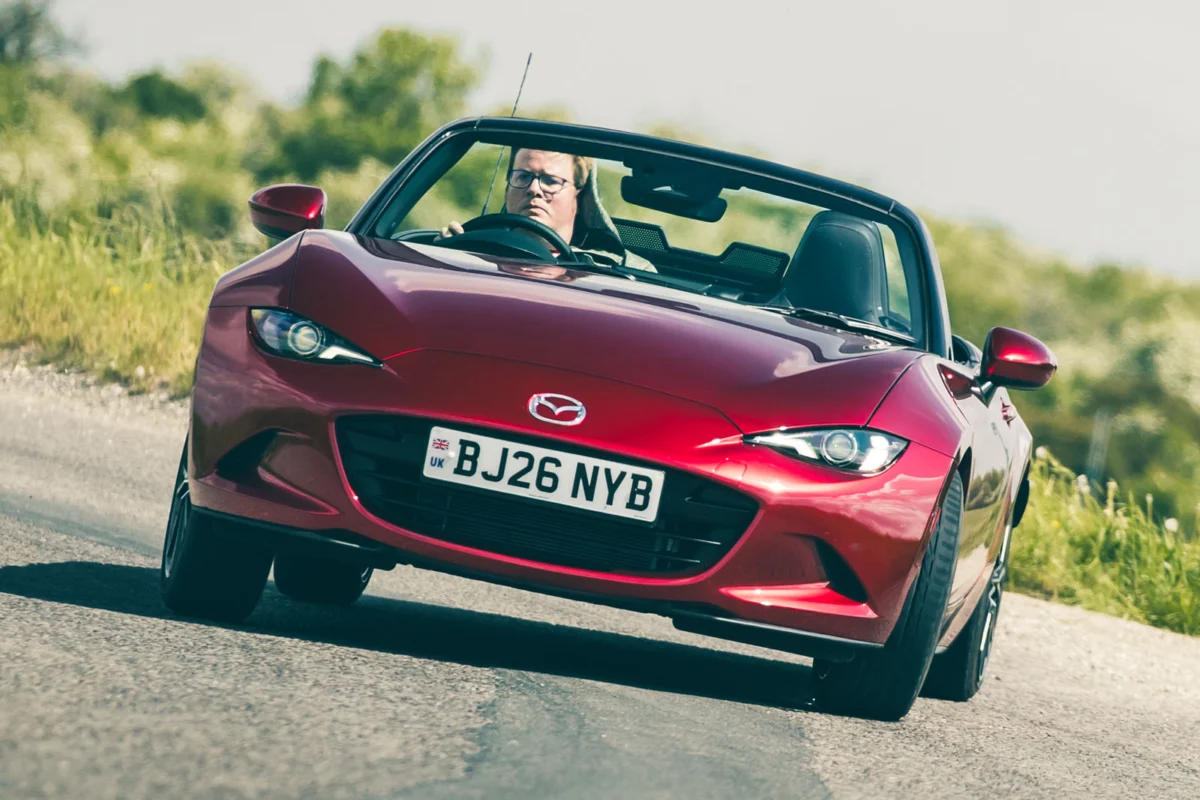
The automotive landscape in the United Kingdom is undergoing a significant transition as Mazda UK confirms the removal of the 2.0-litre powertrain from its iconic MX-5 lineup. This strategic move marks the end of the road for the more powerful, 181bhp variant of the world’s best-selling roadster, leaving the 1.5-litre, 130bhp engine as the sole remaining option for British buyers. While the 2.0-litre model has long been the choice for enthusiasts seeking higher performance and the inclusion of a limited-slip differential, its departure is a direct consequence of tightening environmental regulations and a shifting market focus toward fleet-wide emission reductions. Existing stocks of the 2.0-litre model are expected to sustain consumer demand until early 2027, after which the MX-5 will exist exclusively as a lower-capacity, lightweight sports car in the UK market.
The Technical Transition: 2.0-Litre vs. 1.5-Litre
The discontinuation of the 2.0-litre Skyactiv-G engine represents a fundamental shift in the MX-5’s value proposition. The 2.0-litre unit, which was significantly updated in 2018 to produce 181bhp and 151lb-ft of torque, has been lauded for its free-revving nature and its ability to propel the lightweight chassis from 0-62mph in approximately 6.5 seconds. Crucially, the 2.0-litre variants—specifically the Homura and Exclusive-Line trims—were equipped with a mechanical limited-slip differential (LSD) and Bilstein dampers. These features provided a level of mechanical grip and cornering predictability that defined the car’s reputation as a "driver’s car."
In contrast, the 1.5-litre engine, producing 130bhp and 112lb-ft of torque, offers a more traditional, "momentum-based" driving experience. While it lacks the raw pace of its larger sibling, Mazda maintains that the 1.5-litre unit is the spiritual heart of the MX-5. The current "ND" generation was originally engineered around this smaller, lighter engine to achieve a near-perfect 50:50 weight distribution and a lower overall curb weight. However, the 1.5-litre model does not feature the limited-slip differential, a fact that may deter some track-day enthusiasts and high-performance seekers. Despite this, a recent update in the Japanese market has seen the 1.5-litre engine’s output marginally increased to 134bhp, an upgrade that is expected to arrive in the UK to help bridge the performance gap left by the 2.0-litre’s exit.
Regulatory Drivers: Emissions and the ZEV Mandate
The primary catalyst for the removal of the 2.0-litre engine is the evolving regulatory framework in both the European Union and the United Kingdom. In 2024, Mazda began phasing out the larger engine in European markets to comply with stricter CO2 targets. The UK, despite its departure from the EU, has maintained similar—and in some cases more stringent—environmental standards through its own legislative channels.
A central component of this is the UK’s Zero Emission Vehicle (ZEV) mandate, which came into force in early 2024. The mandate requires a specific percentage of a manufacturer’s new car sales to be zero-emission (battery electric) each year, starting at 22% in 2024 and rising to 100% by 2035. While the MX-5 is an internal combustion engine (ICE) vehicle, the legislation also impacts how manufacturers manage their "fleet average" emissions. The 2.0-litre MX-5 produces 153g/km of CO2, whereas the 1.5-litre variant produces a more modest 140g/km. By streamlining the range to include only the lower-polluting engine, Mazda can more effectively balance its fleet emissions profile, thereby avoiding heavy financial penalties and aligning with the "rewards" system for manufacturers who demonstrate significant cuts in their average tailpipe emissions.
A Chronology of the Mazda MX-5 ND Generation
To understand the impact of this decision, it is necessary to examine the timeline of the fourth-generation (ND) MX-5, which has been in production for over a decade:
- 2014-2015: The ND MX-5 is unveiled and launched globally. It is praised for returning to the lightweight roots of the 1989 original (NA), with the 1.5-litre engine serving as the base model.
- 2018: Mazda introduces a significant mid-cycle update (often referred to as the ND2). The 2.0-litre engine receives a major overhaul, increasing power from 158bhp to 181bhp and raising the redline to 7,500rpm. This cements the 2.0-litre as the definitive performance version.
- 2019: MX-5 sales in the UK peak at approximately 4,000 units, reflecting the success of the engine upgrades and the car’s enduring popularity.
- 2021-2023: Global supply chain issues and a general market shift toward SUVs lead to a decline in sports car sales. UK registrations for the MX-5 drop to roughly 1,500 units annually.
- Early 2024: Mazda introduces the "ND3" update, featuring new LED headlights, an improved infotainment system, and a "Track" mode for the Dynamic Stability Control (DSC) system. Simultaneously, the 2.0-litre engine is withdrawn from mainland European markets.
- Late 2024: Mazda UK confirms the end of 2.0-litre production for the British market, citing the end of the UK’s specific derogation period.
- January 2027: The projected date by which all existing 2.0-litre stock in the UK is expected to be sold.
Market Context and Competitive Pressure
The decision to ax the 2.0-litre engine comes at a time when the "affordable" sports car segment is under immense pressure. The MX-5 has long stood as one of the last remaining purist roadsters, but it is not alone in facing regulatory hurdles. Competitors such as the Toyota GR86 and the Subaru BRZ were withdrawn from European and UK sales due to their inability to meet GSR2 (General Safety Regulation 2) standards without significant and costly re-engineering.
Furthermore, the MX-5 is an aging platform. Having debuted in 2014, it has exceeded the typical seven-year life cycle of most modern vehicles. While Mazda has kept the car fresh with incremental updates, the diminishing sales figures—falling from 4,000 to 1,500 units in five years—suggest that the market for a small, petrol-powered roadster is consolidating. By focusing on the 1.5-litre engine, Mazda is effectively repositioning the MX-5 as a niche, heritage-focused product rather than a high-volume performance car.
Mazda’s Official Philosophy: Jinba Ittai
Mazda’s internal justification for the change leans heavily on its design philosophy of Jinba Ittai, a Japanese phrase meaning "horse and rider as one." A spokesperson for Mazda UK emphasized that the 1.5-litre engine was the original blueprint for the ND generation. The lighter weight of the 1.5-litre unit—which saves approximately 25kg over the front axle compared to the 2.0-litre—enhances the car’s agility and steering response.
"The 1.5-litre engine remains at the heart of the MX-5," the spokesperson stated. "The current-generation MX-5 was originally developed around this engine, with its light weight, responsive and accessible performance perfectly reflecting Jinba Ittai. The continuation of the 1.5-litre ensures customers can continue to enjoy the lightweight, engaging and fun-to-drive experience that has defined the Mazda MX-5 for more than 35 years."
This rhetoric suggests that Mazda is attempting to frame the loss of the 2.0-litre engine not as a compromise, but as a return to the car’s fundamental principles. For many purists, the 1.5-litre’s ability to be "driven to the limit" at road-legal speeds has always been its greatest strength.
Implications for the Future of the MX-5
The removal of the 2.0-litre engine raises questions about the long-term viability of the MX-5 in its current form. As the 2030 and 2035 deadlines for the cessation of new petrol car sales approach, Mazda must decide whether the next generation (NE) will be a hybrid or a fully electric vehicle.
The 1.5-litre variant serves as a bridge, allowing Mazda to keep the MX-5 on sale for a few more years while it navigates the complexities of electrification. The 2027 stock depletion date provides a buffer, giving enthusiasts a final three-year window to purchase the high-performance variant before it disappears from the new-car market entirely.
The move also has implications for the secondary market. As the 2.0-litre 181bhp models become a finite resource, their residual values are expected to remain high, or even increase, as they become sought-after modern classics. The 2.0-litre’s reputation, bolstered by a rare five-star road test rating from Autocar, ensures its status as the high-water mark for the ND generation.
Conclusion: A Rationalized Future
The discontinuation of the 2.0-litre Mazda MX-5 in the UK is a pragmatic response to a changing world. It is a decision driven by the necessity of regulatory compliance and the reality of declining sales in a shrinking segment. While the loss of the limited-slip differential and the extra 50bhp will be felt by the enthusiast community, the survival of the 1.5-litre model ensures that the lightweight roadster formula remains accessible for the time being.
As the automotive industry pivots toward electrification, the MX-5 stands as a final bastion of traditional internal combustion engineering. By narrowing the focus to the 1.5-litre engine, Mazda is attempting to preserve the essence of the roadster for as long as the law allows, ensuring that the "horse and rider" philosophy continues to have a place on British roads, even if it does so with a little less horsepower than before.