


The landscape of artificial intelligence engineering is undergoing a rapid architectural transformation, shifting from the manual crafting of individual model responses to the sophisticated orchestration of autonomous agent networks. As of mid-2026, the industry has settled on a three-tiered hierarchy of control: prompt engineering, loop engineering, and graph engineering. While these terms are frequently used interchangeably in job descriptions and technical forums, they represent distinct layers of a computational stack, each serving a specific function in the development of production-grade AI systems. Understanding the transition between these layers is essential for organizations attempting to move beyond simple chat interfaces toward autonomous, reliable software agents.
The Hierarchical Stack: A New Architectural Standard
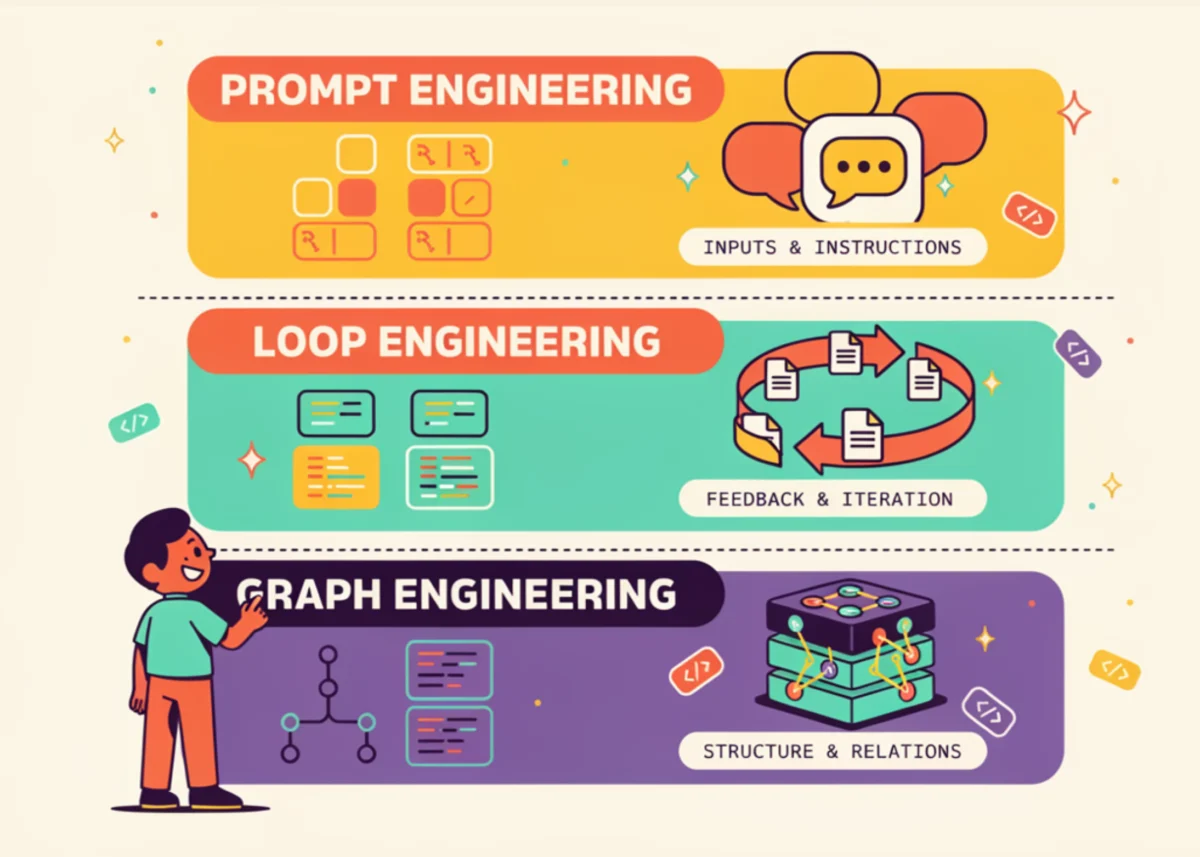
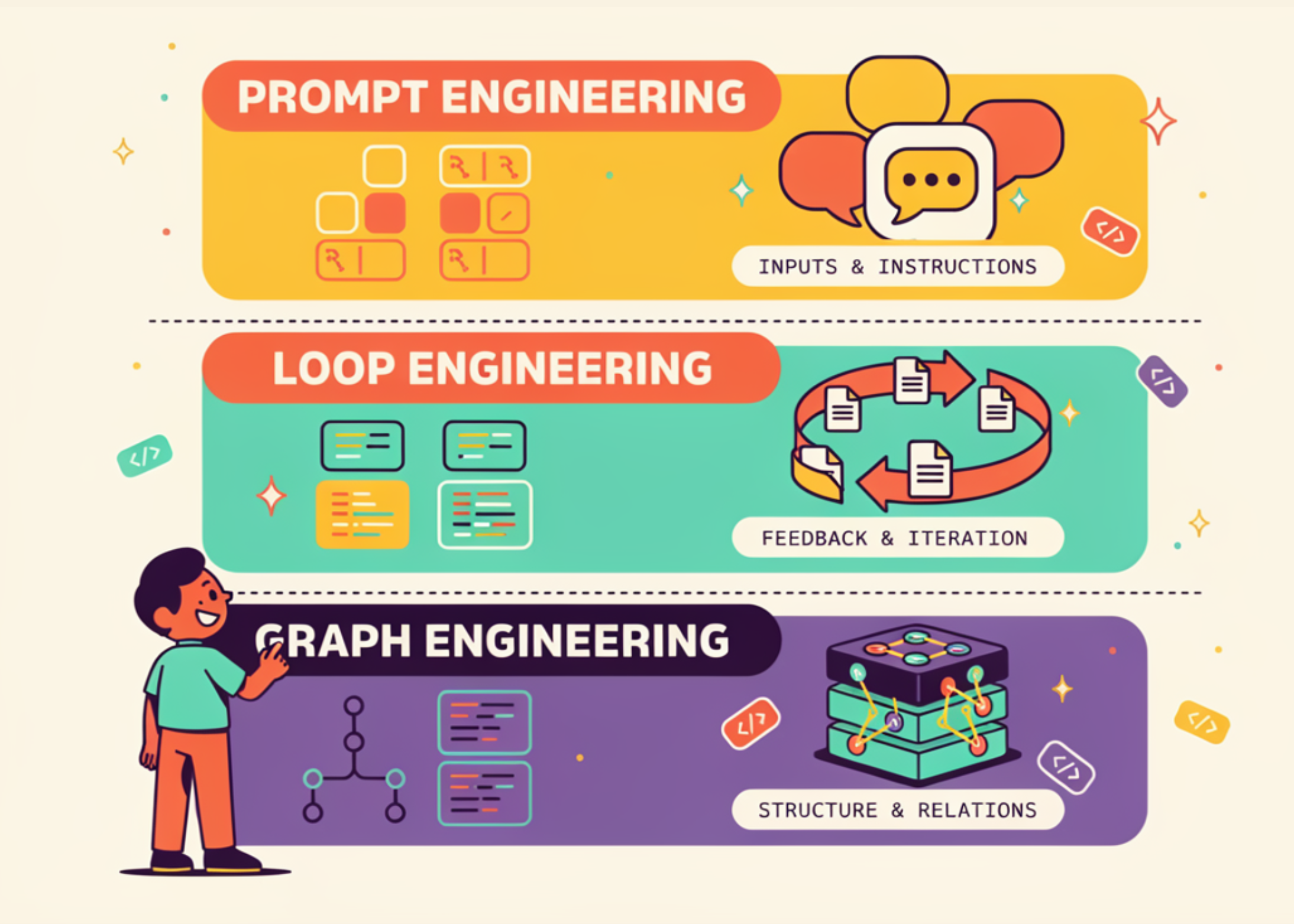
To understand the current state of AI development, one must view these three methodologies not as competing techniques, but as nested units of control. At the base of the stack remains prompt engineering, which governs the output of a single model instance. Above it lies loop engineering, which manages the behavioral cycle of an individual agent as it iterates toward a goal. At the pinnacle is graph engineering, which dictates the organizational structure and communication flow between multiple specialized agents.
This progression reflects the industry’s response to the inherent limitations of large language models (LLMs) when faced with high-volume, multi-step tasks. In early 2025, the primary challenge for engineers was optimizing the "atomic unit"—the prompt. However, as AI was integrated into automated workflows where human oversight at every step became impossible, the focus shifted toward building the "scaffolding" around the model.
Chronology of the Engineering Evolution
The transition through these layers occurred with remarkable speed, driven by the release of increasingly capable coding agents and multi-agent frameworks.
- Pre-2025: The Dominance of Prompting. Engineering efforts were concentrated on zero-shot and few-shot prompting, chain-of-thought techniques, and retrieval-augmented generation (RAG) to improve the accuracy of single-turn interactions.
- Late 2025: The Emergence of Loop Engineering. As developers began building autonomous coding tools, it became clear that a single prompt could not handle complex software development tasks. The concept of "the loop" entered the vocabulary to describe the iterative process of code generation, testing, and self-correction.
- June 2026: Mainstream Adoption of Loops. Public discourse reached a fever pitch following high-profile releases from Anthropic and the Codex team. Discussion shifted from "how to prompt" to "how to design the loop that prompts."
- July 2026: The Graph Engineering Pivot. Just six weeks after the loop engineering boom, the conversation evolved again. Engineers realized that complex enterprise tasks required not just one agent in a loop, but a network of agents. The focus moved to "graphs"—the topological maps of agent interaction.
Layer 1: Prompt Engineering and the Human-in-the-Loop Constraint
Prompt engineering is defined by the assumption that a human is the primary arbiter of quality. In this layer, an engineer writes a prompt, observes the model’s response, and refines the instructions based on the output. This iterative cycle is effective for creative writing, summarization, and simple queries.
However, this model breaks down under three specific conditions: high volume, multi-step complexity, and the absence of a human grader. When an AI system must process thousands of requests per hour or perform tasks where the output of step one serves as the input for step two, manual prompting becomes a bottleneck.
Crucially, prompt engineering does not disappear when moving to higher layers. According to a multi-agent research system report published by Anthropic, prompt engineering remained the "primary lever" for resolving coordination failures between agents. In one instance, an early multi-agent system spawned 50 unnecessary sub-agents to answer a simple query. The solution was not to change the system’s architecture (the graph) but to refine the high-level prompts (the instructions) to enforce restraint. Prompting remains the fundamental method of communicating intent, even when that intent is delivered to an autonomous loop rather than a human.
Layer 2: Loop Engineering and the Science of Iteration
Loop engineering treats the AI agent as a brute-force tool for problem-solving. Rather than trying to get the perfect answer in one shot, the engineer designs a system that allows the agent to try, fail, and try again. This layer became the industry standard in June 2026, popularized by the Claude Code team at Anthropic and documented extensively by software engineers like Addy Osmani.
The loop is composed of five core primitives that provide the agent with a "reasoning cycle":
- Goal: A persistent objective that the agent must achieve.
- Environment: The context or workspace where the agent operates (e.g., a file system or a sandbox).
- Tools: The functions the agent can call, such as a terminal, a web browser, or a database query.
- Observation: The feedback the agent receives after using a tool.
- Reasoning: The internal processing step where the agent evaluates the observation against the goal.
A sixth element—the "holding logic"—ties these primitives together. Modern implementations, such as those found in the Codex app, utilize specialized commands like /loop and /goal. The /goal command is particularly significant because it introduces a "stop condition" checked by a separate, smaller model. This ensures that the agent that wrote the code is not the same agent grading it, reducing the risk of "hallucination loops" where an agent incorrectly convinces itself it has succeeded.
The primary engineering challenge at this layer is the stop condition. A poorly designed loop that cannot distinguish between being "done" and being "stuck" will continue to consume computational tokens indefinitely, leading to massive cost overruns without producing a result.
Layer 3: Graph Engineering and Programmable Organizations
By July 2026, the focus of top-tier AI firms shifted to graph engineering. If loops make an agent’s behavior programmable, graphs make the organization of those agents programmable. This layer addresses the complexity of multi-agent systems where different "specialists" must collaborate.
A critical insight gained during this period is that production-grade systems must manage two distinct types of graphs simultaneously:
The Org Graph
The Org Graph is a stable, long-lived structure. It defines the roles within the system—for example, a "Lead Architect" agent, a "Security Reviewer" agent, and a "Documentation" agent. These agents hold their roles over time, accumulate context, and are only modified during a system redeploy. The Org Graph answers the question of who is responsible for what.
The Work Graph
In contrast, the Work Graph is ephemeral and task-specific. When a user submits a request, a Work Graph is generated to define the steps required for that specific task. It may involve parallel paths where three agents work on different modules simultaneously, followed by a convergence node where their work is merged. Once the task is complete, the Work Graph disappears. This answers the question of what is happening right now.
The technical realization of these concepts is found in frameworks like LangGraph. In these systems, engineers define a StateGraph over a shared state schema. Nodes are registered as plain functions, and edges are wired to control the flow of data. A defining characteristic of graph engineering is that context does not cross a node boundary unless an edge is explicitly designed to carry it. This modularity prevents the "context window bloat" that often plagues simpler AI implementations.
Technical Analysis of the Stack’s Interdependence
The relationship between these three layers is complementary rather than competitive. A July 2026 arXiv paper on coding-agent loops formalized this relationship, noting that a loop is essentially a prompt repeated within a programmatic scaffold. By extension, a graph is a collection of loops wired together.
| Layer | Unit of Control | Primary Artifact | Key Risk |
|---|---|---|---|
| Prompt | Single Response | The Instruction String | Inconsistency / Scalability |
| Loop | Agent Behavior | The Stop Condition | Token Exhaustion / Infinite Loops |
| Graph | Agent Organization | The State Schema | State Fragmentation / Edge Failures |
The transition from one layer to the next is usually dictated by the failure of the previous layer. If a prompt cannot handle the complexity, a loop is required. If a single loop becomes too "noisy" or unfocused, the task must be broken down into a graph of specialized agents.
Economic and Operational Implications
The shift to higher layers of engineering has significant implications for the cost and speed of AI development. While graph and loop engineering can significantly increase the success rate of complex tasks, they also introduce "hidden" costs.
- Token Consumption: An autonomous loop may take 20 iterations to solve a problem that a human could prompt in one, leading to a 20x increase in API costs.
- Debugging Complexity: In a multi-agent graph, identifying which node or edge caused a failure requires sophisticated observability tools. The industry has seen a surge in "agentic telemetry" platforms designed specifically to trace state changes across graph boundaries.
- The Engineering Skill Gap: There is a growing concern among industry leaders regarding the "operator" of these systems. As the architecture becomes more complex, it becomes easier for an engineer to build a system they do not fully understand. A loop can hide an engineer’s lack of domain knowledge by "brute-forcing" a solution, but such solutions are often brittle and difficult to maintain.
Industry Reaction and Future Outlook
Major players like Anthropic and LangChain have already integrated these tiered concepts into their documentation and product roadmaps. Anthropic’s "five workflow patterns"—prompt chaining, routing, parallelization, orchestrator-workers, and evaluator-optimizer—are now recognized as the standard library of graph topologies.
As the industry moves toward late 2026, the focus is expected to shift toward the "autonomous optimization" of these layers. We are already seeing the first instances of "meta-agents" that can analyze a failed Work Graph and suggest a new topology for the Org Graph to prevent future errors.
In conclusion, the evolution from prompt to loop to graph engineering represents the maturation of AI from a novelty into a rigorous engineering discipline. For the modern AI engineer, the task is no longer just talking to the machine, but building the complex machinery that allows the AI to talk to itself, evaluate its own work, and operate within a structured organizational framework. The "stack" is now the standard, and the ability to navigate between these layers of control will define the next era of software development.