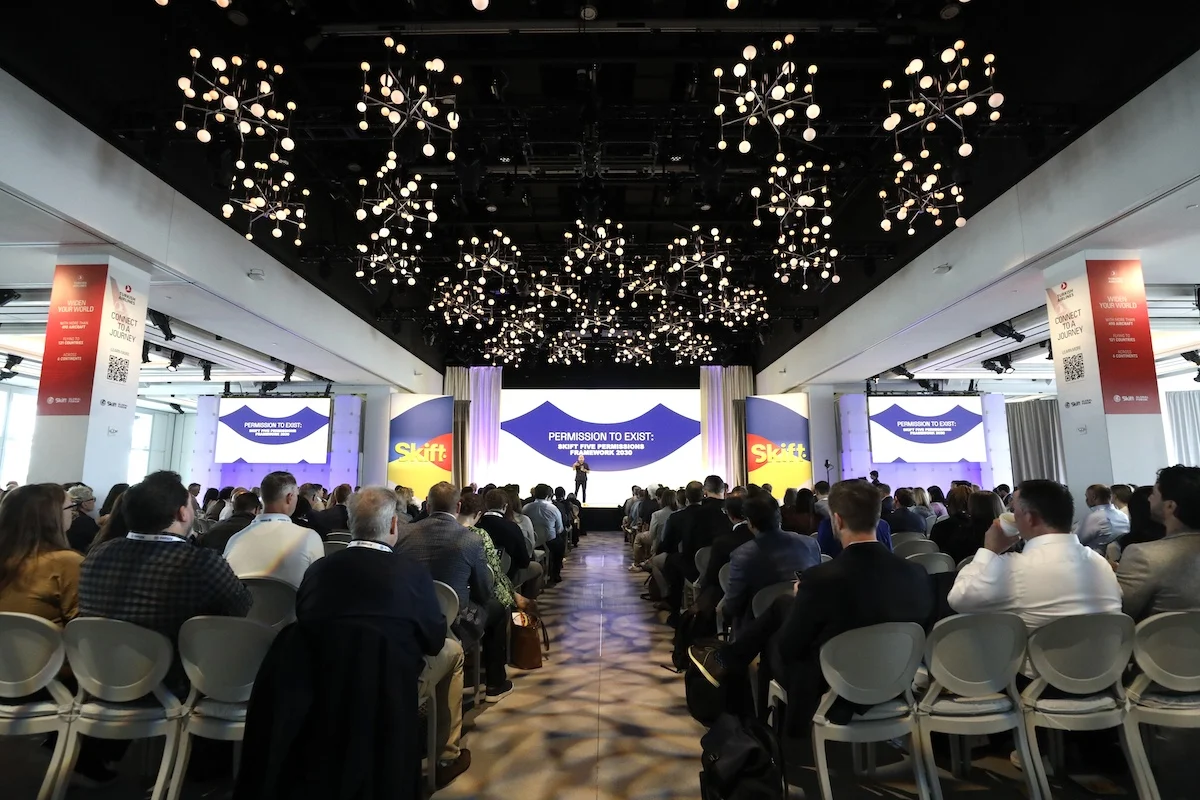
The global travel industry stands at a critical crossroads as leaders prepare to convene for the Skift Global Forum 2026, an event defined by the urgent need to recalibrate business models against a backdrop of unprecedented technological and economic volatility. Scheduled for September 22–24, the forum arrives at a moment when traditional travel demand patterns, distribution channels, and technology stacks are undergoing a fundamental transformation. As the industry grapples with the "State of Travel 2026," a central question persists: are the sector’s current leaders building for the next decade, or merely defending the last one?
The current landscape is defined by two primary tensions. First, while the global travel market continues to expand in total volume, its geographic and demographic shape is shifting rapidly. Second, the pace of technological evolution, particularly in artificial intelligence, has outstripped the level of trust that both consumers and corporate entities are willing to place in these systems. This divergence has forced a re-evaluation of what Skift Research identifies as the four essential layers of the travel stack: consumers, commerce, operations, and experiences. In this environment, every travel brand is being challenged to prove its relevance or risk being bypassed by more agile, AI-native competitors.
The Battle for Distribution: Incumbency Versus AI Reinvention
One of the most significant shifts identified heading into the 2026 forum is the divergence in how established giants and emerging challengers approach infrastructure. For legacy brands, the focus has largely remained on internal efficiency. By mid-2025, artificial intelligence had successfully driven significant returns on investment (ROI) by streamlining back-end operations, yet its impact on front-end booking demand remained marginal.

However, the venture capital landscape suggests a massive bet on a different future. Funding for AI-enabled travel startups surged from 10% of total industry investment in 2023 to 45% by the middle of 2025. This influx of capital supports a new generation of "AI-native" companies designed to upend the traditional distribution model.
The strategy of Airbnb under Brian Chesky serves as a primary case study for this transition. Unlike its peers, Airbnb is attempting to rebuild its entire platform as an AI-native ecosystem while its core business continues to fund the transformation. This "rebuild versus retrofit" debate is central to the decisions facing distribution leaders. While Booking Holdings and Expedia Group currently control the lion’s share of distribution and cash reserves, they are burdened by legacy systems that may not scale as the industry shifts toward AI-driven booking agents.
Currently, the data reveals a stark reality: referral traffic from AI agents accounts for less than 1% of room nights at Booking.com. Conversely, Airbnb has demonstrated the operational power of the technology, reducing its support cost per booking by approximately 16% within a single year through AI integration. The industry is now watching to see if an AI-native startup can bridge the gap between operational efficiency and consumer-facing discovery to challenge the established duopoly.
From Search to Discovery: The Evolution of the Consumer Funnel
The traditional consumer journey—characterized by the "search-scroll-compare" method—is rapidly being replaced by an "ask-shortlist-decide" framework. According to the Skift Research State of Travel 2026 report, nearly 30% of travelers now report "extensive" use of AI for trip planning, a figure that has more than doubled in just twelve months.

Despite this surge in planning usage, a significant "trust gap" remains. Only 2% of leisure travelers are currently willing to allow an AI agent to complete a transaction on their behalf. Traveler sentiment regarding AI-led booking remains net negative, with most consumers still preferring the perceived security of direct brand websites or established Online Travel Agencies (OTAs).
This shift presents a strategic dilemma for hotel and airline brands. AI systems are designed to shortlist only the brands whose data they can easily ingest and interpret. Brands that do not structure their data for AI visibility risk becoming "invisible" unless a consumer specifically requests them by name. However, by optimizing for AI discovery, brands cede control over how their products are represented and compared. Currently, only 6% of hotels appear in AI-generated search results, highlighting a massive disconnect between traditional digital marketing and the requirements of the new AI-driven funnel.
The Premiumization Paradox: Revenue Growth Amidst Price Sensitivity
Economic data for 2025 and 2026 reveals a growing divide in the travel market. The industry’s financial health is currently being bolstered by affluent travelers, leading to a "premiumization" of services. Delta Air Lines reported a 7% increase in premium revenue in 2025, even as its main cabin revenue declined by 5%. This trend is mirrored by American Airlines and United Airlines, both of which are aggressively retrofitting aircraft to ensure that premium seating accounts for nearly half of their total cabin capacity.
While premium seats offer significantly higher margins, this strategy carries inherent risks. Skift Research indicates that 62% of global travelers are now adjusting or canceling plans due to rising costs. By focusing heavily on the top tier of the market, travel providers may be thinning the customer base necessary to maintain occupancy and volume during economic downturns.

In late 2025, premium cabin revenue surpassed economy revenue for the first time in Delta’s history. While this serves as a robust revenue story in the short term, analysts suggest it is also a precarious bet on continued income inequality. The industry must decide if "raising the floor" through premium services will provide a sufficient buffer when the broader, price-sensitive market retracts.
The Human Element: Balancing Automation and Service
As hotel brands integrate AI to manage reservations and routine inquiries, they face a delicate balancing act regarding the "human touch." The prevailing trend has been to view human service as a luxury line item. While this is a logical response to a persistent global labor shortage, it risks stripping mid-market brands of their primary differentiators.
Investment in AI is currently flowing toward reservation efficiency and automated guest communications. However, the labor shortage is most acute in areas where human interaction is highly valued, such as concierge services and personalized hospitality. If human service becomes a feature exclusive to the ultra-luxury segment, the mid-market may find it impossible to rebuild its service culture once frontline headcount has been permanently replaced by machines. The forum will address whether brands can maintain guest loyalty if the "human element" is removed from the standard travel experience.
Strategic Agility: Speed Versus Certainty in a Volatile World
The final tension defining the 2026 landscape is the choice between waiting for market certainty and acting with speed. In the United States, domestic travel has remained stable at 2019 levels in real terms, but international inbound volume has struggled, with recovery forecasts recently pushed back from 2025 to 2029.

Geopolitical instability in 2026 has forced global companies, particularly airlines and hotel groups, to reset their strategic plans on a quarterly basis. The shift in demand has been geographic as well as sectoral, with significant growth moving toward South America and Asia, while the Middle East and North Africa (MENA) and U.S. markets face various headwinds.
Industry leaders are finding that waiting for definitive data often means missing the window of opportunity. Conversely, committing capital based on volatile data carries the risk of significant losses if market conditions shift in the following quarter. The Skift Global Forum aims to provide a platform for leaders from companies like Accor, which has navigated global volatility through diversified regional strategies, to share insights on balancing risk and action.
Conclusion: Building for the Next Decade
The Skift Global Forum 2026 serves as a reminder that the travel industry has already undergone a fundamental recalibration. The move from international to domestic focus in certain regions, the transition from economy to premium dominance in aviation, and the shift from traditional search to AI-assisted discovery are no longer future projections—they are current realities.
As the forum commences, the objective for attendees is to move beyond re-forecasting for past disruptions and begin building for the ones ahead. Participants will leave the event with a clearer understanding of how to stabilize their operations in a shifting landscape. By examining the conflicting strategies of incumbents like Booking Holdings and challengers like Airbnb, and by analyzing the premium-heavy models of major airlines, travel executives can determine which direction their own organizations must take to remain relevant in the decade to come. The era of predictable growth has ended; the era of strategic recalibration has begun.