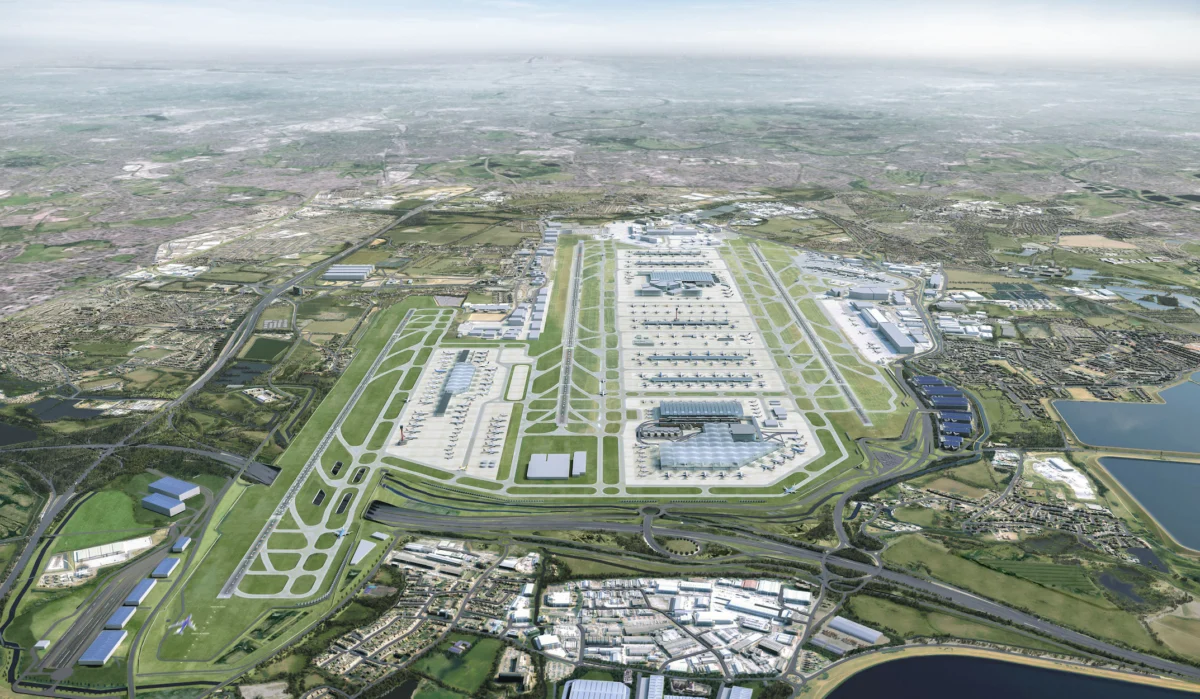
The ongoing debate surrounding the expansion of Heathrow Airport has reached a critical juncture as the United Kingdom’s independent climate advisors warn that the project may be fundamentally incompatible with the nation’s legally binding environmental targets. The Climate Change Committee (CCC), the government’s official advisory body on climate policy, has signaled that the only viable path to curbing aviation emissions while simultaneously expanding infrastructure would be to aggressively throttle passenger demand. This assessment comes at a time when the aviation industry is under intense pressure to decarbonize, even as Heathrow Airport Holdings pushes forward with long-standing plans to construct a third runway to maintain its status as a premier global hub.
Nigel Topping CMG, the chair of the Climate Change Committee, recently underscored the severity of the situation, noting that emissions from flying are projected to rise regardless of whether the expansion proceeds. According to Topping, the UK currently lacks a "credible plan" to bring these emissions down, which poses a significant threat to the country’s 2050 Net Zero commitments. The CCC’s position is clear: the government must ensure that the aviation industry bears the full cost of its decarbonization efforts and takes direct responsibility for the carbon footprint it generates. Under current policy frameworks, the committee argues that these necessary conditions do not yet exist.
The Core Conflict Between Infrastructure and Atmosphere
At the heart of the controversy is a mathematical and environmental mismatch. Heathrow is currently the busiest airport in Europe, operating at near-total capacity. Proponents of the third runway argue that expansion is vital for the UK’s post-Brexit "Global Britain" strategy, facilitating new trade routes and securing thousands of jobs. However, the environmental cost of such growth is increasingly difficult to reconcile with the UK’s Carbon Budget 6, which requires a 78% reduction in emissions by 2035 compared to 1990 levels.
Aviation currently accounts for approximately 2.5% of global carbon emissions, but its impact is disproportionately high in developed nations like the UK. Furthermore, aviation emissions are considered "hard to abate" because the technology required for zero-emission long-haul flight—such as high-density batteries or liquid hydrogen propulsion—is decades away from commercial viability at scale. Consequently, the CCC suggests that if the physical capacity of airports increases, the only way to stay within carbon limits is to make flying more expensive or less frequent through policy interventions.
A Chronology of the Heathrow Expansion Project
The quest for a third runway at Heathrow has been one of the most protracted infrastructure sagas in British history, spanning multiple decades and several administrations.
- 2003: The Department for Transport’s White Paper, "The Future of Air Transport," first officially suggests a third runway at Heathrow as a preferred option for expanding UK airport capacity.
- 2009: The Labour government formally approves the expansion, but the decision faces immediate legal challenges and intense local opposition.
- 2010: The incoming Conservative-Liberal Democrat coalition cancels the project, with David Cameron famously declaring, "No ifs, no buts, no third runway."
- 2012: The Airports Commission, chaired by Sir Howard Davies, is established to re-examine the need for additional capacity in the southeast of England.
- 2015: The Davies Commission concludes that a third runway at Heathrow is the best option, provided stringent environmental conditions regarding noise and air quality are met.
- 2018: Members of Parliament vote overwhelmingly in favor of the National Policy Statement (NPS) supporting Heathrow expansion.
- 2020: The Court of Appeal rules that the expansion is illegal because it failed to take into account the UK’s commitments under the Paris Agreement. However, later that year, the Supreme Court overturns this ruling, stating the government’s policy was lawful at the time it was drafted.
- 2023-2024: Post-pandemic travel recovery brings the expansion back into focus, but the CCC issues its strongest warnings yet regarding the lack of a decarbonization roadmap.
Supporting Data and the Emissions Gap
The statistical reality of aviation emissions highlights the scale of the challenge. Before the COVID-19 pandemic, Heathrow handled over 80 million passengers annually. If a third runway is completed, that number is projected to rise to 130 million. While Heathrow Airport Holdings has committed to making the airport’s ground operations carbon-neutral, the vast majority of emissions—over 95%—come from the aircraft themselves during takeoff, flight, and landing.
The UK government’s "Jet Zero" strategy relies heavily on the development of Sustainable Aviation Fuels (SAF). SAF can be dropped into existing jet engines and is made from waste products or synthetic processes. However, current global SAF production accounts for less than 0.1% of total jet fuel demand. To meet 2050 targets, the industry would need to scale this production by several thousand percent, a feat that experts warn is both economically and logistically daunting.
Furthermore, the CCC has pointed out that the government’s current projections assume a "high-efficiency" scenario that may not materialize. If fuel efficiency improvements or SAF adoption lag behind targets, the only remaining lever to control emissions is demand management. This could include a "frequent flyer levy," which targets the small percentage of the population responsible for the majority of flights, or a moratorium on all airport expansions across the UK.
Official Responses and Stakeholder Perspectives
The debate has polarized stakeholders across the political and economic spectrum. Heathrow Airport Limited maintains that expansion and decarbonization are not mutually exclusive. A spokesperson for the airport stated that they are "investing heavily in SAF and carbon removal technologies," and that the third runway would actually allow for more efficient flight paths, potentially reducing "stacking" and idling times for aircraft.
Airlines, particularly International Airlines Group (IAG), the parent company of British Airways, have expressed cautious support for expansion but are increasingly wary of the costs. IAG has voiced concerns that the high costs of building the runway will be passed on to airlines and passengers through increased landing fees, potentially making Heathrow less competitive compared to hubs like Paris Charles de Gaulle or Amsterdam Schiphol.
On the other side of the argument, environmental advocacy groups such as Greenpeace UK and Friends of the Earth have praised the CCC’s recent intervention. They argue that any expansion of aviation capacity is a "climate crime" in the context of the current ecological crisis. These groups point to the fact that the UK’s current climate strategy relies on unproven "negative emissions technologies"—such as Carbon Capture and Storage (CCS)—to offset the emissions from expanded flight schedules.
The Department for Transport (DfT) has remained relatively steadfast in its support for the aviation sector, emphasizing the industry’s role in the national economy. A DfT spokesperson noted, "The aviation sector is a major contributor to the UK economy, and we are committed to reaching Jet Zero by 2050 through innovation and technology, rather than by limiting people’s freedom to fly."
Fact-Based Analysis of Future Implications
The tension between the CCC’s recommendations and the government’s infrastructure goals suggests several potential outcomes for the coming decade.
First, the legal landscape remains volatile. Any formal move to break ground on a third runway will likely trigger a new wave of judicial reviews. These legal battles will center on whether the government’s updated "Jet Zero" strategy provides a "credible" enough framework to satisfy the requirements of the Climate Change Act. If the courts find the plan lacking in concrete mechanisms for emission reduction, the expansion could be stalled indefinitely.
Second, the economic viability of the expansion is under threat from the very measures meant to save it. If the CCC’s recommendation for "demand management" is adopted, the government might introduce higher Air Passenger Duty (APD) or carbon taxes. These costs would naturally reduce the number of passengers, potentially undermining the financial justification for a multi-billion-pound third runway. Investors may become hesitant to fund a project whose primary revenue source—passenger growth—is being intentionally suppressed by government policy.
Third, there is the "carbon leakage" argument. Proponents of Heathrow expansion argue that if the UK limits its capacity, passengers will simply fly via other European or Middle Eastern hubs. This would result in the same global emissions (or even higher due to longer flight paths) while the UK loses the economic benefits. However, the CCC argues that as a global leader in climate policy, the UK must set a precedent for demand management that other nations can follow.
Conclusion: A Narrow Path Forward
The warning from Nigel Topping and the Climate Change Committee serves as a stark reminder that the era of unconstrained aviation growth may be coming to an end in the United Kingdom. While the technical possibility of a carbon-neutral aviation industry exists in theory, the practical timeline for its implementation does not align with the urgent requirements of the 2030 and 2035 carbon budgets.
For Heathrow to expand, the UK government faces a difficult choice: either implement radical, market-distorting policies to suppress flight demand elsewhere or prove that technological breakthroughs in SAF and zero-emission flight can happen much faster than currently predicted. Without a "credible plan" that addresses these contradictions, the third runway remains a project at odds with the nation’s environmental destiny. The coming years will determine whether Heathrow becomes a symbol of sustainable modern infrastructure or a relic of an era that prioritized expansion over ecological stability.