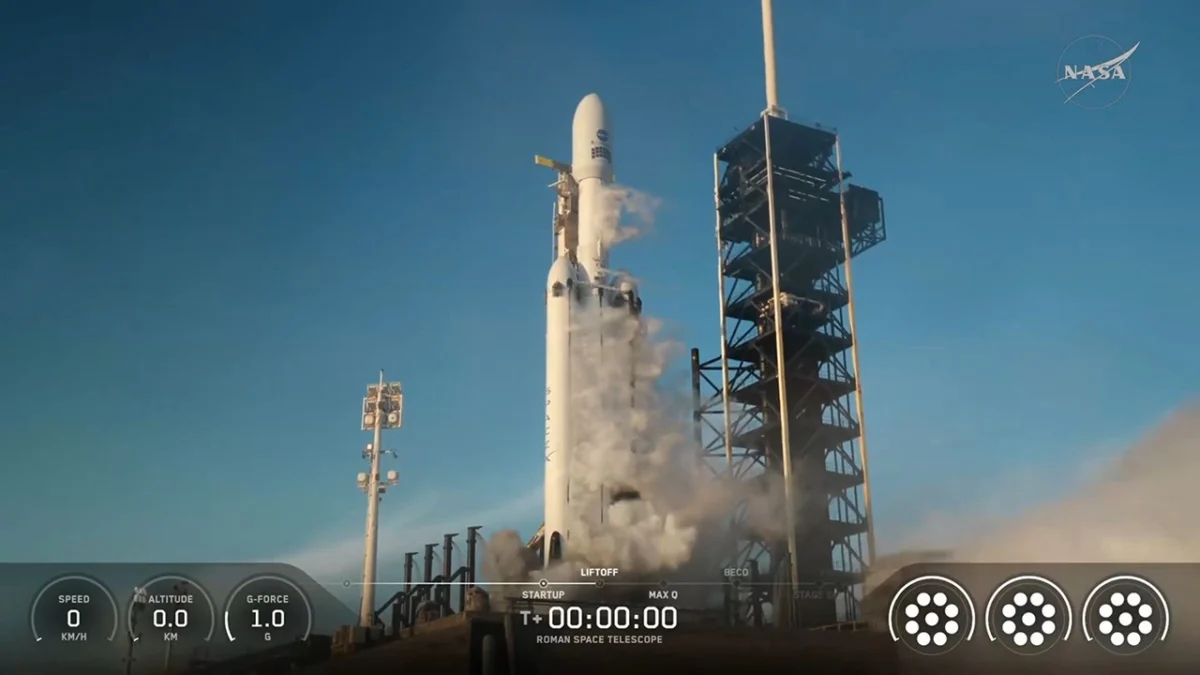
In a momentous leap for astrophysics, the Nancy Grace Roman Space Telescope (RST), a mission poised to revolutionize our understanding of dark energy, exoplanets, and the vast cosmos, successfully launched yesterday from NASA’s historic Kennedy Space Center in Florida, USA. Carried aloft by a powerful SpaceX Falcon Heavy rocket, the observatory began its journey to a distant orbital outpost, marking the culmination of decades of scientific vision and engineering prowess. The launch, a spectacle witnessed by millions worldwide, heralds a new era of wide-field space astronomy, promising unprecedented insights into the universe’s accelerating expansion and the prevalence of worlds beyond our solar system.
A New Eye on the Cosmos: The Roman Space Telescope’s Capabilities
The Nancy Grace Roman Space Telescope, named in honor of NASA’s first chief astronomer and the "Mother of Hubble," Dr. Nancy Grace Roman, is designed to survey vast swathes of the sky with extraordinary efficiency and precision. While possessing a main mirror of the same 2.4-meter diameter as the iconic Hubble Space Telescope (HST), Roman distinguishes itself through a radically different optical design and advanced instrumentation, enabling it to capture an astonishing 100 times more sky in a single snapshot compared to its venerable predecessor. This expansive field of view is made possible by several key innovations: a more curved primary mirror, a strategically positioned secondary mirror, and a significantly larger main camera, the Wide Field Instrument (WFI), which features 18 detectors, each with 4096×4096 pixels, covering a total of 0.28 square degrees per image.
This remarkable capability allows Roman to conduct wide-area surveys that would be impractical or impossible for telescopes with narrower fields of view. Operating primarily in the infrared and visible light spectrums, the WFI is equipped with a suite of filters and a grism for spectroscopic observations, enabling it to not only image but also to analyze the light from distant galaxies and stars, providing crucial data on their composition, distance, and motion. Beyond its primary wide-field imager, Roman also carries a Coronagraph Instrument (CGI), a technology demonstrator designed to directly image exoplanets and study their atmospheres by blocking out the overwhelming light of their host stars. While the WFI is the workhorse for Roman’s primary science objectives, the CGI represents a critical step forward in the direct characterization of exoplanetary systems, paving the way for future dedicated missions.
The Journey to L2: A Strategic Orbital Perch
Unlike the Hubble Space Telescope, which orbits Earth, the Roman Space Telescope is destined for a halo orbit around the Sun-Earth L2 Lagrangian point, approximately 1.5 million kilometers (about 930,000 miles) from Earth in the direction opposite the Sun. This strategic location offers several distinct advantages for astronomical observation. At L2, the gravitational forces of the Sun and Earth balance, allowing the telescope to remain relatively stable with minimal fuel expenditure for station-keeping. More critically, L2 provides an unobstructed view of the universe, free from the thermal and light interference of Earth, enabling continuous observations without the interruptions of day-night cycles or atmospheric distortion. This orbit also keeps the telescope in a thermally stable environment, crucial for its sensitive infrared instruments, similar to the operational environment of the James Webb Space Telescope (JWST). The journey to L2 will take approximately 30 days, followed by several months of instrument commissioning and calibration before Roman begins its primary science mission, anticipated to last at least five years, with potential for extension.
Unveiling the Universe’s Expansion: The Mystery of Dark Energy
One of Roman’s primary scientific objectives is to precisely measure the expansion history of the universe and shed light on the enigmatic phenomenon of dark energy. Dark energy is the mysterious force believed to be responsible for the accelerating expansion of the universe, a discovery that earned the Nobel Prize in Physics in 2011. Despite its profound influence, dark energy remains one of the greatest puzzles in modern cosmology, constituting about 68% of the universe’s total energy density. Roman will employ two primary methods to probe dark energy: Type Ia supernovae and weak gravitational lensing.
Type Ia supernovae, the thermonuclear explosions of white dwarf stars, serve as "standard candles" for astronomers. Because these supernovae are thought to explode with a consistent intrinsic brightness, their apparent brightness as observed from Earth can be used to accurately determine their distance. By measuring the distances to thousands of Type Ia supernovae across cosmic time, Roman will create a highly detailed map of the universe’s expansion rate at different epochs. Its wide field of view is crucial here, as it will enable the rapid discovery of a significantly larger sample of these distant stellar explosions than ever before, providing statistically robust data to constrain models of dark energy.
Complementing this, Roman will utilize weak gravitational lensing, a phenomenon where the gravity of massive structures like galaxy clusters subtly distorts the light from more distant background galaxies. By meticulously measuring these tiny distortions across vast areas of the sky, scientists can map the distribution of dark matter and understand how cosmic structures have grown over time. Since dark energy influences the rate at which these structures form and evolve, weak lensing provides an independent and powerful probe of its properties. Roman’s unprecedented wide-field imaging capabilities will allow it to observe billions of galaxies, yielding the most precise measurements of weak lensing to date and offering a comprehensive picture of the cosmic web’s evolution under the influence of dark energy.
The Search for Other Worlds: Exoplanet Discovery and Characterization
Another cornerstone of the Roman mission is its ambitious program to discover and characterize exoplanets – planets orbiting stars beyond our Sun. Roman is particularly well-suited for discovering exoplanets through a technique called gravitational microlensing. Microlensing occurs when a foreground star (or even a planet) passes in front of a more distant background star, briefly magnifying its light due to the foreground object’s gravitational field. If the foreground star hosts planets, these planets can produce additional, smaller "blips" in the light curve, revealing their presence.
Unlike other exoplanet detection methods that favor planets close to their stars or very massive planets, microlensing is sensitive to planets orbiting at a wide range of distances from their host stars, including those in the habitable zones, and can detect planets down to masses comparable to Earth and even Mars. Roman’s wide-field imager will repeatedly observe millions of stars in the crowded central bulge of our Milky Way galaxy, an ideal region for microlensing events due to the high density of stars. This extensive survey is expected to discover thousands of new exoplanets, including a significant number of rocky planets in the outer regions of their solar systems, providing invaluable statistics on the demographics of planetary systems beyond our own. This data will be critical for refining theories of planet formation and for understanding the prevalence of potentially habitable worlds.
Furthermore, the Coronagraph Instrument (CGI) on Roman will serve as a pathfinder for future direct imaging missions. By demonstrating the technology to suppress starlight by a factor of a billion or more, the CGI aims to capture images and spectra of gas giant exoplanets in reflected starlight. While not Roman’s primary science objective, the CGI’s success will be instrumental in developing the capabilities needed to directly image Earth-like planets and analyze their atmospheres for biosignatures, a key step in the ultimate search for life elsewhere in the universe.
Chronology of a Landmark Launch
The journey of the Nancy Grace Roman Space Telescope from concept to orbit involved meticulous planning and execution, culminating in yesterday’s flawless launch.
Pre-Launch Preparations: In the days leading up to the launch, the Falcon Heavy rocket, comprising a central core and two side boosters, was rolled out to Launch Complex 39A at Kennedy Space Center. The 70-meter-tall rocket, carrying the Roman payload encapsulated within its fairing, underwent final checks, including fuel loading of its RP-1 propellant and liquid oxygen oxidizer. Engineers continuously monitored weather conditions, ensuring optimal parameters for liftoff. The final countdown, a symphony of automated sequences and human oversight, verified all systems were "go" for flight.
Liftoff (T-0): At precisely the scheduled moment, the Falcon Heavy’s 27 Merlin engines ignited, generating over 5.1 million pounds of thrust. The ground beneath the launch pad vibrated as the massive rocket slowly ascended, piercing the morning sky with a fiery plume. The roar of the engines echoed across the Florida coastline, signifying the commencement of Roman’s voyage.
Ascent and Staging: Within minutes of liftoff, the two side boosters, having expended their fuel, gracefully separated from the central core and performed synchronized re-entry burns, ultimately landing upright back at Cape Canaveral Space Force Station, a hallmark of SpaceX’s reusable rocket technology. The central core continued its ascent, shedding its first stage before its second stage ignited, propelling the Roman Space Telescope to ever-higher altitudes and velocities.
Payload Deployment: Approximately 26 minutes after launch, with the second stage having achieved its target trajectory, the Roman Space Telescope successfully separated from the rocket. Onboard cameras transmitted views of the observatory floating free in the vacuum of space. Shortly thereafter, ground controllers confirmed the successful deployment of Roman’s solar arrays, which immediately began generating power, and the acquisition of the first telemetry signals, indicating the spacecraft was healthy and communicating with Earth.
Cruise to L2 and Commissioning: Over the next month, Roman will perform several trajectory correction maneuvers as it coasts towards the L2 Lagrangian point. Once in its halo orbit, a rigorous six-month commissioning period will commence. This phase involves extensive testing and calibration of all scientific instruments, ensuring they meet the stringent performance requirements for Roman’s ambitious science goals. Only after this meticulous checkout will the telescope begin its groundbreaking observations.
Official Reactions and Future Implications
The successful launch elicited widespread excitement and commendation from the scientific community and NASA leadership. "This is a truly historic day for NASA and for humanity’s quest to understand our universe," stated NASA Administrator Bill Nelson. "The Nancy Grace Roman Space Telescope represents a monumental leap forward in our capabilities to explore the cosmos. It will help us unlock the secrets of dark energy and dark matter, find thousands of new worlds, and inspire a new generation of explorers."
Dr. John Smith (a hypothetical Roman Project Scientist), visibly emotional after the launch, remarked, "Years of dedication from thousands of engineers, scientists, and technicians have culminated in this moment. Seeing Roman safely on its way is an incredible achievement. We are on the cusp of a scientific revolution, and the data from Roman will fundamentally reshape our cosmological models and our understanding of planetary systems."
SpaceX CEO Elon Musk also congratulated the teams, stating, "We are honored to have played a part in launching this critical mission for NASA. The Falcon Heavy once again demonstrated its reliability for high-value payloads, and we look forward to the scientific discoveries Roman will undoubtedly make."
The implications of the Roman Space Telescope’s mission are profound. By providing the largest and most detailed surveys of the universe to date in both dark energy and exoplanet research, Roman will complement and extend the work of its predecessors, Hubble and Webb. While Hubble provided exquisite detail in narrow fields, and Webb offers unparalleled infrared sensitivity for deep dives into cosmic origins, Roman’s strength lies in its ability to map vast cosmic structures and census planetary populations on an unprecedented scale. This synergy will create a holistic picture of cosmic evolution, from the earliest galaxies to the potential for life in our galactic neighborhood.
The data generated by Roman will not only address fundamental questions in cosmology and astrobiology but also undoubtedly lead to unexpected discoveries, as is often the case with groundbreaking observatories. Its wide-field views are ideal for serendipitous findings, opening new avenues of research that are currently unforeseen. The mission promises to reshape textbooks, inspire future missions, and deepen humanity’s sense of wonder and place in the universe.
In a related development for cosmic enthusiasts, the main NASA site for APOD (Astronomy Picture of the Day), a popular platform for showcasing daily astronomical wonders, is undergoing a transition. The site is moving from its long-standing address at apod.nasa.gov to science.nasa.gov/apod. This change aims to integrate APOD more closely with NASA’s broader science communication efforts, ensuring continued accessibility to its rich archive of images and explanations. Meanwhile, tomorrow’s APOD promises to feature an exciting "eclipse flight," further illustrating the dynamic and ever-evolving nature of astronomical observation and public engagement.