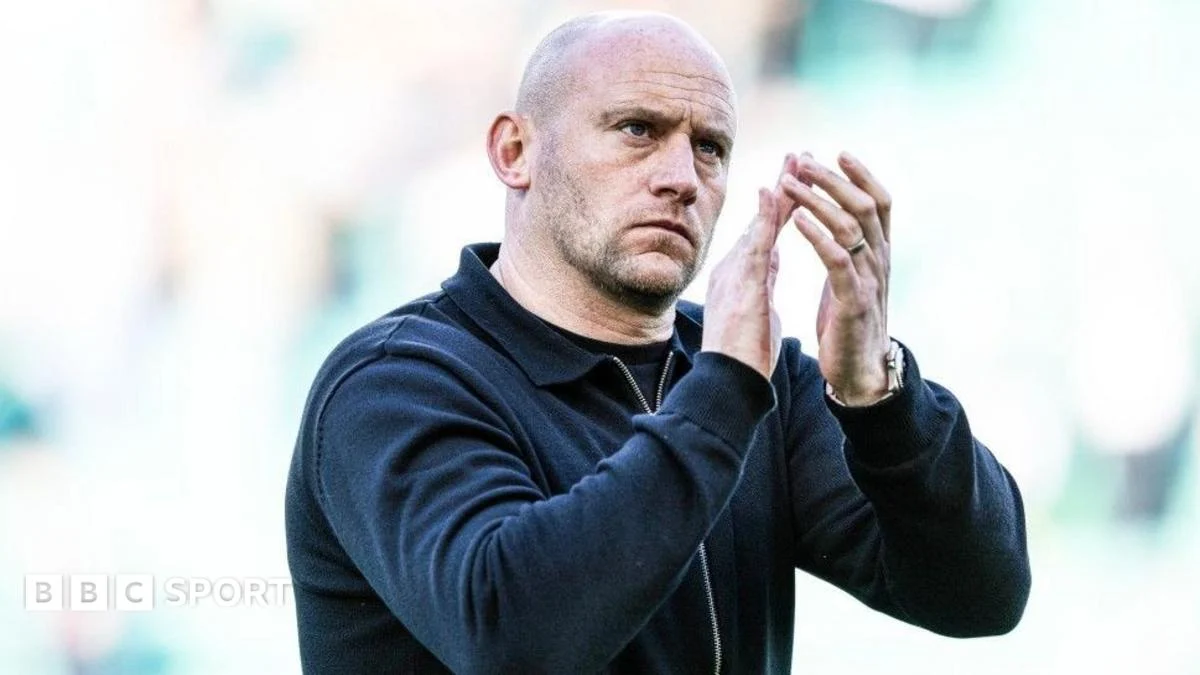
Hibs have parted ways with their first-team manager, David Gray, marking the end of a significant chapter for the club that saw him transition from iconic player to decorated manager. The departure, confirmed on Wednesday evening, was met not with the expected outpouring of elation from the fanbase, but rather a palpable sense of collective relief, a poignant testament to the complex emotions surrounding his tenure. Gray, a figure etched into Hibernian folklore for his goalscoring exploits and Scottish Cup triumph in 2016, leaves Easter Road after two-and-a-bit seasons at the helm, a period characterized by both notable achievements and growing concerns over performance and style.
A Legacy Forged in Emotion and Frustration
David Gray’s connection with Hibernian runs deep, a narrative woven through more than a decade of service. His initial impact as a player was transformative, culminating in the historic Scottish Cup victory in 2016, a moment that secured his legendary status among the Easter Road faithful. This deep-seated affection meant that calls for his dismissal, even as results and performances dipped, were always met with a heavy heart. The moniker "Sir David Gray," bestowed upon him by supporters, underscored the respect and adoration he commanded. However, the realities of modern football management, where consistent results are paramount, ultimately necessitated a difficult decision. Unlike previous managerial changes that may have been driven by outright dissatisfaction, Gray’s exit was tinged with a profound sadness, an acknowledgment of his deep commitment and past successes, juxtaposed against the current struggles.
The club has a history of frequent managerial turnover in recent years, with names like Nick Montgomery, Lee Johnson, and Shaun Maloney preceding Gray’s permanent appointment. Yet, Gray represented a different entity. Described as driven, passionate, and unflinchingly honest, his candid assessments of the team’s shortcomings, even when they reflected poorly on his own stewardship, were a hallmark of his character. This introspection, while commendable, also highlighted the persistent issues that plagued the team under his charge.
Statistical Milestones and Lingering Doubts
Gray’s managerial career at Hibernian is marked by a series of statistical achievements that stand out against the club’s recent history. He became the first manager since Eddie Turnbull in the early 1970s to guide the club to back-to-back top-five finishes in the Scottish Premiership. This consistency in achieving a respectable league position is a significant accomplishment, especially considering Hibernian’s often turbulent fortunes over the past half-century. Furthermore, Gray’s tenure saw Hibernian qualify for European competition in consecutive seasons, a feat not replicated since Turnbull’s era. His record at challenging away grounds was also noteworthy; he is the only Hibernian manager to secure victories at Ibrox in three consecutive seasons and achieved a win at Celtic Park last season, demonstrating the team’s potential to perform on the big stage.
However, these successes are overshadowed by a series of concerning trends. The club endured a grim record of six successive home defeats in the league, a slump not seen since 1920. The two opportunities to qualify for the UEFA Europa Conference League playoffs, which carried significant financial implications, were squandered in a manner that felt self-inflicted. The current season has seen a worrying dip in form, with only six points secured from the opening six league fixtures, leaving Hibernian languishing in ninth place. The recent dismal loss to Kilmarnock on Tuesday, coupled with a pervasive sense of drift, ultimately proved to be the decisive factor in the decision to part ways with Gray. Even reaching the League Cup semi-final, a notable achievement that pitted them against fierce rivals Hearts, was insufficient to preserve his position.
The Specter of Stagnation: Style and Substance
Beyond the raw statistics, a significant concern for the Hibernian faithful has been the team’s style of play. The football on display has frequently been described as uninspiring, lacking the energy and entertainment value that fans crave. This perception of staleness and a lack of direction has been a growing issue, despite occasional flashes of brilliance that hinted at the team’s underlying capabilities. These moments of promise, however, have been too fleeting to build sustained momentum.
The contrast with other Premiership clubs is stark. At Motherwell, Jens Berthel Askou injected a sense of zest and enjoyment into their play last season, a foundation that his successor, Alfred Johansson, is attempting to build upon. While both teams experienced difficult results on Tuesday, Johansson’s approach at Motherwell, and Wouter Vrancken’s at Hearts, are seen as creating something more compelling, with their respective fanbases largely unified behind their managers. This suggests that Hibernian supporters may be yearning for a similar dynamic, a more vibrant and engaging brand of football.
There is a widely held belief within the fanbase that Hibernian possesses a squad of capable players, yet the team’s performance often falls short of its potential. This underperformance has led to a perception that the club is not maximizing its resources, with the team potentially languishing at the top of an unofficial table for under-achieving sides.
A Shared Responsibility: Players and Leadership
While David Gray bears ultimate responsibility as manager, the article points to a shared accountability for his departure. The players, described as a "largely protected species," are seen as needing to shoulder a significant portion of the blame. The piece suggests that some individuals, characterized as "weak-willed and unreliable," have not earned their protected status. However, the article acknowledges the impracticality of removing an entire dressing room in one go, thus shifting the focus to the manager and his staff as the more immediate solution.
Beyond the playing squad, the article implicitly calls for introspection from other key figures within the club. Malky Mackay, the sporting director, Ian Gordon, the chairman, and Dan Barnett, the chief executive, are all presented as individuals who must "look in the mirror." The description of Barnett as "scarcely more low-key if he lived in a bunker under Easter Road" suggests a perceived lack of visibility and proactive leadership from the executive level. The article questions the level of trust the fanbase places in Chairman Ian Gordon to spearhead the search for a new manager, implying a need for a transparent and effective recruitment process.
The Shadow of the Rise of Hearts
Gray’s first season at the helm saw him achieve an impressive third-place finish in the league, followed by a fifth-place finish last season. While an argument could be made that these league positions warranted further time, the reality of Scottish football, particularly the resurgence of rivals Hearts, adds an intense layer of pressure to any Hibernian manager. The sustained success of Hearts in recent years, including their challenges at the top of the league, has amplified the scrutiny on Hibernian and their managerial appointments. This competitive landscape makes consistent performance at Easter Road not just desirable, but arguably essential.
The Persistent Problem of Late Goals
A recurring and deeply frustrating theme throughout Gray’s tenure, and indeed in previous seasons, has been Hibernian’s "ruinous capacity to concede late goals." This recurring issue has consistently checked momentum, derailed potential victories, and made the pursuit of much-needed consistency an elusive goal. The article provides a stark statistical breakdown of these late capitulations.
In the 2024-25 season alone, late goals cost Hibernian points against Kilmarnock (88th minute), Ross County (90th minute), Hearts (90th minute), Dundee (twice, in the 90th and 86th minutes), and Dundee United (twice, in the 90th and 87th minutes). This pattern of conceding in the dying stages of matches, often when a draw or a win was within reach, is a significant indictment of the team’s ability to maintain concentration and defensive solidity until the final whistle.
The previous season (2023-24) was similarly plagued by this issue. Damaging goals were conceded against Midtjylland (119th minute), Legia Warsaw (90th minute), Livingston (98th minute), Dunfermline (90th minute), Dundee (90th minute), and Hearts (three times, in the 90th, 88th, and 90th minutes). Even in European competition, this vulnerability was evident, with Motherwell scoring in the 85th minute and Gent netting in the 84th and 90th minutes, contributing to Hibernian’s exit from the Conference League. While these late goals sometimes salvaged a point or even three, they more often resulted in missed opportunities and a negative impact on the team’s overall standing. Gray, like his players, will undoubtedly carry regrets over these "what-might-have-beens" and the numerous "if onlys" that punctuate his time in charge.
A Search for Steel and Mentality
The article suggests that beyond tactical adjustments, there is a deeper issue within the Hibernian squad. While acknowledging the presence of "decent-to-good players," the piece identifies a missing element, perhaps "some steel, perhaps, some mentality, some leadership, some coaching nous." This implies that the club needs to address not just the technical aspects of the game but also the psychological fortitude and ingrained winning culture within the dressing room.
David Gray, it is stated, "did his utmost to improve things." He was consistently perceived as a manager who was deeply invested in his role, living and breathing the job, and visibly affected when plans did not come to fruition. Most managers who face dismissal believe they could have turned things around with more time, and it is presumed that Gray shares this sentiment. His first season, which began with significant struggles and saw him at the bottom of the league in November, ultimately ended with a remarkable third-place finish. He would have likely backed himself to replicate such a recovery in the current challenging circumstances. However, that opportunity has now passed.
The Cycle Continues: Back to the Drawing Board
Hibernian now finds itself back at the drawing board, a familiar position for the club in recent years. This consistency in managerial change, if nothing else, is a stable feature of their recent history. Meanwhile, David Gray embarks on the next chapter of his career, presumably armed with the lessons learned from the often brutal realities of football management. The hope is that he will emerge stronger, his experience at Easter Road, with its highs and lows, having equipped him for future endeavors. The departure marks a significant juncture, forcing the club to confront its persistent challenges and to seek a leadership figure capable of navigating the complexities of modern football and rekindling the spark that has, at times, been absent from Easter Road.