Former U.S. President Donald Trump has announced a significant modification to his previously proposed triumphal arch, revealing that the monumental structure is now envisioned to double as an advanced military complex. This updated plan, disclosed in a Sunday morning post on his social media platform, Truth Social, indicates that the arch would be equipped to house military equipment, including the capability to deploy snipers and drones from its strategic vantage points. The former president cited "strong request" from the U.S. military and "national security purposes" as the drivers behind this unprecedented dual-purpose design.
A Monument Transformed: From Symbol to Strategic Asset
The initial concept for Trump’s triumphal arch, unveiled in April, depicted a grandiose monument intended to celebrate American exceptionalism and serve as a prominent landmark in the nation’s capital region. However, the latest iteration radically redefines its function. According to Trump’s statement, the proposed structure would be a "top grade" military complex designed to "house, store, and have the rapid ability to use large numbers of drones, plus Snipers, on both the roof and plaza areas, and additionally have and hold large quantities of sniper ammunition in storage." This description paints a picture of a fortified installation seamlessly integrated into a symbolic national monument, a combination unprecedented in modern American public works.
The former president further asserted that "There will be no facility like this anywhere in the World," underscoring his ambition for a unique and powerful structure. He also reiterated his earlier claim that Washington D.C. is "the only one in the world that does not have a triumphal arch" among "the 59 top cities and Capitals," though the criteria for this specific list remain unspecified and open to interpretation. The fusion of monumental architecture with overt military functionality raises immediate questions about design, security, urban planning, and the symbolic message such a structure would convey.
Background of the Triumphal Arch Concept

Triumphal arches have a rich historical lineage, originating in ancient Rome as monumental structures erected to commemorate victorious generals or significant public events. These arches, such as the Arch of Titus or the Arch of Constantine, served as powerful symbols of imperial might and civic pride, often adorned with sculptures depicting military triumphs and historical narratives. Over centuries, the tradition evolved, with nations across the globe adopting the form to celebrate national identity, military victories, and enduring values. Iconic examples include the Arc de Triomphe in Paris, commemorating Napoleon’s victories and French national identity, and the Brandenburg Gate in Berlin, a symbol of German unity and history.
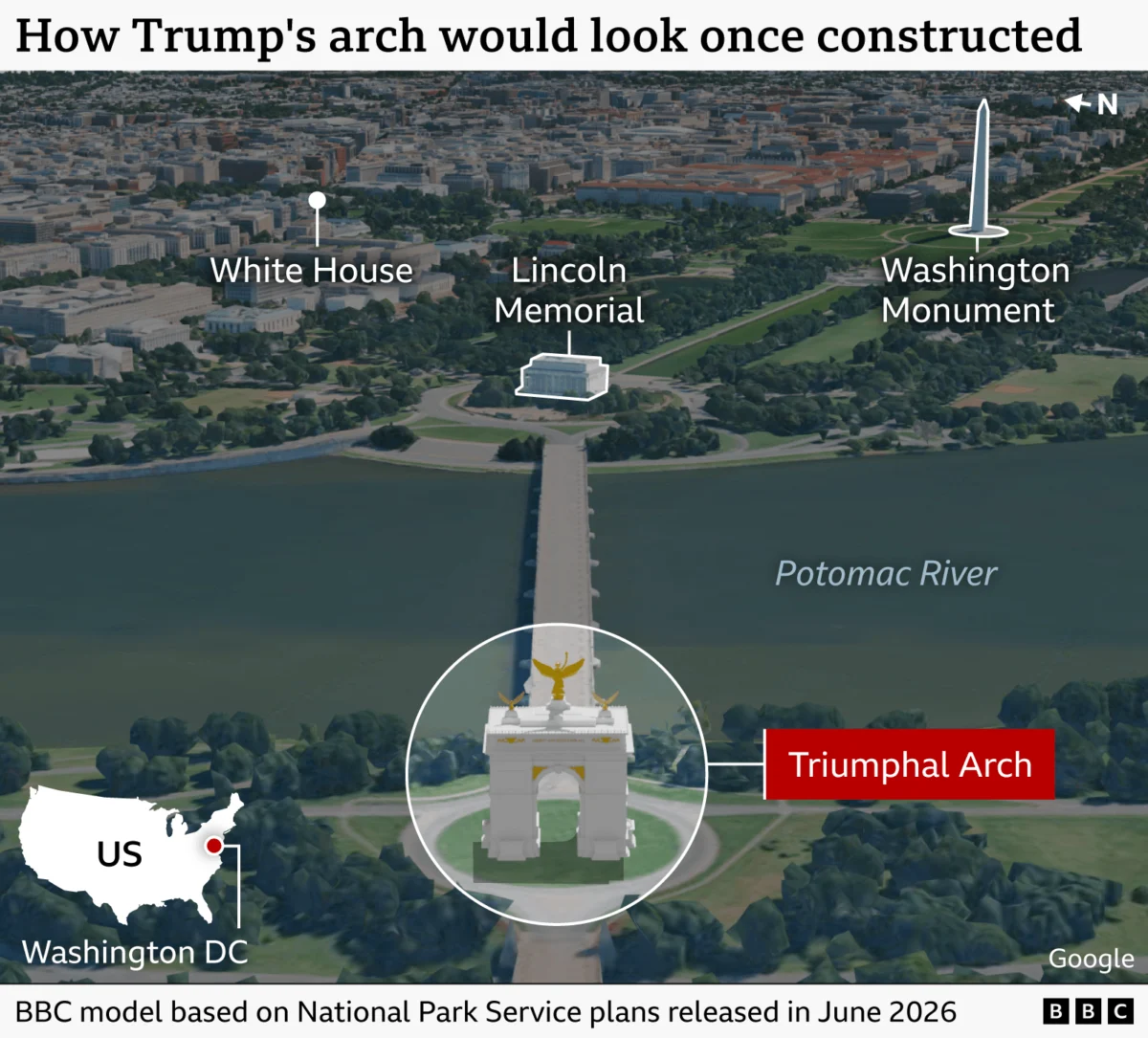
Trump’s initial proposal for a triumphal arch in the Washington D.C. area tapped into this historical tradition, aiming to add a new grand monument to a city already replete with powerful symbols. The renderings from earlier this year showcased a towering structure, planned for a site across the Potomac River from Washington D.C., specifically just outside the solemn grounds of Arlington National Cemetery. The design featured a golden, winged Lady Liberty atop the arch, flanked by two gold eagles, with the inscriptions "One Nation Under God" and "Liberty and Justice for All" emblazoned in gold on its sides. Standing at an impressive 250 feet (76 meters) from its base to the apex of the golden Lady Liberty statue, the arch would significantly dwarf nearby landmarks like the 99-foot Lincoln Memorial and would be approximately half the height of the iconic Washington Monument. This scale alone ensured it would be a dominant feature on the capital’s skyline.
Chronology and Evolution of the Proposal
The idea of a triumphal arch, though its precise origins within Trump’s public discourse are somewhat fluid, gained significant traction and visual representation earlier in the year.
- April [Year implied by context]: Initial design plans and renderings for the 250-foot triumphal arch were publicly circulated. These plans emphasized the arch’s symbolic and aesthetic grandeur, positioning it as a patriotic monument. The proposed location across the Potomac River, near Arlington National Cemetery, was also identified. At this stage, there was no public mention of military functionality.
- [Month of Article Publication] Sunday Morning: Donald Trump posts on Truth Social, announcing the updated plans to incorporate military capabilities into the arch. This marks a dramatic shift from a purely commemorative structure to a dual-purpose architectural and defensive asset. The rationale provided was "strong request" from the U.S. military and "national security purposes."
- [Implied Current Timeline]: Construction was "expected to begin this month" for the original arch design. The impact of the newly announced military modifications on this timeline, and whether new approvals or design phases are required, remains unclear.
This chronological progression highlights a significant re-imagining of the project, moving from a traditional monument to an innovative, albeit controversial, fusion of national symbol and military infrastructure.
Logistical and Regulatory Hurdles: A Complex Path Forward

The transformation of a monumental arch into a sophisticated military complex in such a sensitive location would undoubtedly face a labyrinth of logistical, regulatory, and political challenges. Typically, projects of this scale and nature, especially those involving federal land and military installations, require extensive review and approvals from multiple government bodies.
- Department of Defense (DoD) Response: When contacted for comment, the Department of Defense declined to provide additional details regarding Trump’s claims. This silence could indicate a lack of official endorsement, ongoing internal discussions, or simply an unwillingness to comment on a proposal that may still be in its nascent, unofficial stages. For any military facility, the DoD would conduct rigorous operational assessments, strategic impact studies, and cost-benefit analyses, none of which have been publicly detailed for this arch.
- Congressional Oversight and Funding: A project of this magnitude, particularly one with military components, would necessitate substantial federal funding. This would require congressional appropriation, a process that involves intense scrutiny, debate, and potentially bipartisan support, which could be challenging given the political landscape.
- Urban Planning and Federal Commissions: Washington D.C. and its surrounding areas are subject to strict urban planning and aesthetic regulations. The National Capital Planning Commission (NCPC) and the U.S. Commission of Fine Arts (CFA) are key federal bodies responsible for reviewing and approving construction projects within the capital region, especially those impacting its monumental core and historical integrity. Integrating a military facility of this nature, with its explicit operational requirements for drones and snipers, into such a symbolically charged and aesthetically controlled environment would present unprecedented challenges to these commissions. Issues like visual impact, security perimeters, noise pollution from drones, and public access would all require extensive deliberation.
- Environmental and Community Impact: Any large-scale construction project near the Potomac River and Arlington National Cemetery would trigger comprehensive environmental impact assessments. Concerns from local communities, veterans’ groups, and environmental organizations would also need to be addressed. The proximity to Arlington National Cemetery, a site of profound national reverence, adds another layer of sensitivity to the proposed militarization.
Expert Perspectives and Broader Implications
The proposal has opened a wide array of discussions among experts in architecture, urban planning, national security, and constitutional law.
- Architectural and Urban Planning Concerns: Architects and urban planners might express reservations about the aesthetic and functional integration of overt military features into a symbolic monument. "A triumphal arch is meant to inspire awe and commemorate achievement, not project overt military force in a civilian area," noted an unnamed urban design specialist. The very idea of snipers and drones operating from a structure intended to symbolize "Liberty and Justice for All" could be seen as fundamentally contradictory, potentially undermining the monument’s intended message. Furthermore, the sheer scale of the arch and its potential military components could irrevocably alter the visual character of the D.C. monumental core, an area meticulously preserved for its historical and symbolic significance.
- National Security and Domestic Deployment: Security analysts would weigh the practical utility of such a facility. While the idea of rapid deployment for drones and snipers sounds robust, the strategic value of a fixed, highly visible, and potentially vulnerable installation within or immediately adjacent to the capital is debatable. Modern security protocols often favor distributed, adaptable, and less conspicuous assets. The legal implications of deploying military assets like snipers and drones in a domestic, potentially civilian-populated area also raise questions, particularly concerning the Posse Comitatus Act, which generally restricts the use of the U.S. military for domestic law enforcement purposes. Exceptions exist, but a permanent, publicly known military installation of this kind would represent a novel approach to domestic security.
- Symbolic Messaging: Perhaps one of the most significant implications lies in the symbolism. A monument of triumph, traditionally celebrating unity and national pride, becoming a fortified military outpost sends a complex message. It could be interpreted as a symbol of strength and vigilance in an uncertain world, or, conversely, as a sign of national insecurity and a blurring of the lines between civil and military authority in public spaces. The juxtaposition of "One Nation Under God" and "Liberty and Justice for All" with overt instruments of force raises questions about the values such a structure would ultimately represent.
- Presidential Legacy and Public Works: This proposal also fits into a pattern of ambitious and often controversial construction and renovation projects pursued by Donald Trump. During his second term, he pursued various initiatives to revamp the U.S. capital, including a gilded makeover of the Oval Office, constructing a White House ballroom estimated to cost around $400 million, paving over the White House Rose Garden, and renovating the Lincoln Memorial Reflecting Pool. The triumphal arch, especially with its militarized update, stands out as one of the most audacious and transformative projects he has set his sights on, reflecting a desire for monumental legacy and a distinct aesthetic vision for the nation’s capital.
In conclusion, Donald Trump’s updated proposal for a triumphal arch that doubles as a military complex represents a highly unusual and potentially groundbreaking architectural and strategic endeavor. While the former president frames it as a measure for national security and a unique global facility, the concept immediately invokes profound questions about its feasibility, legality, financial implications, and its ultimate symbolic message within the heart of American democracy. With no official details on construction plans, timing, or the necessary governmental approvals, the future of this ambitious, dual-purpose monument remains highly speculative, poised at the intersection of architectural ambition, military strategy, and political will.