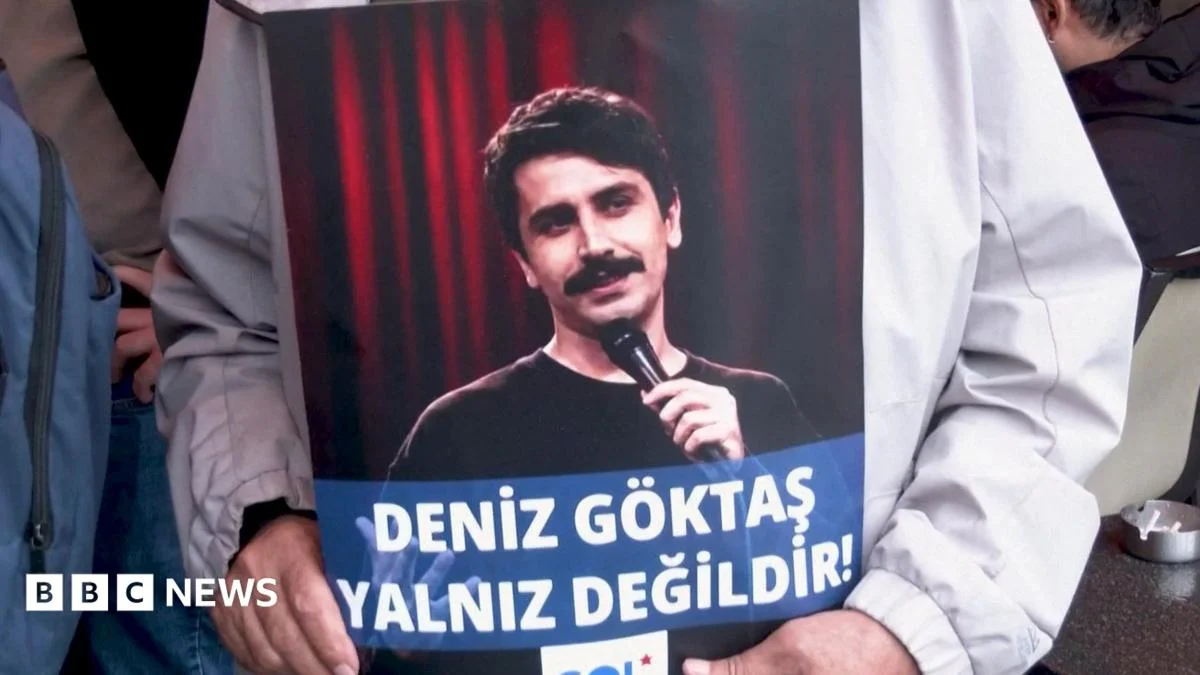
An Istanbul court has delivered a verdict in the high-profile case of popular comedian Deniz Göktaş, convicting him of insulting President Recep Tayyip Erdoğan and imposing a sentence of nearly 19 months in prison. However, the court ordered his immediate release, citing time already served during his pre-trial detention. Despite his release from custody, the court imposed a stringent travel ban, effectively preventing Göktaş from leaving Turkey. This decision, while offering a measure of relief to his supporters, underscores the persistent challenges to freedom of expression in the country, particularly under Article 299 of the Turkish Penal Code, which criminalizes insulting the president. The final legal determination of the case now rests with the court of appeals, where the verdict will be subject to further review.
The Case Against Deniz Göktaş: A Viral Routine and a Legal Battle
Deniz Göktaş, a comedian whose stand-up routines have garnered significant attention, found himself at the center of a legal storm following a performance that went viral on YouTube, accumulating over 15 million views. Prosecutors specifically targeted a line from his routine in which he referred to the Turkish leader as "a shy dictator." Göktaş, who steadfastly denied the charges throughout the proceedings, argued that his comments contained no criminal element. "Dictator is not an insult," he asserted during his defense, "it is a political characterization." This distinction lies at the heart of many freedom of expression cases in Turkey, where the boundaries between satire, political commentary, and criminal insult are frequently contested.
The comedian’s legal troubles escalated rapidly. He was arrested and handcuffed at Istanbul airport in July upon his return from a holiday, an incident that immediately drew widespread criticism from human rights advocates. He subsequently spent 88 days in solitary confinement, a period that he referenced with characteristic humor during his court appearance. "Three months have been taken away from my life," Göktaş quipped on the stand, "but I quit smoking, so I’ll add another three months to my life." This remark reportedly drew laughter and loud applause from those present in the courtroom, demonstrating his resilience and the solidarity of his supporters. Prosecutors had initially sought a much harsher sentence, asking for up to 12 years in prison, a demand that highlighted the severity with which such accusations are often pursued in Turkey.
Chronology of Events: From Stage to Courtroom
The events leading to Deniz Göktaş’s conviction unfold as a stark illustration of the pressures faced by critics in Turkey:
- Early 2023: Deniz Göktaş performs a stand-up routine, which includes the line referring to President Erdoğan as "a shy dictator."
- Spring 2023: The performance is uploaded to YouTube and quickly goes viral, attracting millions of views and sparking public debate.
- July 2023: An investigation is launched based on the complaint regarding the "insulting" comment. Göktaş is arrested at Istanbul airport upon his return from a holiday and subsequently detained.
- July – October 2023: Göktaş spends approximately 88-90 days in pre-trial detention, including a period in solitary confinement.
- October 2023: The first court hearing takes place, where Göktaş denies the charges, arguing his comment was political characterization, not an insult. Prosecutors formally request a sentence of up to 12 years.
- November 2023: The Istanbul court delivers its verdict, convicting Göktaş of insulting the president, sentencing him to nearly 19 months, but ordering his release due to time served. A travel ban is simultaneously imposed.
- Post-Verdict: The case is now set to proceed to the court of appeals for a final decision, a process that can take several months or even years.
The Broader Context: Article 299 and Shrinking Space for Dissent
Deniz Göktaş’s case is not an isolated incident but rather a prominent example within a wider pattern of legal actions taken against individuals perceived to be critical of the government or President Erdoğan. Article 299 of the Turkish Penal Code, which prohibits insulting the president, has been extensively utilized since Erdoğan assumed the presidency in 2014. Critics argue that this law, originally intended to protect the dignity of the office, has been weaponized to silence opposition and curtail freedom of speech.
Supporting data paints a concerning picture:
- Escalating Prosecutions: According to official statistics from the Turkish Justice Ministry, thousands of investigations are launched annually under Article 299. For instance, in 2020 alone, over 31,000 investigations were initiated, leading to more than 7,000 cases and over 3,000 convictions. While not all investigations result in convictions, the sheer volume demonstrates the law’s pervasive application.
- Judicial Independence Concerns: International human rights organizations and bodies like the Council of Europe have repeatedly expressed concerns about the independence of the Turkish judiciary, particularly in cases involving political dissent. The perception that courts are influenced by political considerations further exacerbates fears regarding fair trial rights.
- Freedom of Expression Indices: Turkey consistently ranks low in global freedom of expression and press freedom indices. Reporters Without Borders (RSF), for example, has placed Turkey among the countries with the worst records for press freedom, highlighting the imprisonment of journalists, the closure of media outlets, and the chilling effect of self-censorship.
The crackdown on dissent in Turkey has intensified significantly, particularly in the aftermath of the failed coup attempt in July 2016. The subsequent declaration of a state of emergency led to widespread purges in state institutions, mass arrests, and the closing of numerous civil society organizations and media outlets. This period saw a dramatic erosion of democratic freedoms, with human rights groups documenting extensive abuses. The targets of these actions have been diverse, including journalists, academics, human rights campaigners, student protesters, LGBTQ+ activists, and opposition politicians. The reference in the original article to "prisons are full in Turkey these days" is a stark, albeit anecdotal, reflection of this reality, symbolizing the vast number of individuals detained for various alleged offenses, many of which relate to expressions of dissent. The ongoing legal battles faced by figures like the elected Mayor of Istanbul, Ekrem İmamoğlu, further illustrate the reach of these measures into the political opposition.
Reactions and Implications: A Mixed Verdict
The verdict in Göktaş’s case elicited a range of reactions, primarily relief mixed with ongoing concern. Firat Aksal, a fellow comedian and supporter, expressed profound surprise and happiness at the outcome. "We hardly know what to do with our happiness," he stated, adding, "We are thrilled. To be honest, we weren’t hopeful of getting a fair trial." This sentiment underscores the prevailing skepticism about judicial fairness in politically sensitive cases among many in Turkey. Aksal also indicated that Göktaş planned to rest and reunite with his family before returning to the stage, suggesting an immediate desire to resume his artistic work despite the legal ordeal.
However, the imposition of a travel ban casts a shadow over Göktaş’s release. While he is no longer physically incarcerated, the ban restricts his fundamental right to freedom of movement, limiting his professional opportunities and personal liberty. This measure is often employed in Turkey for individuals under ongoing legal scrutiny or those deemed a flight risk, but in cases involving political expression, it can also serve as a continued form of control and punishment.
Broader Impact and Implications:
- Chilling Effect vs. Resilience: The conviction, even with time served, reinforces the "chilling effect" on freedom of expression, especially for comedians, satirists, and critics. The message is clear: criticizing the president carries significant legal risks. Yet, Göktaş’s defiance and his immediate intention to return to the stage also signal a degree of resilience among artists and activists.
- International Scrutiny: Cases like Göktaş’s draw renewed attention from international bodies and human rights organizations, further highlighting concerns about Turkey’s human rights record and its adherence to democratic norms. The European Union, for instance, frequently cites such cases in its annual progress reports on Turkey’s accession process, impacting diplomatic relations and potential for closer integration.
- The Role of Satire: The case reignites debates about the role of satire in a democratic society. While some argue that all leaders should be open to critical humor, others contend that such humor can cross into defamation, especially in cultures that value respect for authority. Göktaş’s defense, differentiating "dictator" as a political characterization rather than an insult, is a crucial legal argument that could influence future cases.
- Judicial Precedent: The court of appeals’ final decision will be significant. If the conviction is upheld, it will solidify the interpretation of Article 299 as broadly encompassing political commentary, even when presented as satire. If overturned, it could offer a glimmer of hope for a more liberal interpretation of freedom of expression.
- Political Climate: The ongoing prosecution of critics contributes to a political climate where open debate is stifled, and self-censorship becomes prevalent. This can hinder democratic discourse and the ability of citizens to hold their leaders accountable, thereby impacting the overall health of Turkey’s democratic institutions.
While Deniz Göktaş’s release from prison is a welcome development for his supporters, the conviction and the travel ban serve as potent reminders of the precarious state of freedom of expression in Turkey. His case remains a pivotal symbol in the ongoing struggle between artistic liberty and the expansive application of laws designed to protect state officials from criticism, a struggle that continues to shape the country’s social and political landscape.