The United States has once again reaffirmed its dominance in the Presidents Cup, staging a remarkable comeback on the final day of singles matches to defeat the International team and secure their eleventh consecutive victory in the biennial team competition. The hosts, a formidable assembly boasting eight of the world’s top eleven ranked players, entered Sunday’s pivotal showdown trailing by three points. The prospect of avoiding just their second defeat in the tournament’s 32-year history loomed large, adding an extra layer of intensity to the proceedings at Medinah Country Club, a venue etched in golf lore for its own dramatic Ryder Cup turnaround in 2012.
A Dominant Sunday Surge
On Sunday, the American contingent unleashed a relentless surge, winning nine of the twelve available singles matches. This overwhelming performance culminated in a decisive 17-13 victory, a testament to their resilience and the unwavering support of the home crowd. The pressure was palpable, with the outcome hanging precariously in the balance for much of the day.
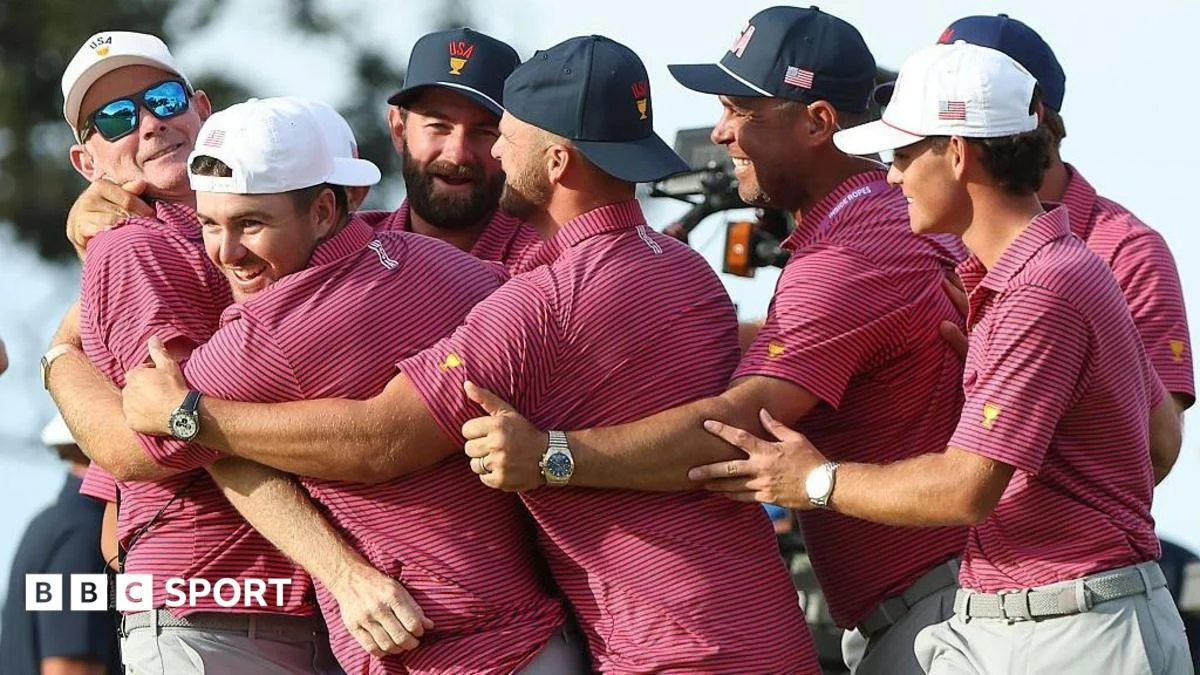
The decisive moment arrived with Jacob Bridgeman, who secured the winning point for the United States. With the match against Australia’s Min Woo Lee reaching its climax, Bridgeman calmly sank a four-foot par putt on the 18th hole, clinching a hard-fought one-up victory and igniting jubilant celebrations among his teammates and supporters. His clutch performance underscored the depth of talent and the fighting spirit present within the American squad.
Beyond Bridgeman’s heroics, the United States witnessed stellar performances from a host of its star players. Cameron Young, Justin Thomas, World Number 1 Scottie Scheffler, Chris Gotterup, Collin Morikawa, Patrick Cantlay, Xander Schauffele, and Jackson Koivun all contributed crucial points to the team’s triumphant tally. Each victory, regardless of margin, was vital in chipping away at the initial deficit and building the momentum necessary for the ultimate comeback.
Echoes of Past Dramas at Medinah
The choice of Medinah Country Club as the venue proved to be a poignant one. This storied course famously hosted the 2012 Ryder Cup, where a European team, captained by José María Olazábal, mounted an improbable comeback to defeat the United States in what is now known as the "Miracle at Medinah." The echoes of that historic event undoubtedly resonated through the fairways and greens as the American team navigated their own path to redemption.
US Captain Brandt Snedeker, who was a member of the American team that suffered that demoralizing Ryder Cup defeat in 2012, drew a direct parallel to the current triumph. "I told the guys last night that funny stuff happens here," Snedeker remarked, reflecting on the historical significance of the venue. "Medinah’s got a history of funny things happening." He emphasized the collective effort and unwavering commitment of his players, stating, "All these guys fought for each other, fought for this country, fought for this team." His words highlighted the unifying power of team competition and the pride associated with representing the United States.
International Perspective: A Close Call
Despite the eventual outcome, the International team, led by captain Geoff Ogilvy, displayed significant grit and determination. Ogilvy acknowledged the formidable challenge posed by the American squad, stating, "The US team came out firing, we knew they would." He described the contest as being "on a knife edge all day," underscoring how small margins could have drastically altered the final result.
"If some of those one downs we had out there had flipped to one up, the numbers looked really good and who knows what momentum that could give," Ogilvy mused, highlighting the fine line between victory and defeat in such closely contested events. His candid assessment provided insight into the strategic battles and the psychological swings that characterized the final day of matches. The International team, comprised of players from diverse golfing backgrounds, consistently proves to be a resilient opponent, often punching above its weight against a more star-studded American roster.
Historical Context of the Presidents Cup
The Presidents Cup, established in 1994, serves as a unique team golf competition that pits the United States against an International team comprising players from outside of Europe. Unlike the Ryder Cup, which features a European contingent, the Presidents Cup offers a platform for golfers from countries such as Australia, Canada, Japan, South Africa, and others to compete against the perennial powerhouse of American golf. The tournament is contested over four days, with a format that includes foursomes, fourballs, and singles matches.
The United States has enjoyed an almost unbroken period of dominance since the competition’s inception. Their victory at Medinah marks the eleventh consecutive triumph, extending a remarkable streak that began in 1996. The lone exception to this American hegemony was a tie in 1998, which, under the rules at the time, resulted in the cup being retained by the defending champions. This enduring success underscores the consistent strength and depth of American professional golf.
The Spectacle of Team Golf
Team golf events like the Presidents Cup offer a distinct flavor compared to individual stroke play tournaments. The camaraderie, strategic partnerships, and the pressure of playing for a team rather than solely for oneself create an electrifying atmosphere. The Presidents Cup, in particular, often highlights the diverse personalities and nationalities within the International squad, fostering a sense of global representation in the sport.
The format of the Presidents Cup, with its mix of alternate shot (foursomes), best ball (fourballs), and head-to-head singles matches, allows for various strategic approaches and creates opportunities for dramatic swings in momentum. The early sessions, typically foursomes and fourballs, are crucial for establishing an early lead or staying within striking distance, setting the stage for the high-stakes singles matches on the final day.
Presidential Presence and Support
Adding to the occasion, United States President Donald Trump was in attendance, serving in his role as honorary chairman. His presence underscored the national significance often attached to such sporting events, and he was observed greeting players and delivering a pre-match speech, aiming to galvanize the American team. The involvement of high-profile figures often amplifies the visibility and prestige of these competitions.
Analysis of Implications: Continued American Ascendancy
The United States’ eleventh consecutive Presidents Cup victory solidifies their position as the preeminent force in team golf. This sustained success speaks to the consistent development of top-tier talent within American golf and the strategic advantage of competing on home soil. While the International team consistently demonstrates remarkable spirit and skill, the depth of American talent, particularly among the world’s top-ranked players, has proven exceptionally difficult to overcome.
For the International team, the close nature of the contest, despite the final margin, offers a glimmer of hope. Captain Ogilvy’s observations about crucial putts flipping the momentum highlight the fine margins that separate victory and defeat. Continued investment in player development and strategic preparation will be key for the International squad as they aim to break the American stranglehold in future editions.
The Presidents Cup, beyond its competitive aspect, serves as a vital platform for promoting golf globally and fostering goodwill between nations. The drama, sportsmanship, and high-level play witnessed at Medinah once again underscored the enduring appeal of team golf and its ability to captivate audiences worldwide. As the United States celebrates yet another triumph, the International team will undoubtedly be regrouping, analyzing their performance, and preparing to challenge for the coveted trophy in the years to come. The history of this competition suggests that while dominance can be sustained, the pursuit of victory by the challengers remains a compelling narrative in itself.