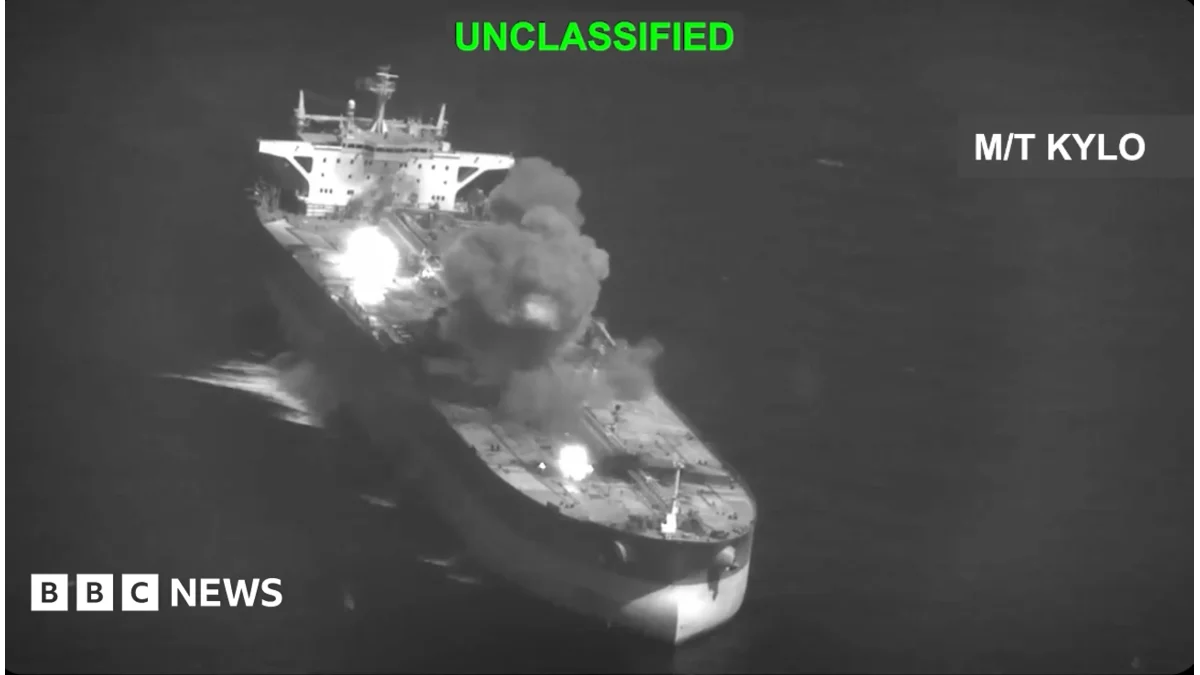
The United States military has confirmed it struck three Iran-linked oil tankers in the Gulf of Oman and near Kharg Island, a direct retaliation for what it described as Iranian ballistic missile attacks targeting two American Navy warships in the region. This sequence of events, unfolding over the past week, signals a sharp escalation in the long-standing hostilities between Washington and Tehran, raising alarms about regional stability and the safety of international maritime trade routes.
The Retaliatory Strikes: A Detailed Account
According to a statement issued by US Central Command (Centcom) on Saturday, the American forces executed precision strikes against the Iranian vessels. One tanker, operating near Iran’s strategically vital Kharg Island, was reported to have been "permanently disabled." Simultaneously, another tanker in the Gulf of Oman, near the Iranian port of Jask, also suffered permanent disabling damage. A third vessel, also located in the Gulf of Oman, was "completely destroyed" by the US military action. Defence Secretary Pete Hegseth, in a stark message posted on social media, articulated the US rationale: "It’s simple: if Iran shoots at US ships, we will destroy (and sink) their oil tankers." This unequivocal declaration underscores a shift towards a more direct and economically punitive response strategy from the United States.
Iranian state media, including the Islamic Republic of Iran Broadcasting (IRIB), corroborated the US accounts of strikes on three of its oil tankers, specifically confirming the attack on a vessel near Kharg Island. IRIB reported that there were no casualties in the Kharg Island incident, noting that the tanker’s cooling system effectively extinguished the resulting fire within approximately an hour. For the two tankers attacked in the Gulf of Oman, IRIB stated that their crews were safely evacuated to shore via lifeboats. One of these vessels was reported to be empty, while the other was carrying a cargo of oil, details that could influence the environmental and economic fallout, depending on the specifics of the damage. Notably, Tehran’s official channels did not immediately acknowledge or comment on the alleged Iranian attacks on US warships that precipitated the American retaliation.
Centcom, which oversees US military operations across the Middle East, asserted that its forces had "successfully evaded" multiple ballistic missile attacks launched by the Islamic Revolutionary Guard Corps (IRGC). These Iranian missiles were reportedly aimed at a US aircraft carrier and a guided-missile destroyer operating in the region. Crucially, Centcom confirmed that no American troops were harmed during these engagements. Admiral Brad Cooper, Centcom’s commander, issued a stern warning in a statement on Saturday, emphasizing the punitive nature of the US response: "Let the message to the IRGC be clear: If you shoot at two of our ships, we will impose an even higher economic cost – taking out three of yours." He further vowed, "We will not hesitate to defend American forces, and if necessary, destroy Iran’s limited and exposed oil fleet." Centcom elaborated that the targeted Iranian oil tankers were considered "part of a multi-billion-dollar shadow network that funds the IRGC and its regional proxies," thereby framing the strikes as a direct blow to the financial infrastructure supporting Iran’s regional influence.
Escalating Tensions: A Recent Timeline
The current wave of hostilities represents a significant break from a recent period of relative calm, or at least less overt confrontation, between the two adversaries. The US strikes on the Iranian tankers come less than a week after the United States itself resumed offensive actions in the region. On the preceding Sunday, American forces conducted strikes against two rocket launchers, citing intelligence that they were poised to be used for deploying naval mines in the Strait of Hormuz, a critical international waterway. This preemptive action highlights the ongoing cat-and-mouse game between US and Iranian forces, particularly concerning control and access within strategic maritime choke points.
Over the past year, the Gulf region has witnessed a series of incidents, including tanker seizures, drone attacks, and intermittent confrontations between naval forces, all contributing to a volatile environment. These events are often framed within the broader context of the US "maximum pressure" campaign against Iran, initiated following the US withdrawal from the Joint Comprehensive Plan of Action (JCPOA), commonly known as the Iran nuclear deal, in 2018. The campaign involves stringent sanctions aimed at crippling Iran’s economy, particularly its oil exports, to force Tehran to renegotiate a more comprehensive agreement on its nuclear program and regional activities. Iran, in turn, has often responded with actions designed to demonstrate its capacity to disrupt regional energy supplies and challenge US dominance, often through its proxy forces and unconventional warfare tactics. This latest exchange of direct fire and economic targeting marks a worrying shift towards a more overt and dangerous phase of this long-running standoff.
The Geopolitical Chessboard: Understanding the Stakes
The geographical locations of these latest incidents underscore their profound strategic significance. Kharg Island, a small rocky outcrop situated merely 15 nautical miles (24 kilometers) off the Iranian mainland, serves as the primary export terminal for approximately 90% of Iran’s crude oil. This critical facility receives oil via pipelines from mainland production fields, making it an indispensable artery for Iran’s economy. Any disruption to operations at Kharg Island or to the tankers servicing it has immediate and severe economic implications for Tehran, particularly under the burden of international sanctions that have already significantly curtailed its oil revenues. Prior to the re-imposition of sanctions, Iran was capable of exporting over 2 million barrels per day (bpd); current estimates place its exports significantly lower, often below 500,000 bpd, largely reliant on covert shipping networks.
The Gulf of Oman, where two of the three tankers were hit, is the gateway to the Strait of Hormuz. This narrow waterway, at its most constricted point only 21 miles wide, is arguably the world’s most important oil transit chokepoint. An estimated 20% of global petroleum consumption, amounting to around 21 million barrels of oil per day, passes through the Strait of Hormuz. This includes crude oil, refined petroleum products, and liquefied natural gas (LNG). Any perceived threat to shipping through the Strait invariably triggers global alarm, impacting oil prices and prompting international calls for restraint. The IRGC, Iran’s elite military and ideological force, plays a significant role in projecting Iranian power, both domestically and regionally. Its naval arm frequently conducts exercises in the Strait and has been involved in numerous confrontations and incidents with commercial shipping and foreign naval forces. Centcom’s assertion that the targeted tankers were part of a "multi-billion-dollar shadow network" funding the IRGC highlights the intricate web of illicit finance that Tehran allegedly uses to circumvent sanctions and support its regional proxies, including groups in Yemen, Iraq, Syria, and Lebanon. The US Fifth Fleet, headquartered in Bahrain, maintains a substantial naval presence in the region precisely to deter such activities, ensure freedom of navigation, and protect US interests.
Navigating International Waters: Legal and Security Implications
The legality and implications of these strikes in international waters or near territorial boundaries are complex and subject to differing interpretations under international law. The United States asserts its right to self-defense against attacks on its military assets. However, retaliatory strikes on commercial vessels, even those allegedly linked to a military organization, raise questions about proportionality and the targeting of civilian infrastructure. International maritime law generally protects commercial shipping, and direct attacks on such vessels, regardless of their ownership, can be highly contentious. This incident is likely to be scrutinized by international bodies and maritime organizations, particularly regarding the potential precedent it sets for future engagements.
Beyond the legal debate, the immediate security implications for commercial shipping in the Gulf region are severe. Ship owners and operators are likely to face soaring insurance premiums, increased security costs, and potential reluctance from crews to operate in such a high-risk environment. The potential for miscalculation or accidental escalation, particularly given the close proximity of naval forces from multiple nations in a confined waterway, remains a paramount concern. Maritime traffic through the Strait of Hormuz and the broader Gulf of Oman is a continuous, dense flow, making any military engagement inherently dangerous for non-combatant vessels.
Global Responses and Diplomatic Silence
Official reactions from the international community have begun to emerge, though many nations are likely to adopt a cautious stance given the volatility of the situation. While Iran confirmed the attacks on its tankers, its silence regarding the alleged missile launches against US warships is notable. This non-acknowledgement could be a tactic to avoid direct admission of responsibility for an act of aggression that would justify the US retaliation, or it could indicate an internal debate within Tehran about how to frame the incident. However, should Iran choose to officially protest the strikes, it would likely do so through the United Nations or other diplomatic channels, condemning the US action as an act of aggression against its economic assets.
US allies in the region, such as Saudi Arabia and the United Arab Emirates, while typically supportive of US efforts to counter Iranian influence, will also be wary of a broader regional conflict that could destabilize their own economies and security. European nations, traditionally advocates for diplomatic solutions and the preservation of the JCPOA, are expected to call for de-escalation from both sides. The United Nations Secretary-General and other international bodies will likely issue statements urging restraint and the avoidance of further actions that could exacerbate tensions in an already fragile region. Energy market analysts, meanwhile, have already begun to factor in the increased geopolitical risk. While initial oil price surges may be contained by global supply dynamics, sustained escalation or direct disruption to the Strait of Hormuz could lead to significant and prolonged increases in crude oil futures, impacting global energy consumers.
The Ripple Effect: Economic, Regional, and Geopolitical Ramifications
The destruction and disabling of three oil tankers represent a direct and significant economic blow to Iran. Even if the vessels were part of a "shadow network," their loss still impacts Iran’s capacity to export oil and generate much-needed revenue, further straining an economy already reeling under sanctions. The psychological impact on Iran’s shipping sector, which often struggles to secure insurance and financing due to sanctions, will also be considerable. This incident could lead to increased reluctance from third parties to engage in trade with Iran, fearing secondary sanctions or direct military targeting.
Regionally, the strikes amplify the risks of a wider conflict. The tit-for-tat nature of the attacks – Iranian missiles on US ships, US strikes on Iranian tankers – sets a dangerous precedent for future engagements. Proxy groups aligned with Iran across the Middle East could be emboldened or instructed to escalate their own activities, potentially targeting US interests or those of its allies in Iraq, Syria, or Yemen. This could destabilize already volatile states and further entrench the region in proxy warfare.
Geopolitically, the incident tests the limits of deterrence and the parameters of engagement between a superpower and a regional power. The US has demonstrated its willingness to use military force to protect its assets and impose economic costs, but this strategy carries inherent risks of unintended consequences. Iran’s response will be closely watched, as Tehran often seeks to project strength and resist what it perceives as foreign aggression. The involvement of a "shadow network" complicates the narrative, allowing both sides to frame their actions in terms of national security and countering illicit activities. The broader international community faces the challenge of encouraging de-escalation without validating either side’s aggressive actions, navigating a complex web of alliances, economic interests, and security concerns.
A Precarious Balance: The Path Forward
The recent exchange of hostilities between the United States and Iran represents a dangerous inflection point in their enduring rivalry. The direct targeting of military assets and economic infrastructure underscores the heightened stakes and the potential for rapid escalation. While both sides likely wish to avoid a full-scale war, the current pattern of retaliatory strikes increases the risk of miscalculation or an unintended confrontation spiraling out of control. The stability of global energy markets, the safety of international shipping, and the broader security architecture of the Middle East all hang in a precarious balance. Moving forward, diplomatic channels, however strained, will be crucial in preventing further escalation and exploring potential avenues for de-escalation, even as the immediate focus remains on securing regional waterways and assessing the full ramifications of these latest, alarming developments.