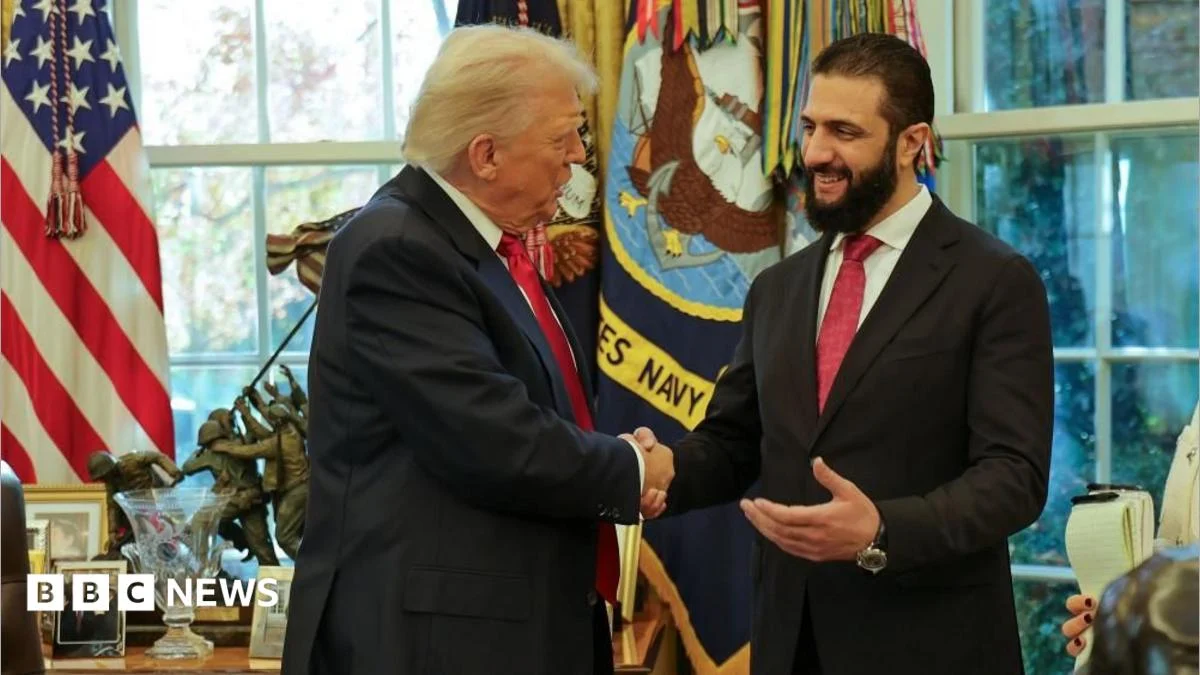
The United States has officially removed Syria from its list of state sponsors of terrorism, a landmark decision that concludes a 47-year designation and is poised to dismantle what Washington describes as the "final major barriers" to private sector investment and the country’s broader reintegration into the global economy. This profound policy shift, announced on Monday by Secretary of State Marco Rubio, represents a dramatic reorientation of American engagement in the Middle East and a calculated bet on the transitional government led by President Ahmed al-Sharaa, a former militant leader who once had a substantial American bounty on his head.
Secretary Rubio stated that the decision was a direct acknowledgment of the Syrian government’s proactive and verifiable measures to unequivocally distance itself from acts of international terrorism. This assessment follows a period of intense diplomatic engagement and a reevaluation of the strategic landscape in Syria. The Trump administration has fully embraced President al-Sharaa, who ascended to power following the successful rebel offensive in late 2024 that overthrew the long-standing regime of Bashar al-Assad. Simultaneously, Hayat Tahrir al-Sham (HTS), al-Sharaa’s Islamist group, which now dominates the transitional administration, was also formally removed from the US list of global terrorist organizations.
A Decades-Long Designation and its Ramifications
Syria’s placement on the US list of state sponsors of terrorism dates back to 1979, a period marked by heightened Cold War tensions and complex regional geopolitics. The designation was initially imposed due to the Ba’athist regime’s support for various Palestinian militant groups and its alleged involvement in acts of international terrorism. Over the decades, this listing served as a powerful instrument of US foreign policy, imposing a stringent array of financial sanctions, prohibiting US foreign aid, and restricting defence exports and sales to Syria. Furthermore, it empowered the US Treasury to penalize individuals and entities, including other nations, that engaged in significant trade or financial transactions with the sanctioned state.
The consequences for Syria were profound, contributing significantly to its economic isolation, stifling foreign direct investment, and hindering its development. The designation effectively cut Syria off from much of the international financial system, making it exceedingly difficult for businesses to operate or for the government to secure loans and aid from international bodies. While some limited humanitarian exceptions were occasionally granted, the overarching framework ensured Syria remained an international pariah in the eyes of the US and its allies. Its removal now marks a pivotal moment, signaling a potential new chapter for a nation devastated by more than a decade of civil conflict and economic hardship.
The Transformation of HTS and Ahmed al-Sharaa
The trajectory of Ahmed al-Sharaa and his group, HTS, is central to understanding this dramatic US policy reversal. HTS, formerly known as al-Nusra Front, initially emerged as al-Qaeda’s official affiliate in Syria during the early stages of the civil war. Its early years were characterized by a brutal jihadist ideology and a prominent role in various anti-Assad offensives, often alongside other hardline Islamist factions. This history led to its designation as a Foreign Terrorist Organization (FTO) by the US and its leader, al-Sharaa (then known by his nom de guerre Abu Mohammad al-Jolani), being listed as a Specially Designated Global Terrorist (SDGT), with a multi-million dollar bounty on his head.
However, a significant turning point occurred in 2016 when al-Nusra Front publicly announced its severance of ties with al-Qaeda, rebranding itself as Jabhat Fateh al-Sham and later evolving into Hayat Tahrir al-Sham. This move, while initially met with skepticism by many international observers who viewed it as a tactical rebranding, was accompanied by a gradual shift in strategy. Under al-Sharaa’s leadership, HTS began to focus more intensely on local governance in areas under its control, particularly in Idlib province, establishing civil administrations, providing services, and attempting to portray itself as a more pragmatic, nationalist force rather than a global jihadist entity. This transformation involved cracking down on more extremist factions within its territories and engaging with local populations, albeit often through authoritarian means.
The US began to cautiously acknowledge these shifts in late 2023. This culminated in the revocation of HTS’s FTO designation and the removal of al-Sharaa from the SDGT list, as previously reported. These actions laid the groundwork for the more expansive decision to delist Syria itself. US officials privately indicated that extensive intelligence assessments confirmed HTS’s genuine disengagement from al-Qaeda’s global agenda and its increasing focus on a local, albeit Islamist, governance model. The group’s decisive military campaign in late 2024, which ultimately led to the collapse of the Assad regime and the establishment of a transitional government under al-Sharaa, provided a concrete demonstration of its military and administrative capabilities.
Chronology of a Strategic Shift:
- 1979: Syria is added to the US list of State Sponsors of Terrorism due to its support for various militant groups.
- 2011: Syrian Civil War erupts, leading to the rise of numerous armed factions, including al-Nusra Front.
- 2012: Al-Nusra Front is established as al-Qaeda’s affiliate in Syria.
- 2013: The US designates al-Nusra Front as a Foreign Terrorist Organization (FTO) and places a bounty on its leader, Abu Mohammad al-Jolani (Ahmed al-Sharaa).
- July 2016: Al-Nusra Front publicly announces its break from al-Qaeda, rebranding as Jabhat Fateh al-Sham, and later evolving into Hayat Tahrir al-Sham (HTS).
- Late 2023: The US revokes HTS’s FTO designation and removes Ahmed al-Sharaa from its list of Specially Designated Global Terrorists (SDGTs), signaling a re-evaluation of the group’s nature.
- July [Current Year – 2025]: US officials, including Secretary Rubio, begin to publicly flag the potential removal of Syria from the SST list, citing ongoing positive developments.
- Late 2024: HTS leads a broad rebel offensive that culminates in the overthrow of President Bashar al-Assad and the establishment of a transitional administration with Ahmed al-Sharaa as its head.
- [Current Date]: The US formally removes Syria from the list of State Sponsors of Terrorism.
Official Reactions and Hopes for Stability
US Treasury Secretary Scott Bessent echoed Rubio’s sentiments, stating, "Today’s action will help foster additional investment in Syria to promote political and economic stability." This underscores the Biden administration’s dual objectives: to stabilize a war-torn nation and to prevent it from becoming a renewed breeding ground for extremism or a destabilizing proxy battleground.
Syrian Foreign Minister Asaad Hassan al-Shaibani greeted the news as a "historic step," according to state-run news agency SANA. In his statement, al-Shaibani affirmed, "We will continue working to remove the effects of isolation and create an environment based on transparency, mutual interests and respect." This official Syrian response highlights the new government’s eagerness to shed the legacy of isolation and engage with the international community, particularly on economic terms.
Broader Impact and Implications
The removal of Syria from the state sponsors of terrorism list carries significant geopolitical, economic, and security implications, both regionally and globally.
Economic Reintegration and Reconstruction:
The immediate and most tangible impact is economic. With the lifting of sanctions, Syria is now theoretically open for international business. The country’s infrastructure has been decimated by years of war, with estimates of reconstruction costs ranging from $250 billion to over $400 billion. Sectors such as energy (oil and gas), infrastructure development (roads, bridges, housing, power grids), agriculture, and light manufacturing are ripe for investment. International financial institutions, previously unable to engage, may now consider aid and development projects, potentially unlocking billions in funding. However, challenges remain substantial, including widespread corruption, a nascent legal framework, the ongoing need for security sector reform, and the complex issue of property rights for millions of displaced Syrians. While the US hopes for a "path to prosperity," the journey will be arduous and protracted.
Geopolitical Realignments:
A core motivation for the US in this strategic pivot is to draw Syria into its orbit, countering the entrenched influence of Russia and China, who have been key allies of the Assad regime. For Moscow, Syria represented a crucial military outpost in the Mediterranean and a significant geopolitical lever. Beijing has viewed Syria as a potential node in its Belt and Road Initiative. The US move aims to diminish their sway by offering a Western-backed pathway to recovery.
- Russia and China: This decision represents a significant setback for their long-standing support of the Assad regime and their strategic interests in Syria. While they may seek to adapt and engage with the new government, their exclusive influence is likely to wane as Western investment and diplomatic presence increase.
- Iran: The delisting is a major blow to Iran’s "axis of resistance," which relied heavily on Syria as a crucial land bridge for projecting power and supplying proxies like Hezbollah. The new Syrian government, while pragmatic, is less likely to be a willing conduit for Iranian expansionism, potentially forcing Tehran to recalibrate its regional strategy.
- Israel: While the overthrow of Assad removes a long-standing adversary, Israel views the new Syrian reality with a mixture of caution and strategic recalculation. The presence of HTS, an Islamist group, as the dominant force in Syria raises long-term security questions. However, a stable, less Iranian-influenced Syria could reduce direct threats from its northern border. Dialogue and de-escalation mechanisms will be crucial.
- Turkey: Turkey has long sought to secure its southern border and address the Kurdish question in Syria. The new Syrian government, while perhaps less overtly hostile than Assad’s, still presents a complex partner. Opportunities for cooperation on border security and refugee return exist, but potential for friction over territorial control and influence remains.
- European Union and Arab League: This development could pave the way for broader normalization efforts, the return of Syrian refugees, and increased humanitarian and development aid from European nations and Arab states, many of whom had been wary of engaging with the Assad regime.
Security and Governance Challenges:
Despite the optimistic pronouncements, the risks associated with this policy shift remain significant. Syria is still far from secure, with various armed groups operating within its borders and the potential for renewed conflict. The nature of the transitional government, dominated by HTS, raises concerns about long-term democratic governance, human rights, and inclusivity. While HTS has rebranded, its Islamist ideology and past record will be closely scrutinized by human rights organizations and international bodies. The US strategy is a calculated gamble that economic engagement and diplomatic support can steer al-Sharaa’s administration towards a more representative and stable future.
The Remaining Three:
Syria’s removal leaves just three countries on the US list of state sponsors of terrorism: Cuba (re-listed in 2021), North Korea (re-listed in 2017), and Iran (listed in 1984). This reduction highlights the exceptional nature of the Syrian decision and may lead to renewed scrutiny of the criteria for these remaining designations, particularly as global geopolitical dynamics continue to evolve.
In conclusion, the US decision to remove Syria from its list of state sponsors of terrorism after 47 years is not merely a bureaucratic adjustment but a profound strategic reorientation. It signifies a willingness to engage with a former adversary, even one led by a controversial figure, in pursuit of broader regional stability and reduced rival influence. While the "path to prosperity" is fraught with challenges, this move unequivocally opens the door for Syria to begin rebuilding its shattered economy and re-engaging with the global community, under the watchful eye of a world eager to see if this audacious gamble will yield the desired dividends of peace and stability.