The Engineering Legacy of Hans Mezger
To understand the significance of the Mezger flat-six, one must first look at the career of the man who gave the engine its name. Hans Mezger, who joined Porsche in the late 1950s, was instrumental in developing some of the most successful racing engines in history, including the air-cooled flat-eight for the Porsche 804 Formula 1 car and the 1,100-horsepower turbocharged flat-12 that powered the 917/30 in the Can-Am series.
The specific lineage referred to as the "Mezger engine" in modern parlance, however, traces its roots to the water-cooled unit developed for the Porsche 911 GT1. Unlike the standard M96 and M97 engines found in the contemporary 996 and 997 Carrera models, which featured an integrated dry-sump design and a two-piece crankcase, the Mezger engine utilized a true dry-sump system and a three-piece crankcase derived from the air-cooled 964 and 993 architectures. This design allowed for superior oil scavenging under high lateral G-forces—a critical requirement for sustained track performance—and avoided the reliability concerns, such as intermediate shaft (IMS) bearing failures, that affected the standard production engines of the late 1990s and early 2000s.
From Le Mans to the Showroom: The 911 GT1 Connection
The transition of the Mezger engine from a pure racing prototype to a road-legal powerhouse is a pivotal chapter in Porsche’s history. In 1998, Porsche achieved its 16th overall victory at the 24 Hours of Le Mans with the 911 GT1-98. The heart of this victory was a 3.2-litre, twin-turbocharged flat-six. When Porsche decided to launch the 911 GT3 for the 996 generation, they opted to use the GT1’s bottom end rather than the engine from the standard 911 Carrera.
This decision was driven by the need for a high-revving, naturally aspirated unit that could survive the rigors of competition. The resulting 3.6-litre engine produced 360 horsepower (later increased to 381 hp in the 996.2) and featured a redline of 7,800 RPM. This architecture served as the foundation for every GT3 and GT2 model through the 997 generation, as well as the 996 and 997.1 Turbo models. The reliability of the Mezger block was such that it could withstand massive boost pressures in the Turbo and GT2 variants, often being tuned by aftermarket firms to exceed 800 horsepower without internal modifications.
Technical Architecture: The Split Crankcase and Oil Management
The primary technical differentiator of the Mezger engine is its crankcase. In a standard Porsche M96 engine, the cylinders and the crankcase are integrated, which can lead to structural flex under extreme loads. The Mezger engine uses a split-case design where the cylinders are separate from the main block. This allows for the use of more robust materials and provides a much stiffer foundation for the rotating assembly.
Furthermore, the external oil tank and multi-pump dry-sump system ensure that the engine remains lubricated regardless of the cornering force. In a traditional wet-sump or "integrated" dry-sump engine, oil can slosh away from the pickup tube during hard cornering, leading to momentary oil starvation and catastrophic engine failure. The Mezger design’s ability to maintain consistent oil pressure made it the engine of choice for Porsche’s Supercup and Carrera Cup series globally, where engines were expected to run thousands of track miles with minimal maintenance.
A Chronology of Performance Evolution
The Mezger engine underwent several significant evolutions between its debut in the 1999 911 GT3 and its final application in 2011.
- The 3.6-Litre Era (1999–2005): Featured in the 996 GT3 and the 996 Turbo. The Turbo variant introduced VarioCam Plus, which adjusted valve timing and lift to optimize torque and fuel efficiency, while the GT3 focused on lightweight internals and high RPMs.
- The 997 Generation (2006–2009): The displacement remained 3.6 litres for the GT3 but power jumped to 415 hp. The 997.1 Turbo also utilized the 3.6L Mezger unit, marking the last time a Porsche Turbo model would use this specific racing architecture.
- The 3.8-Litre Expansion (2010–2011): For the 997.2 GT3, Porsche bored out the engine to 3.8 litres, incorporating center-lock wheels and improved aerodynamics. Power rose to 435 hp, and the redline was pushed to 8,500 RPM.
- The 4.0-Litre Masterpiece (2011): The final evolution of the Mezger engine was found in the 911 GT3 RS 4.0. Using the crankshaft from the RSR race car, this engine produced 500 hp—a staggering 125 hp per litre—without the aid of turbocharging.
The 4.0 RS: The Mezger’s Final Masterpiece
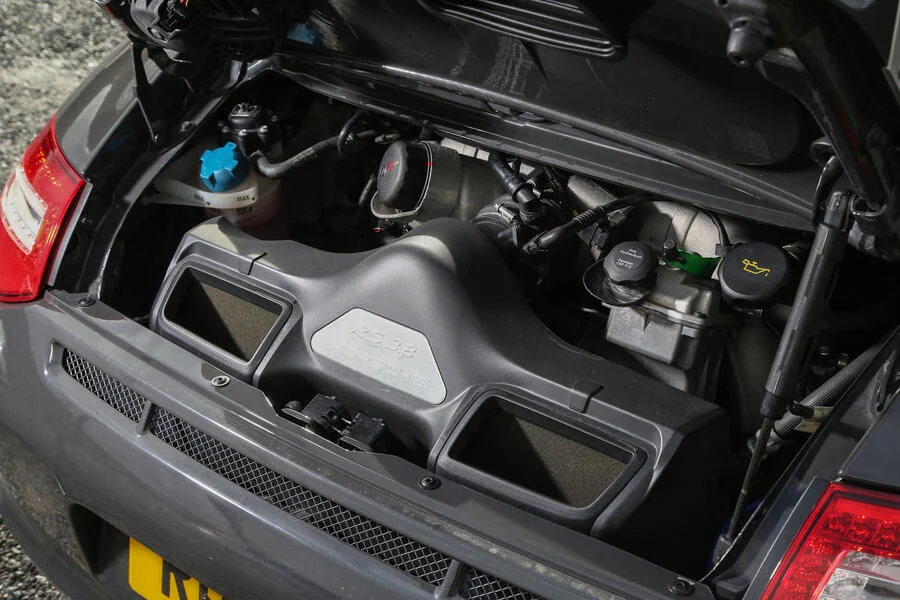
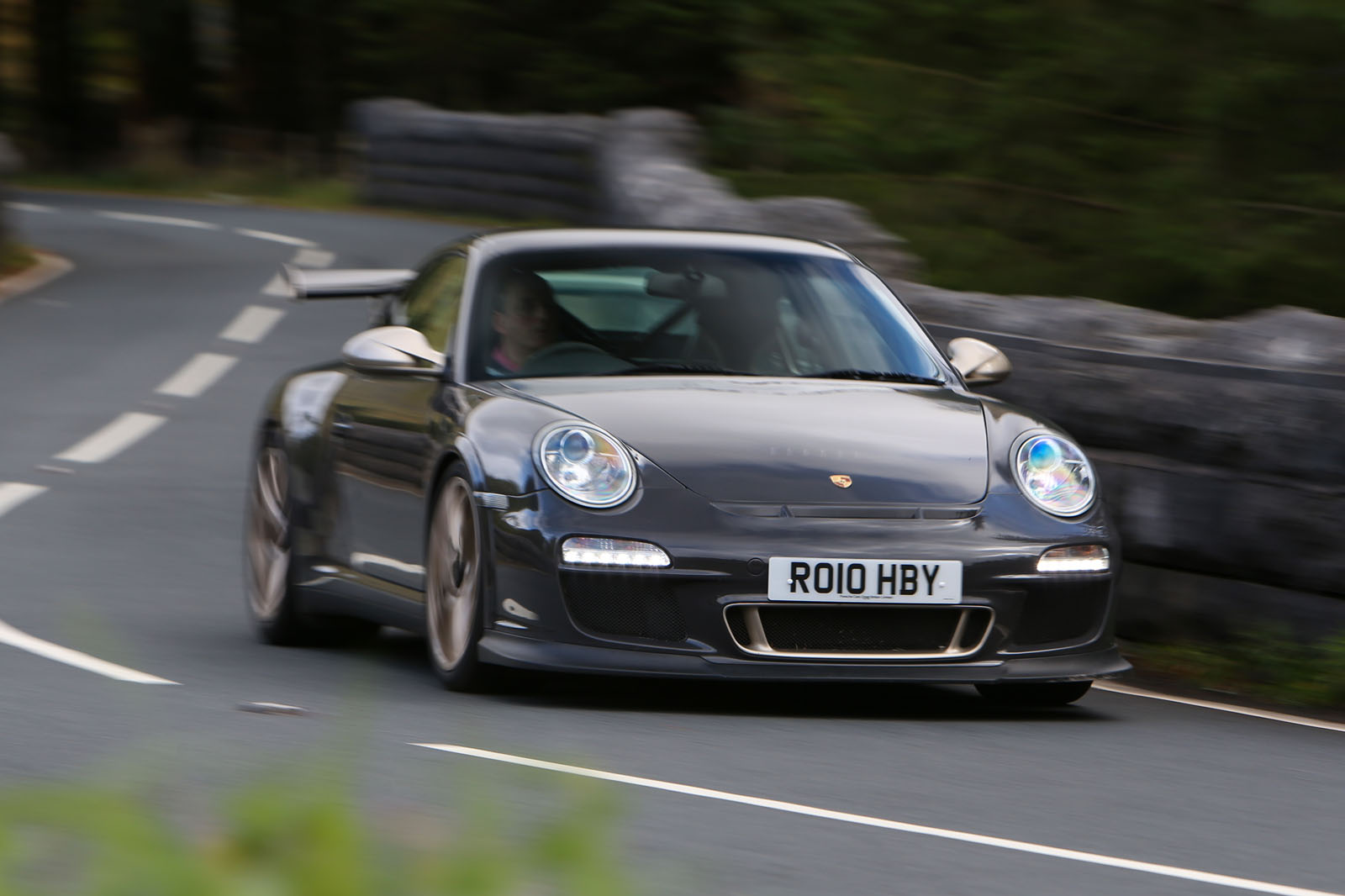
The 2011 Porsche 911 GT3 RS 4.0 is widely regarded by collectors and automotive historians as the high-water mark for the Mezger engine. Limited to just 600 units worldwide, it represented the ultimate distillation of Hans Mezger’s engineering philosophy. The engine utilized titanium connecting rods and the 80.4mm stroke crankshaft from the 911 GT3 RSR racing car.
By the time the 4.0 RS was released, Porsche had already transitioned the standard 911 Carrera and the 997.2 Turbo to the newer "9A1" engine platform, which featured direct fuel injection (DFI) and fewer moving parts. However, for the flagship GT3 RS 4.0, Porsche engineers insisted on the Mezger block one last time, citing its proven track record in endurance racing. The 4.0 RS became an instant legend, with current market values often exceeding triple its original MSRP, largely due to the "heart" of the car being the final iteration of this race-bred engine.
Market Impact and Collectibility
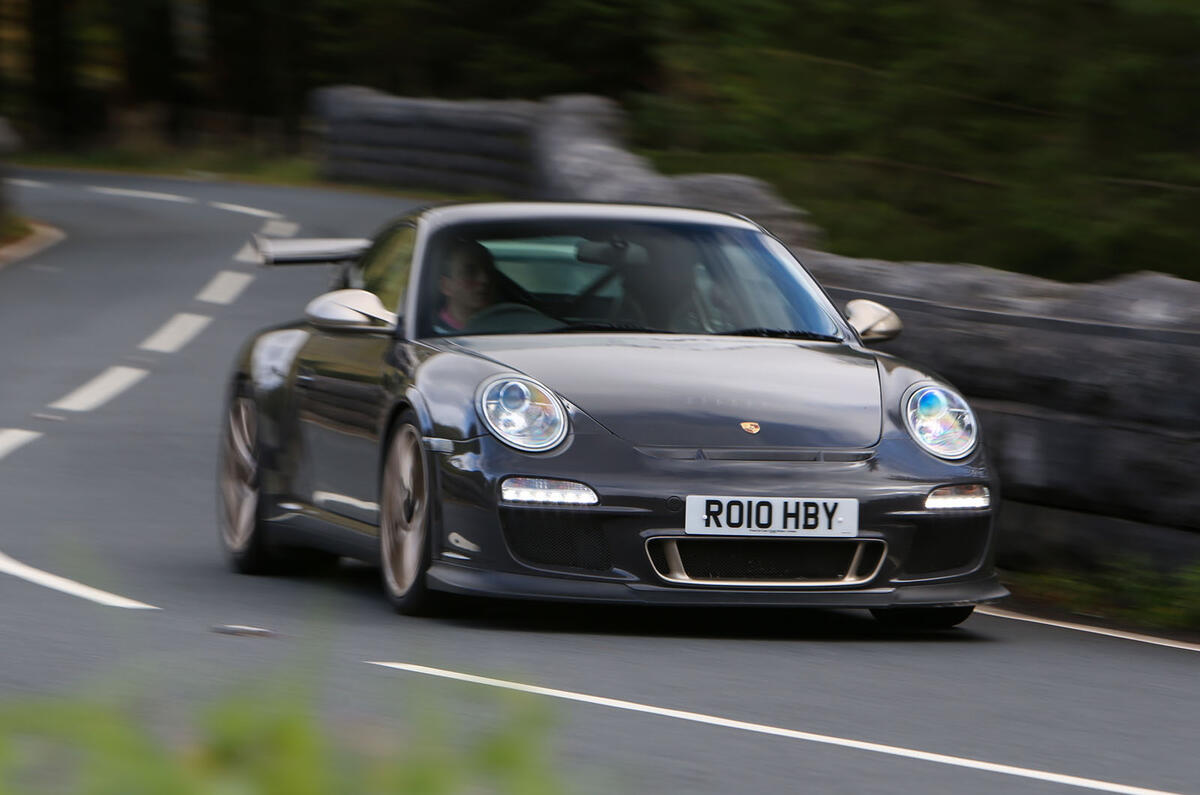
The distinction between "Mezger" and "Non-Mezger" Porsches has created a significant divide in the secondary market. Models equipped with the Mezger unit—specifically the 996 and 997 GT3, GT2, and 996/997.1 Turbo—command a premium over their successors or counterparts.
Data from automotive auctions over the last decade shows a consistent upward trend for Mezger-powered vehicles. For example, a 997.1 Turbo (Mezger) often sells for 20-30% more than a 997.2 Turbo (9A1), despite the latter being newer and featuring a faster dual-clutch transmission (PDK). Collectors prize the Mezger for its mechanical "chatter" at idle, its linear power delivery, and its historical link to Porsche’s most successful era at Le Mans. The engine is often described as feeling "bulletproof," a sentiment backed by numerous examples of GT3s surpassing 100,000 miles of heavy track use without needing a rebuild.
Official Responses and Industry Recognition
While Porsche has moved on to more efficient, direct-injected, and turbocharged powerplants to meet modern emissions standards, the company continues to acknowledge the Mezger engine’s role in building the brand’s reputation. At the time of Hans Mezger’s passing in 2020 at the age of 90, Porsche Executive Board Chairman Oliver Blume stated, "We thank him for his unique engineering achievements, which he performed for Porsche. His contributions to our sports cars and racing cars are unforgettable."
Engineers who worked under Mezger have often noted that the engine’s over-engineered nature was a product of a time when "racing improved the breed" was not just a marketing slogan but a core development principle. The shift to the 9A1 and later the 4.0-litre engines in the 991 and 992 GT3 RS models brought more power and better efficiency, but many purists argue that the visceral, mechanical connection of the Mezger unit remains unmatched.
Broader Implications for Automotive Engineering
The legacy of the Mezger engine serves as a case study in the longevity of high-quality mechanical design. In an era where software and electronic management often define a vehicle’s character, the Mezger flat-six stands as a reminder of the importance of hardware. Its success across multiple disciplines—from the 24 Hours of Le Mans to the daily commute—demonstrates that an engine designed for the extremes of competition can offer unparalleled durability for the road.
As the automotive world pivots toward electrification, the Mezger flat-six is increasingly viewed as a benchmark of the internal combustion era. It represents a period where the constraints of physics were met with elegant mechanical solutions, such as the split crankcase and the dry-sump system. While modern V12s may offer more cylinders and newer turbocharged units may offer more torque, the Mezger flat-six remains a definitive favorite for those who value heritage, reliability, and the raw, unadulterated sound of a race engine on the open road. Its place in history is secure, not just as a successful racing engine, but as the mechanical soul of Porsche’s most celebrated modern classics.