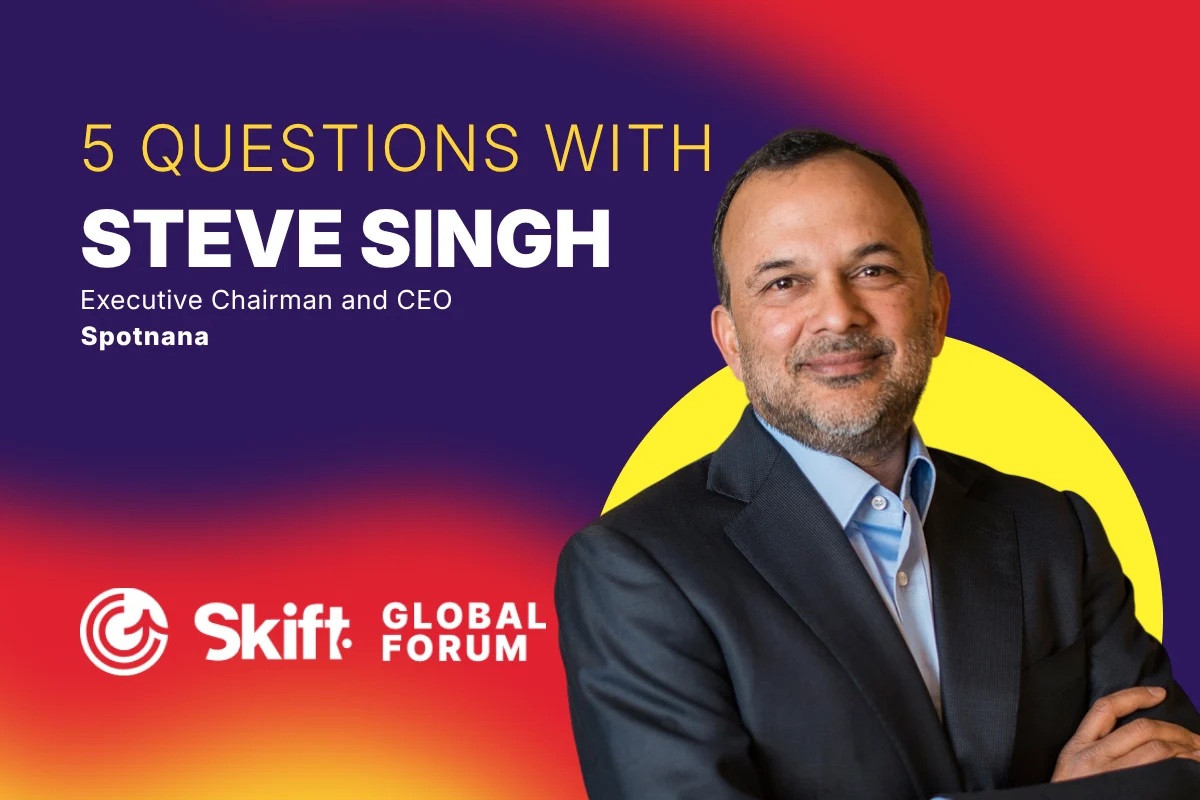
The global travel industry has long operated under the assumption that the primary battlefield for value creation lies at the beginning of the customer journey, specifically within the realms of discovery, search, and the eventual transaction. However, Steve Singh, the Executive Chairman and CEO of Spotnana and a titan of the travel technology sector, is challenging this consensus. As the industry prepares for the Skift Global Forum in New York City, Singh is pivoting the conversation toward the "unglamorous" backend of the travel experience: servicing. By leveraging advanced artificial intelligence to automate post-booking workflows, Singh posits that travel companies can reduce servicing costs by 50% or more while simultaneously deepening traveler trust.
This shift in focus comes at a critical juncture for the industry. While the front-end booking experience has been largely digitized and streamlined over the last two decades, the post-purchase phase—handling cancellations, rebookings, refunds, and unticketed segments—remains heavily reliant on manual labor and legacy systems. Singh argues that this inefficiency is where margins are currently being lost and where the next great technological revolution in travel will take place.
The Economic Imperative of Servicing Automation
For decades, the travel management and distribution sector has funneled the majority of its research and development budget into the "top of the funnel." The logic was simple: capture the traveler’s attention, offer the best price, and secure the booking. However, the true cost of a customer often manifests after the "buy" button is clicked. In the traditional Travel Management Company (TMC) model, human agents spend a disproportionate amount of their time managing routine, repetitive tasks.
According to data presented by Spotnana, a significant portion of what traditionally landed in an agent’s queue—such as processing a flight cancellation or managing a refund—no longer requires human intervention. Singh highlights that Spotnana’s AI agents are now capable of handling these specific segments autonomously. The economic implications are profound. If a company can automate half of its servicing volume, the labor cost per transaction drops precipitously. This allows travel providers to either improve their margins or reinvest those savings into "high-touch" services where human empathy and complex problem-solving are actually required.
Industry analysts note that the average cost of a manual intervention by a travel agent can range from $15 to $35 per interaction, depending on the complexity and the region. By shifting these tasks to AI-driven workflows, that cost can be reduced to cents. Singh’s assertion that servicing costs can fall by 50% reflects a broader trend in the enterprise software world: the transition from "software as a tool" to "software as a service-provider."
A Chronology of Travel Tech Evolution: From GDS to AI Agents
To understand why Singh’s focus on servicing is revolutionary, one must look at the timeline of travel technology.
In the 1960s and 70s, the advent of Global Distribution Systems (GDS) like Sabre and Amadeus revolutionized how flights were booked, moving the industry away from paper ledgers and telephone calls. The 1990s and early 2000s saw the rise of Online Travel Agencies (OTAs) and booking tools like Concur—a company Singh co-founded—which brought search and booking directly to the consumer’s desktop.
However, the "servicing" side of the equation lagged behind. While a traveler could book a flight in seconds, changing that flight during a weather event often meant hours on hold with a call center. The 2010s introduced mobile apps that offered some self-service features, but these were often just "skins" over old, manual processes.
The current era, beginning around 2023 with the explosion of Generative AI and Large Language Models (LLMs), represents the first time the industry has had the tools to handle the nuance of servicing. Unlike previous automated systems that followed rigid, "if-then" logic, modern AI agents can understand intent, navigate fragmented content sources, and execute multi-step processes across different platforms. Spotnana’s architecture is built specifically to capitalize on this, utilizing a cloud-native platform that treats every part of the trip as a dynamic data object that can be manipulated by AI in real-time.
The Trust Gap: Where Relationships Are Won or Lost
Singh’s philosophy is rooted in the idea that "anyone can sell a ticket." In a commoditized market, price parity is common, and search results are often identical across platforms. Therefore, the differentiator becomes the quality of the experience when things go wrong.
"Service is where trust is earned or lost," Singh asserts. The traveler’s relationship with a brand is rarely defined by a seamless booking; it is defined by how the brand handles a missed connection in a foreign airport at midnight. If an AI agent can proactively identify a delay, rebook the traveler on the next available flight, and update their hotel reservation before the traveler even realizes there is a problem, the level of trust built is far greater than any marketing campaign could achieve.
This "proactive servicing" is the cornerstone of the modern traveler/customer relationship. To achieve this, Spotnana has invested heavily in direct integrations with airlines and hotel chains. By bypassing traditional intermediaries in many cases, they can synchronize changes across systems instantly. If a traveler makes a change on a mobile app, that change is reflected in the airline’s system and the corporate travel department’s dashboard simultaneously. This "single source of truth" prevents the data fragmentation that typically leads to servicing failures.
Curation and the Conversational Interface
As the industry moves toward conversational AI—where travelers interact with a chat interface rather than a grid of flight options—the role of curation becomes paramount. In a traditional search, a traveler might browse 50 hotel options. In a conversational interface, the AI might only suggest three.
Singh explains that this shift places a higher burden of responsibility on the technology provider. To maintain trust, the AI must be "solving for the traveler." Spotnana’s goal is to ensure that the small handful of offers presented to a traveler are the ones they would have chosen 95% of the time if they had looked at the full list.
This requires rich, accurate data. For an AI to recommend a hotel room on a high floor with an ocean view and early check-in, the underlying data source must be incredibly detailed. Singh notes that direct integrations (such as those using NDC or New Distribution Capability) are the best sources for this level of granularity. Legacy systems often strip away these "ancillary" details, making it impossible for AI to perform high-level curation.
Broader Industry Implications and Official Responses
The perspective shared by Singh is echoed by other leaders scheduled to speak at the Skift Global Forum, including Glenn Fogel of Booking Holdings and Ariane Gorin of Expedia Group. While each company has a different market focus, the consensus is clear: the "Connected Trip" is the ultimate goal. This concept involves a seamless, end-to-end journey where every component (flight, car, hotel, rail) is linked and serviced as a single entity.
However, the transition to AI-led servicing is not without its tensions. Labor unions and traditional travel agencies have expressed concerns about the displacement of human workers. In response, proponents like Singh argue that AI is not replacing humans but rather elevating their roles. By removing the "drudgery" of routine cancellations and refunds, human agents are freed to act as "travel consultants" or "concierges" for complex itineraries that require a personal touch.
Furthermore, there are technical hurdles. The travel industry is notorious for its "spaghetti code" and legacy infrastructure. For Singh’s vision of 50% cost reduction to become an industry-wide reality, older players must modernize their stacks to allow for the type of API-first, cloud-native communication that Spotnana employs.
Conclusion: The New Frontier of Travel Economics
As Steve Singh prepares to take the stage at the Skift Global Forum, his message to the industry is a wake-up call. The era of focusing solely on the "point of sale" is ending. In a world of fragmented content and rising traveler expectations, the real value—and the real profit—lies in the "after-purchase" work.
The successful travel companies of the next decade will be those that view servicing not as a cost center to be minimized, but as a product to be perfected. By deploying AI agents to handle the routine and utilizing direct connections to ensure data integrity, companies like Spotnana are rewriting the economics of travel. The goal is a future where the "servicing queue" is no longer a bottleneck of frustrated travelers and overwhelmed agents, but a silent, efficient engine of customer loyalty.
As the industry gathers in New York, the discussion will undoubtedly center on how quickly this transition can happen. If Singh’s predictions hold true, the industry is on the verge of a productivity boom that could redefine the traveler experience for generations to come. The message is clear: look past the booking, because that is where the future of travel is being built.