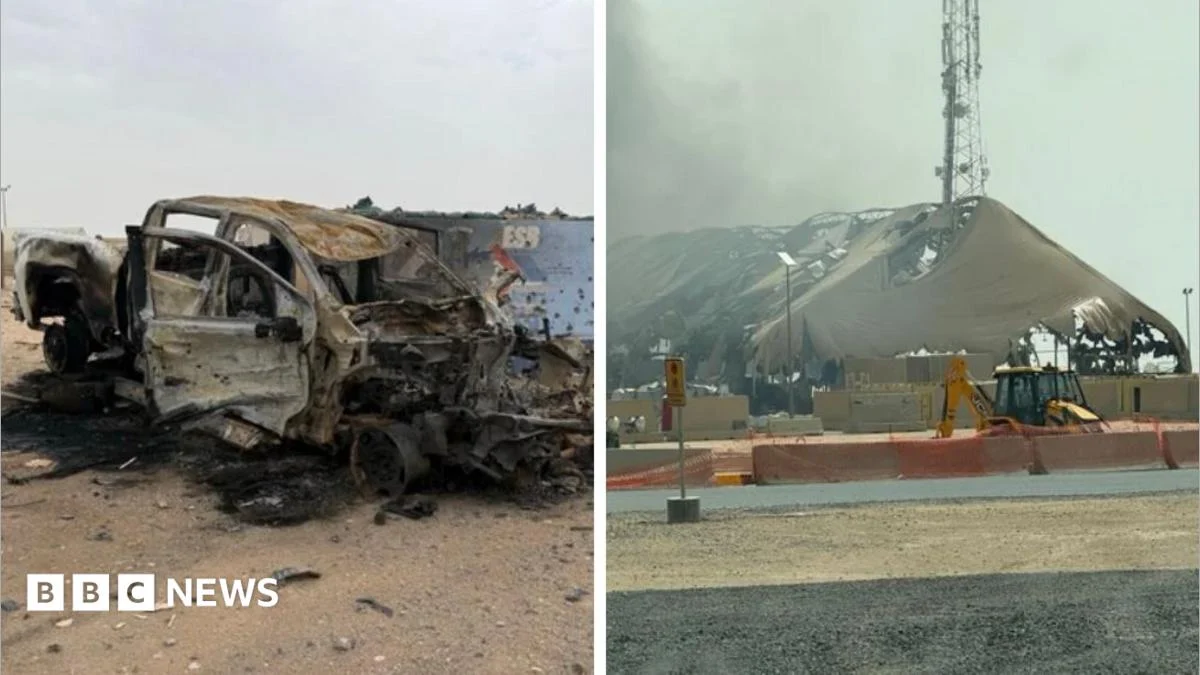
Images obtained by the BBC’s US partner CBS reveal significant and widespread damage to multiple United States sites across the Middle East, resulting from a series of Iranian strikes. These revelations, corroborated by active military personnel, expose a scale of destruction that had not been fully communicated to the American public, sparking concerns over transparency, military readiness, and the financial burden of the ongoing conflict. The striking photographs depict a severed radar jet, numerous flattened trailers, and severely damaged buildings at US bases in Saudi Arabia and Kuwait, underscoring the severe impact of Iranian aggression.
Unveiling the Extent of the Damage and Financial Toll
The newly surfaced images, though undated and not independently verified by the BBC, paint a stark picture of the consequences of the conflict. One particularly jarring photograph shows a Boeing E-3 Sentry, an advanced airborne early warning and control (AWACS) aircraft, at Prince Sultan Air Force Base in Saudi Arabia, ripped in half with its tail section crumpled into a tangled mess of metal. The E-3 Sentry, a critical asset for surveillance and command-and-control, represents a significant loss given its strategic importance and cost.
These visual confirmations arrive on the heels of a report from the Pentagon’s own watchdog, which definitively confirmed that Iranian strikes had "damaged and destroyed hundreds of buildings and structures at US bases in Kuwait, Bahrain, Qatar, UAE, Saudi Arabia, Iraq, Oman, and Jordan during the conflict." This extensive geographic scope of damage highlights the broad reach and persistent nature of Iranian attacks across the region. The Pentagon’s report further detailed that equipment losses alone have totaled an staggering $3.7 billion (£2.8 billion). When accounting for all expenditures, the US had spent $33.4 billion (£24.7 billion) on the war up to June 29, indicating the immense financial commitment to the conflict.
Beyond static infrastructure, the impact on airpower has been substantial. The Pentagon’s document noted that in the months following the war’s commencement, "dozens of US aircraft were destroyed or damaged." Specific examples included five refuelling aircraft, which were "damaged or destroyed on the ground in Saudi Arabia by Iranian munitions," critical losses that impair aerial logistical capabilities.
Further elaborating on the financial implications, a separate report from the Congressional Budget Office (CBO) provided a more granular breakdown of specific equipment losses. The CBO estimated the total cost of equipment lost in battle – encompassing planes, drones, and a Terminal High Altitude Area Defense (THAAD) system – to be $1.9 billion (£1.4 billion). The report specifically highlighted the E-3 Sentry aircraft, noting that it is no longer in production, necessitating its replacement with a more modern equivalent, the E-7. The CBO placed the cost of a single E-3 aircraft at $500 million (£371 million), emphasizing the high price tag associated with rebuilding lost capabilities.
The CBO’s review, however, was explicitly subjected to "uncertainty" due to the Department of Defense’s failure to respond to its requests for information. This forced the agency to rely on government databases and public reports, raising questions about the completeness and accuracy of the official picture. Adding to this ambiguity, the extent of repairs and rebuilding that the US military plans to undertake remains unclear, according to the report, leaving a significant void in public understanding of the recovery process.
A Conflict’s Genesis and Escalation Timeline
The current conflict with Iran officially commenced on February 28, with the United States and Israel launching joint attacks on the country. This marked a significant escalation in an already tense relationship, characterized by decades of geopolitical rivalry, proxy conflicts, and disputes over Iran’s nuclear program and regional influence. The initial strikes were framed by US and Israeli officials as responses to perceived Iranian threats and destabilizing activities in the Middle East.
Following these initial joint attacks, Iran swiftly retaliated, initiating a series of targeted strikes against US bases and allied states in the Gulf, as well as directly against Israel. These retaliatory actions, which have consistently challenged US military presence and regional security, included ballistic missile attacks, drone assaults, and other forms of asymmetric warfare designed to inflict damage and signal resolve. The repeated nature of these attacks, as evidenced by the widespread damage now coming to light, indicates a sustained campaign rather than isolated incidents. This ongoing tit-for-tat dynamic has trapped the region in a cycle of escalation, with each strike increasing the risk of a broader, more devastating conflict.
Official Silence and Military Frustration
In response to inquiries regarding the damage, the White House referred the BBC to US Central Command (CENTCOM), the operational command responsible for US military operations in the Middle East. However, CENTCOM did not immediately respond to requests for comment, maintaining a notable silence on the revelations. This lack of official immediate transparency stands in stark contrast to the severity of the damage depicted in the images and detailed in the watchdog reports.
The sentiment within certain military circles appears to reflect frustration with this perceived lack of openness. One unnamed military member, whose statement was relayed by CBS, voiced profound concern, stating: "This is major damage to our bases that hasn’t been communicated to the American public. We’re standing there with our eyes closed getting punched in the face." This powerful quote underscores a deep-seated worry among those serving about the disconnect between the reality on the ground and the information conveyed to the public and policymakers. The implication is that the American people are not being fully informed about the risks, costs, and sacrifices associated with the ongoing military engagements.
Political Fallout and Congressional Pushback
The revelations of extensive damage and mounting costs have significantly intensified public and political pressure on the White House to find an end to the conflict with Iran. Domestically, the war has become a contentious issue, drawing criticism from across the political spectrum regarding its strategic objectives, cost, and the lack of a clear exit strategy.
On Tuesday night, the US House of Representatives took a decisive step, voting for the third time to end the war in Iran. The measure, which passed with bipartisan support, including several Republicans, aims to force President Donald Trump to cease US military action without explicit congressional approval. This vote represents a significant challenge to executive authority, asserting Congress’s constitutional role in declaring and ending wars. The timing of this vote, ahead of the US midterm elections in November, adds another layer of political significance, signaling potential electoral consequences for lawmakers who do not align with growing public sentiment for de-escalation.
Despite the House’s clear stance, the measure faces an uncertain path to passage, as the US Senate has not yet indicated whether it will take up the matter. This divergence highlights the ongoing struggle between the legislative and executive branches over war powers and national security policy.
Concurrently, the same day saw outgoing Republican Congressman Thomas Massie announce his intention to attempt to impeach Defence Secretary Pete Hegseth. Massie’s move, coming as new details about the Iran war’s financial burden for the US emerged, suggests a growing discontent within even conservative ranks regarding the administration’s handling of the conflict and its financial oversight. The Trump administration, however, quickly rallied behind Hegseth, with US Attorney General Todd Blanche telling reporters that the Secretary was "doing a phenomenal job," indicating a firm stance against such political challenges.
Broader Implications and the Path Forward
The implications of these revelations are multifaceted, extending beyond immediate military and financial concerns. Firstly, the widespread damage raises serious questions about the effectiveness of US defensive systems and intelligence capabilities in the region. If hundreds of buildings and dozens of aircraft can be damaged or destroyed, it necessitates a re-evaluation of force protection measures and strategic deployments.
Secondly, the significant financial losses, coupled with the unclear plans for repair and rebuilding, represent a substantial burden on American taxpayers. The cost of replacing advanced systems like the E-3 Sentry, which requires a modern equivalent, adds to the already astronomical figures associated with military operations in the Middle East. This financial strain could divert resources from other critical domestic priorities or military modernization efforts.
Thirdly, the perceived lack of transparency from the administration risks eroding public trust and exacerbating political divisions. The statement from the unnamed military member—"We’re standing there with our eyes closed getting punched in the face"—resonates with concerns about accountability and honest reporting. For a democracy, maintaining public confidence in military operations is paramount, and withholding information about significant losses can undermine that confidence.
Finally, the political pressure from Congress underscores a broader national debate about US foreign policy, military interventionism, and the appropriate balance of power between the executive and legislative branches in matters of war. The House’s repeated votes to end the conflict signal a growing appetite for de-escalation and a more restrained foreign policy, especially in an election year. The outcome of these political battles will not only shape the future of US involvement in Iran but could also set precedents for how the United States engages in future conflicts.
As the US grapples with the fallout from these widespread damages and the increasing political pressure, the path forward remains fraught with challenges. A comprehensive strategy that addresses military readiness, financial accountability, public transparency, and diplomatic solutions will be crucial in navigating this complex and costly conflict. The revelations serve as a stark reminder of the tangible costs of prolonged military engagement and the urgent need for clarity and resolution.