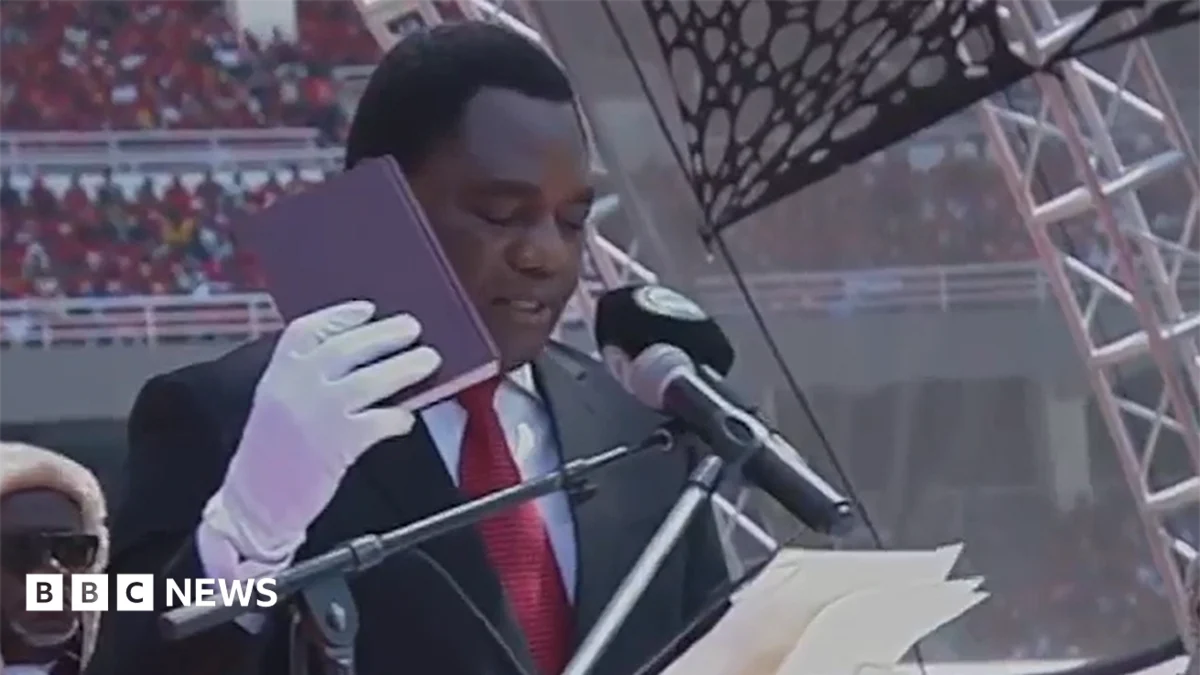
Hakainde Hichilema was officially sworn into office for his second term as President of Zambia on Tuesday, a moment marked by jubilant celebrations from thousands of supporters gathered at the National Heroes Stadium in Lusaka. The ceremony, attended by several African heads of state including presidents from Kenya, Botswana, Zimbabwe, Namibia, and Tanzania, signaled a renewed mandate for Hichilema and his United Party for National Development (UPND) government. However, the celebratory atmosphere was tempered by significant concerns over the recent electoral process, highlighted by European Union observers, and a contentious crackdown on opposition figures in the days following the poll.
The re-inauguration of President Hichilema, alongside his running mate Mutale Nalumango, comes at a critical juncture for Zambia. Having navigated a challenging first term focused on economic stabilization, Hichilema’s second tenure is poised to prioritize growth and prosperity. Yet, the shadows of alleged electoral irregularities and the dramatic arrest of prominent opposition leaders, including former cabinet minister and presidential challenger Mundubile and his running mate Makebi Zulu, cast a complex light on the nation’s democratic landscape.
Controversies Surrounding the Recent Poll
The electoral process that led to Hichilema’s re-election has drawn scrutiny, particularly from international observers. European Union monitoring teams, deployed to assess the fairness and transparency of the polls, reported several procedural deficiencies that raise questions about the integrity of the vote tallying process. According to their findings, staff in numerous tallying centres across the country failed to promptly record results on official tally sheets as soon as they were announced. This delay in documentation introduced a window for potential inaccuracies or manipulation, undermining the principle of real-time transparency.
Furthermore, the EU observers cited weak verification mechanisms between digital entries and the corresponding paper records. In an era where technological advancements are often lauded for improving electoral efficiency and accuracy, such a disconnect between digital and physical tallies presents a significant vulnerability. This lack of robust cross-verification can erode public confidence in the final results, regardless of the ultimate outcome. The report also noted that returning officers frequently paused proceedings, often awaiting instructions from headquarters, which could lead to delays, inconsistencies, and a perception of centralized control over local electoral processes. These observations, while not necessarily alleging widespread fraud, point to systemic weaknesses in electoral administration that Zambia’s Electoral Commission would need to address to strengthen democratic trust.
Post-Election Crackdown and Opposition Arrests
The period immediately following the election was characterized by heightened political tension and a dramatic escalation of events. The day after the poll, security forces raided a property in the capital, Lusaka, linked to Mundubile, a key opposition figure and presidential contender. The raid culminated in a tragic outcome: a former cabinet minister was killed during the operation. In the aftermath, a number of opposition politicians were arrested, intensifying concerns about the government’s approach to dissent and political opposition.
Zambian authorities swiftly accused the opposition of planning an "armed insurrection," a grave charge that carries severe legal implications and suggests a direct threat to national security. The government’s narrative painted the opposition’s actions as an attempt to destabilize the country and subvert the democratic process through violence. However, the opposition leaders vehemently denied these accusations, branding them as politically motivated fabrications designed to suppress legitimate dissent and consolidate power. Mundubile and his running mate, Makebi Zulu, initially went into hiding amidst the escalating crackdown. They were eventually detained by police last week and subsequently charged over the weekend. The specific charges were not immediately detailed in the public domain, but they are widely understood to be related to the government’s accusation of insurrection. These arrests have sent a chilling message through Zambia’s political landscape, raising questions about the space for opposition politics and the rule of law.
President Hichilema’s Inaugural Address: A Call for Unity and Growth
Despite the political storm brewing around the opposition, President Hichilema’s inauguration speech focused heavily on national unity, democratic principles, and his ambitious economic agenda. Notably, Hichilema chose not to comment directly on his opponent’s detention during his address. Instead, he delivered a broader message, emphasizing that "the pursuit of political power must never come at the expense of peace, security and stability in our country." This statement, while not explicitly addressing the arrests, served as a subtle admonition against actions perceived as undermining national stability, aligning with the government’s narrative of safeguarding peace.
Hichilema further articulated his vision for a functioning democracy, stating, "Democracy does not require us to agree on everything. It requires us to respect one another even when we disagree." This appeal for mutual respect, coming amidst deep political divisions, underscored his stated commitment to democratic ideals, even as his government faced criticism for its handling of the opposition. In a gesture aimed at fostering national cohesion, he extended an invitation to the opposition to collaborate with his administration for the betterment of Zambia, promising, "When you have a good idea, we will listen to you." This outreach, while potentially seen as conciliatory, also places the onus on the opposition to engage constructively within the established political framework.
Hichilema’s First Term: Stabilisation and Reform (2021-2026)
President Hichilema’s first term in office, which began in 2021 after a decisive landslide victory, was largely defined by a concerted effort to rescue Zambia from a severe economic crisis. When he first assumed the presidency, the nation was in a precarious state, having recently defaulted on its international debt obligations. This default, a rare occurrence for an African nation, signaled deep-seated financial distress. The economic landscape was further complicated by an alarming annual inflation rate that soared to over 24%, eroding purchasing power and making daily life increasingly difficult for ordinary Zambians. "We inherited a broken-down country… the economy was declining," Hichilema had told the BBC in Lusaka prior to the recent election, encapsulating the daunting challenge his administration faced.
Over the past five years, Hichilema, a former businessman with a background in finance, prioritized economic stabilization and rebuilding international confidence. His government embarked on an arduous process of negotiating a restructuring of the country’s substantial international debt, engaging with a myriad of foreign creditors including multilateral institutions like the International Monetary Fund (IMF) and bilateral lenders, notably China. This complex negotiation process, which involved extensive dialogue and policy commitments, was crucial to restoring Zambia’s financial credibility on the global stage.
Alongside debt restructuring, the administration implemented measures aimed at bringing down inflation. While inflation has indeed seen a reduction from its peak, the cost of living remains a significant challenge for many Zambian households. Prices for essential goods and services continue to rise, albeit at a slower pace, and the impact of global economic headwinds, including supply chain disruptions and volatile commodity prices, continues to be felt locally. Despite these persistent challenges, Hichilema’s government has been credited with laying what he describes as foundational reforms, creating a more stable macroeconomic environment. Zambia’s GDP growth, which had slowed significantly in the years prior to 2021, has shown signs of recovery, albeit remaining vulnerable to external shocks and commodity price fluctuations.
The Vision for the Second Term: From Stabilisation to Growth
With the foundations of economic reform ostensibly laid, President Hichilema’s second term agenda is unequivocally focused on transitioning from stabilization to robust economic growth. In his inauguration speech, he declared, "We are moving from stabilisation to growth." This statement signifies a shift from crisis management and austerity measures towards policies aimed at stimulating broader economic expansion, job creation, and improved living standards for all Zambians.
Hichilema outlined his ambitious vision, asserting, "Having done the heavy lifting in our first term, the next five years is all about growth and prosperity for all our people. I will continue to be a servant president for all the people of Zambia." This pledge to be a "servant president" reinforces his populist appeal and commitment to addressing the needs of the common citizen. The growth agenda is expected to encompass various sectors, including mining (a traditional pillar of the Zambian economy), agriculture, tourism, and diversification into new industries to reduce reliance on copper exports. Attracting foreign direct investment will be crucial, and the perceived stability and reform efforts of the first term are expected to be leveraged to draw international capital. Education, healthcare, and infrastructure development are also likely to feature prominently in his plans to ensure that economic growth translates into tangible improvements in human development.
Broader Implications and Challenges Ahead
President Hichilema’s second term inauguration presents Zambia with a dual challenge: sustaining economic recovery and growth while simultaneously upholding democratic principles and ensuring political stability. The EU observer report and the arrests of opposition figures underscore the need for continuous vigilance regarding electoral integrity and the protection of civil liberties. A vibrant, respected opposition is often seen as a cornerstone of a healthy democracy, and the perceived crackdown risks alienating a significant portion of the electorate and international partners. The government will need to demonstrate its commitment to the rule of law, ensuring fair legal processes for those charged, and fostering an environment where political discourse can thrive without fear of retribution.
Economically, while progress has been made, the fight against the cost of living and unemployment remains critical. The success of Hichilema’s "growth" agenda will depend on his ability to translate macroeconomic stability into tangible improvements in the daily lives of ordinary Zambians. This includes creating employment opportunities for the country’s youthful population, reducing poverty, and ensuring that the benefits of economic growth are equitably distributed across society.
Regionally, Zambia, under Hichilema, has sought to reassert itself as a stable and democratic voice in Southern Africa. The attendance of several regional leaders at his inauguration highlights Zambia’s continued importance within the African political landscape. How Hichilema navigates the delicate balance between national security concerns and democratic freedoms will be closely watched by both domestic and international observers. His ability to foster genuine national unity, engage constructively with political opponents, and deliver on his economic promises will ultimately define his legacy and determine Zambia’s trajectory over the next five years. The path ahead for Zambia, therefore, is one of immense promise, yet equally significant political and economic tests.