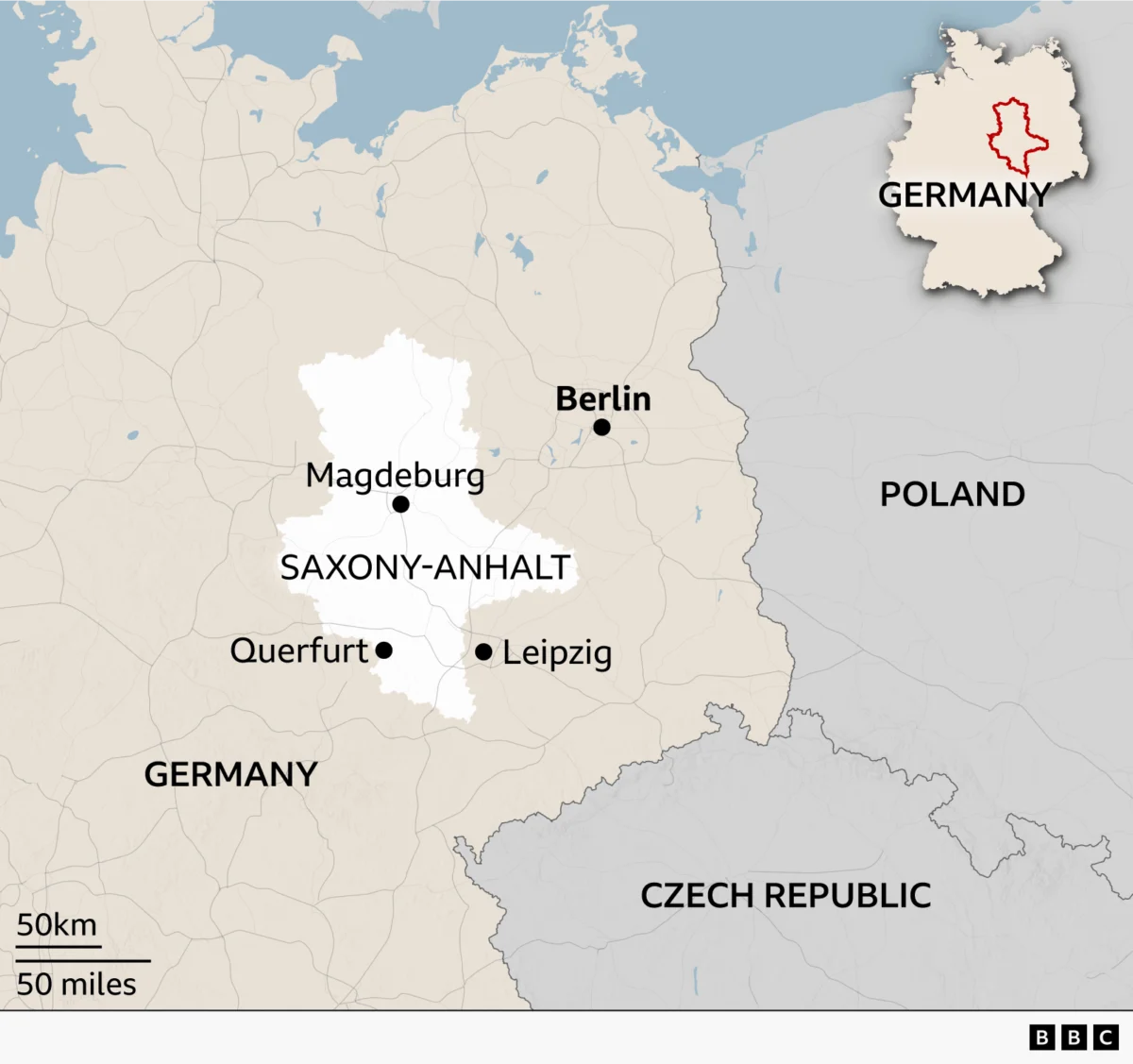
In a deeply charged session of the German Bundestag, Chancellor Friedrich Merz launched a scathing attack on the Alternative for Germany (AfD) party and its leader, Alice Weidel, accusing them of pursuing a migration policy that amounts to "ethnic cleansing" for skilled workers. The heated exchange, which saw Merz declare the AfD a "destructive force," unfolded in the immediate aftermath of the far-right party’s unprecedented electoral triumph in the eastern state of Saxony-Anhalt, a result that has sent shockwaves through Germany’s political establishment.
The Saxony-Anhalt Earthquake: A Deeper Dive into the Electoral Shift
Sunday’s election in Saxony-Anhalt marked a pivotal moment in German politics. The anti-immigration AfD secured an astonishing nearly 44% of the vote, propelling it to become the dominant political force in the state. This outcome represents the highest share of the vote ever achieved by a far-right party in any German state election since the end of World War Two, underscoring a dramatic shift in the political landscape, particularly in the historically more economically challenged eastern regions of the country.
For Merz’s own conservative Christian Democratic Union (CDU), the results were particularly devastating. Their vote share was effectively halved, plummeting to just 17.2%, a clear indicator of voter disillusionment with traditional parties and a significant portion of their base migrating towards the AfD. This stark contrast in fortunes highlights a growing chasm between the political narratives of the mainstream and the rising populist tide. The scale of the AfD’s victory, falling just three seats short of an outright majority in the state parliament, has created an immediate governmental crisis, challenging established political norms and the long-standing "Brandmauer" (firewall) against cooperation with the far-right.
Saxony-Anhalt, like many states in former East Germany, has grappled with unique socio-economic challenges since reunification. Decades of de-industrialization, demographic shifts including significant outward migration of younger populations, and a perception of being overlooked by federal policies have fostered fertile ground for anti-establishment sentiment. While economic indicators have shown improvement in recent years, a sense of grievance, combined with anxieties surrounding immigration and cultural change, appears to have resonated strongly with voters, leading to a protest vote on an unprecedented scale.
The Bundestag Showdown: A Clash of Ideologies and National Visions
The parliamentary debate in Berlin was a direct consequence of this seismic electoral shift, providing the first direct confrontation between the leaders of Germany’s established conservative bloc and its ascendant far-right. Merz, addressing the Bundestag, did not mince words, directly challenging AfD leader Alice Weidel. His central accusation revolved around the AfD’s controversial "remigration" policy, which he argued would have devastating consequences for Germany’s economy and social fabric.
Merz highlighted that approximately one in six skilled workers in Germany has a migration background, making them integral to the nation’s economic prosperity. He contended that the AfD’s proposed policy, which often implies the forced repatriation of individuals with foreign roots, even those with German citizenship or long-term residency, would amount to "nothing other than an ethnic cleansing in the skilled trades based on skin colour and origin." This stark comparison to historical atrocities was a deliberate rhetorical move, aiming to underscore the perceived extremism of the AfD’s platform and its potential for societal fragmentation. He further warned that such a policy would cripple essential services, stating that "no single care home, hospital or restaurant could function" without the contributions of individuals with migration backgrounds.
Beyond migration, Merz also criticized the AfD for harming German national interests through its perceived pro-Russia stance, particularly in the context of the ongoing war in Ukraine. This accusation taps into a broader concern among mainstream parties that the AfD’s foreign policy positions often align with those of authoritarian regimes, undermining Germany’s democratic alliances and international standing.

Alice Weidel, in turn, seized the opportunity to portray Merz’s grand coalition with the center-left Social Democrats (SPD) as a complete failure. She asserted that the Saxony-Anhalt results were a clear mandate from voters signaling that Merz’s time in power was running out. Weidel attributed what she described as Germany’s decline to the government’s policies, arguing that "mass migration" had led to a surge in daily "knife violence and attacks on trains and in stations," directly linking immigration to public safety concerns. She accused the current government of driving Germany towards "bankruptcy," a sentiment that resonates with voters concerned about inflation, energy costs, and the national debt.
The debate itself was marked by an exceptionally tense atmosphere. AfD MPs repeatedly heckled Merz, leading Bundestag President Julia Klöckner to intervene with a stern warning, threatening to expel disruptive members from the chamber with the memorable admonition, "We are not on a football pitch." This unusual level of disruption underscored the deep polarization and animosity now characterizing German parliamentary discourse.
Unpacking "Remigration": Policy, Controversy, and Economic Impact
The term "remigration" has become a central and highly controversial tenet of the AfD’s platform. While ostensibly suggesting a voluntary return of migrants, the party’s rhetoric and internal discussions, particularly those revealed in recent investigative reports, indicate a far more coercive and expansive interpretation. It often refers to the systematic deportation or incentivized departure of large populations, including those who are legally residing in Germany, have citizenship, or are second and third-generation immigrants, based on perceived lack of integration or "foreign" background.
The AfD in Saxony-Anhalt, notably, has been officially labeled as "right-wing extremist" by Germany’s domestic intelligence agency, the Federal Office for the Protection of the Constitution (BfV). This classification is not merely symbolic; it grants the agency enhanced surveillance powers, reflecting serious concerns about the party’s adherence to democratic principles. The BfV’s assessment is partly based on the party’s explicit embrace of a "deportation and remigration offensive" targeting "irregular migrants," a term which, in their broader discourse, often extends beyond those without legal residency.
The implications of such a policy, as highlighted by Merz, are profound. Economically, Germany faces significant demographic challenges, including an aging population and a looming shortage of skilled labor. Immigrants, across various sectors from healthcare to construction to hospitality, play a crucial role in filling these gaps and maintaining economic output. A policy of widespread "remigration" would not only lead to a massive loss of human capital but also damage Germany’s reputation as an open, welcoming, and stable economy, deterring future investment and talent. Socially, it would create deep divisions, foster discrimination, and undermine the principles of equality and human dignity enshrined in Germany’s constitution.
The "Brandmauer" Under Strain: Coalition Prospects in Saxony-Anhalt
The AfD’s near-majority in Saxony-Anhalt has put immense pressure on the "Brandmauer," the unwritten but firmly upheld consensus among Germany’s mainstream parties to refuse any form of cooperation or coalition with the far-right. This firewall has been a cornerstone of post-war German democracy, designed to prevent the resurgence of extremist ideologies in governance.
With the AfD falling three seats short of an outright majority, the immediate question is how a government will be formed. Historically, in such scenarios, mainstream parties would form a coalition among themselves to exclude the far-right. However, given the AfD’s overwhelming mandate in Saxony-Anhalt, forming a stable government without acknowledging their electoral strength becomes an arduous task.
The AfD has indicated a willingness to seek coalition partners, potentially eyeing the newly formed left-wing populist party, Bündnis Sahra Wagenknecht (BSW), which also positions itself against the established order and has voiced critical views on immigration. While a formal coalition between the AfD and BSW would be ideologically challenging, the AfD’s state premier candidate, Ulrich Siegmund, has suggested openness to working with any party willing to back him as the state leader.

Adding to the complexity, Siegmund’s deputy in Saxony-Anhalt has provocatively suggested that even Merz’s CDU could consider abandoning the "Brandmauer" to cooperate with the AfD, reflecting the far-right’s strategy of pushing the boundaries of political acceptability. This suggestion, while immediately rejected by the CDU’s national leadership, highlights the immense pressure and internal debates that the AfD’s success is forcing upon mainstream parties. The alternatives – a minority government, which would be inherently unstable, or a rerun of the elections – all present significant political risks and uncertainties.
Wider Repercussions: National, European, and International Echoes
The Saxony-Anhalt result and the subsequent Bundestag debate carry significant weight beyond Germany’s borders. The rise of the AfD aligns with a broader trend across Europe, where populist and far-right parties have gained traction in countries like France, Italy, and the Netherlands, often on platforms critical of immigration, the European Union, and traditional political elites.
Internationally, the AfD’s success immediately drew praise from former US President Donald Trump, who publicly linked the victory to "absolutely horrible immigration rules and regulations." Trump’s endorsement underscores the global nature of the populist movement and the perceived common ground between various nationalist and anti-establishment forces worldwide. Such external validation, particularly from a figure of Trump’s stature, can further embolden the AfD and its supporters.
For Germany, a nation acutely aware of its 20th-century history, the surge of a party labeled as "right-wing extremist" by its own intelligence services is particularly alarming. It challenges the foundational principles of its post-war democratic order and raises questions about national identity, social cohesion, and the future direction of the country. Merz’s acknowledgment that the result represented a "seismic" shift indicates the gravity with which the established political class views this development.
Historical Echoes and Future Challenges
Germany’s post-war political culture has been characterized by a strong commitment to democratic stability, multilateralism, and a robust defense against extremist ideologies, particularly those echoing the National Socialist era. The "Brandmauer" is a direct legacy of this historical consciousness. The AfD’s ascent, however, suggests that this firewall is under unprecedented stress, and the consensus that once underpinned it is fracturing.
The challenges for mainstream parties are multifaceted. They must find ways to address the legitimate concerns of voters regarding immigration, economic stability, and public safety without validating the extremist rhetoric of the AfD. This involves demonstrating effective governance, fostering economic opportunity in marginalized regions, and engaging in open, honest dialogue about the complexities of migration and integration. Failure to do so risks further alienation of voters and the continued erosion of trust in democratic institutions.
The fiery Bundestag debate between Friedrich Merz and Alice Weidel was more than just a political spat; it was a microcosm of the profound ideological struggle currently gripping Germany. As the country navigates an increasingly complex domestic and international landscape, the implications of the AfD’s growing influence will undoubtedly shape Germany’s political trajectory for years to come, forcing a critical re-evaluation of its democratic resilience and its vision for the future. The outcome in Saxony-Anhalt and the reactions it has provoked signal a new, more confrontational era in German politics, where the boundaries of acceptable discourse and political cooperation are being fiercely contested.