



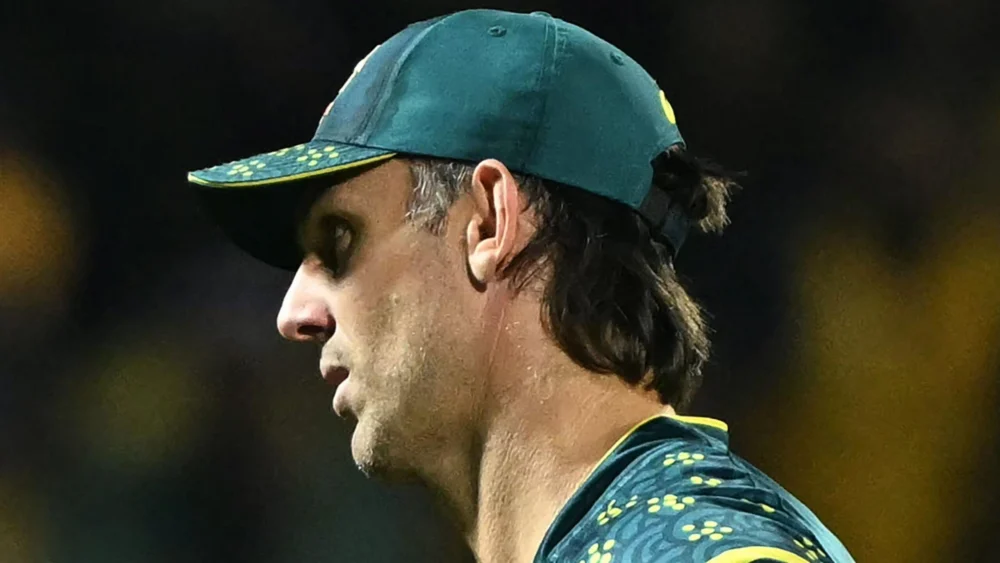
The disappointing T20 World Cup campaign for Australia has culminated in an early exit, marking a significant downturn for the formerly dominant cricketing nation in the shortest format of the game. Following a critical defeat against Sri Lanka, the path to the Super Eight stage was taken out of their hands. Captain Mitchell Marsh’s hope for a favourable outcome from the Ireland versus Zimbabwe match, which would have seen Australia progress, was dashed by inclement weather, leading to an abandonment and a shared points system that ultimately eliminated the Aussies. This marks the first time since 2009 that an Australian side will not feature in the latter stages of a T20 World Cup, and it extends a streak of three consecutive tournaments without reaching the semi-finals, a stark contrast to their victory in 2021.
A Season of Stumbles in Sri Lanka
Australia’s T20 World Cup journey has been a tale of missteps and missed opportunities, played out entirely on Sri Lankan soil throughout the group stages. This tournament performance, coupled with a broader slump in their T20I results, has fueled a growing narrative that the format may not be accorded the highest priority within Cricket Australia’s strategic planning. The team’s struggles have drawn sharp criticism, with former players and commentators questioning selection policies and preparation strategies.
Selection Quandaries and Unforeseen Demands
The familiar post-tournament ritual of scrutinizing selection decisions has been particularly intense for Australia this time around. Steve Smith, a cornerstone of Australia’s Test batting lineup, found himself on the periphery of the T20 squad, having not featured in the format for nearly two years. Despite a respectable showing in the recent Big Bash League, with a century and two half-centuries, he was not initially part of the plans. However, an unfortunate testicular injury sustained by captain Mitchell Marsh during training prior to Australia’s opening fixture against Ireland necessitated a change. Smith was flown to Colombo to be on standby, ready to step in should his inclusion be required.
Ultimately, Smith did find his way into the playing XI, though not as a direct replacement for Marsh. His call-up to the main squad came belatedly as a replacement for Josh Hazlewood, who was ruled out of the competition before a single ball was bowled due to injury. This complex series of events saw Smith, a prolific run-scorer in Test cricket, only manage to participate as a substitute fielder in a match where Australia was still mathematically in contention. He was unable to influence the outcome as Sri Lanka, led by a stellar innings from Pathum Nissanka, secured their victory.
The decision to drop Matthew Renshaw for the crucial encounter against Sri Lanka also proved to be a point of contention. Renshaw’s contribution of 37 runs from 33 balls against Ireland, while considered slow by some, was acknowledged by the Ireland camp as a valuable effort on a challenging pitch. In the subsequent match against Zimbabwe, Renshaw scored a more aggressive 65 from 44 deliveries, though it ultimately fell short of securing a match-winning total. His subsequent omission against Sri Lanka appeared to backfire.
The Collapse After a Promising Start
Australia’s innings against Sri Lanka began with a formidable opening partnership of 104 runs from just 8.3 overs between Travis Head and Mitchell Marsh. This explosive start suggested a dominant performance was imminent. However, the team experienced a significant collapse, losing three wickets for the addition of only 26 runs. This rapid decline exposed a perceived lack of stability in the middle order, a void that some analysts believe Renshaw’s presence might have helped to fill.
Expert Critique: A ‘Smack of England’ in Preparation?
The performance and preparation of the Australian T20 World Cup squad have drawn pointed criticism from prominent figures in the sport. Matthew Hayden, a two-time 50-over World Cup winner for Australia, expressed his disappointment on Test Match Special, suggesting a disconnect between the team’s perceived readiness and the reality of their campaign.
"The reaction back home has been rather heavy because I think we’ve been sold down the stream a little bit in terms of our selection and how we’ve gone about preparing for this T20 World Cup," Hayden stated. He drew parallels with England’s preparation issues during recent Ashes campaigns, describing the Australian approach as a "mix of denial and maybe even just mismanagement."
Hayden elaborated on the team’s apparent miscalculation of conditions: "We enjoy coming to countries like Sri Lanka but we just haven’t prepared for what we’ve seen. We’ve picked power hitters in finesse type conditions." He posited that the team’s strategy was overly reliant on a "plan A" of pure power hitting, a tactic that might be effective in different environments like India but ill-suited to the nuanced pitches found in Sri Lanka. "These conditions [in Sri Lanka], though, are different. They’re not such pure batting surfaces, and that requires methodology. It almost requires a bit more of an old school approach and way of thinking about the game that allows you to stay in the contest."
Depth Concerns in the White-Ball Arena
Australia’s strength in fast bowling is well-established in Test cricket, evidenced by the formidable trio of Josh Hazlewood, Pat Cummins, and Mitchell Starc. However, the landscape shifts significantly in the white-ball format. Starc has retired from T20 internationals, while both Cummins and Hazlewood were sidelined through injury during this tournament. The fact that Australia opted to call up a batter, Steve Smith, rather than an immediate replacement bowler after Hazlewood’s injury further highlighted perceived imbalances in their white-ball bowling depth.
Despite these concerns, players within the Australian camp have maintained a stance of confidence in their squad’s capabilities. Following the defeat to Sri Lanka, Mitchell Marsh asserted, "Looking down our list, honestly, it feels like there’s more than enough talent to look after the situations in the games that we’re playing. As much as we can talk about team line-up and who’s in, who’s out and that sort of thing, I think if everyone just looks after their role it should help [put] us in good stead."
Cameron Green’s Struggles and Renshaw’s Treatment
Cameron Green, who commanded a significant price tag in the Indian Premier League, becoming the most expensive overseas signing for the Kolkata Knight Riders at over £2 million, has also faced scrutiny. Hayden was particularly critical of Green’s batting performances, noting a lack of confidence and a "woody" or "tinny" appearance at the crease. "Cam Green has just looked awful with the bat," Hayden remarked. "He looks woody, he looks tinny, he looks like he’s just a man with no confidence, and I’d be very surprised if that’s not exactly the case."
Hayden also voiced his opinion on Matthew Renshaw’s situation, suggesting he had been "very ill treated" and that he "should be in the Test team too." He contrasted Renshaw’s situation with Green’s, stating, "Matt Renshaw has come with no baggage to this tournament. He actually had a really good series back home in Australia in the ODIs."
The Cultural Context: T20’s Priority in Australian Cricket
Beyond individual selection and on-field performance, there is a broader question regarding Australia’s cultural approach to T20 cricket. While the domestic Big Bash League enjoys healthy attendance figures, the timing of this World Cup has made it difficult for fans back home to follow the team closely. This lack of engagement is reflected in media coverage, with only one Australian journalist reportedly travelling to Sri Lanka to cover the team, indicating a perceived lower level of public interest from editorial desks.
This context raises questions about the actual prioritization of the T20 World Cup within Cricket Australia’s calendar. Even accounting for the unavailability of key players like Cummins and Hazlewood due to injury, it has been noted that other senior players were reportedly instructed to prioritize the Big Bash finals over participating in the pre-tournament warm-up tour to Pakistan.
Matthew Hayden emphasized the need for strategic alignment, stating, "Cricket Australia needs to have a look at their schedule, and they need to be able to manage their number one and primary resource, which is cricket talent. [They need to] find a way to just be a little more controlled, and a little more destined and built towards the purpose of Australian cricket."
The Road Ahead: A Dead Rubber Awaits
As the T20 World Cup campaign draws to a close for Australia, they have one remaining group match against Oman on Friday. This fixture is a dead rubber, a scenario often more commonly associated with the conclusion of an Ashes series, where the ultimate outcome of the contest has already been decided. The performance in this final match will offer little consolation for a tournament that has underscored significant challenges for one of cricket’s most storied nations in the rapidly evolving landscape of the shortest format. The implications of this early exit will undoubtedly lead to further introspection and strategic re-evaluation within Cricket Australia as they look to rebuild for future T20 assignments.