

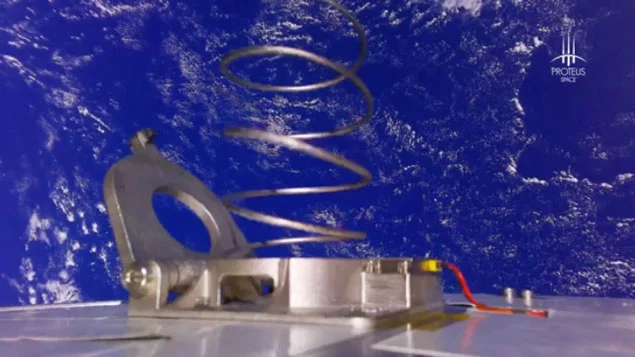
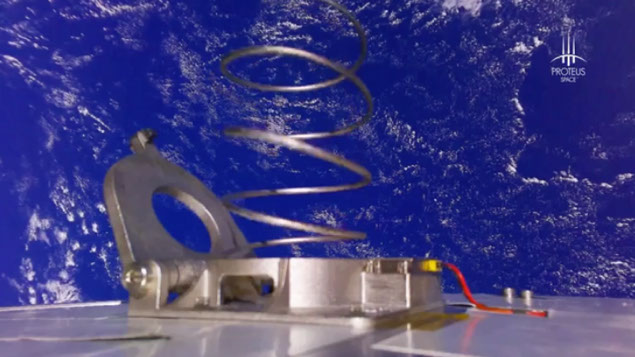
In a landmark demonstration for advanced space technology, a revolutionary jack-in-the-box-like spring, ingeniously designed at NASA’s Jet Propulsion Laboratory (JPL) and known as the JPL Additive Compliant Canister (JACC), successfully deployed on February 3, 2026. This pivotal event, captured by an onboard camera as the Proteus Space Mercury One spacecraft orbited over the vast expanse of the Pacific Ocean in low Earth orbit, unequivocally showcased the profound potential of additive manufacturing – commonly referred to as 3D printing – to dramatically reduce costs and complexity in the creation of futuristic space antennas and other critical space hardware. The successful deployment not only validated years of research and development but also provided compelling visual evidence, with a subsequent still image of JACC after full deployment taken above Antarctica, underscoring the mechanism’s robust performance in the harsh vacuum of space.
The Dawn of a New Deployment Mechanism: JACC’s Design and Innovation
The JACC system is not merely a component; it represents a paradigm shift in how spacecraft mechanisms can be engineered and fabricated. At its core, JACC is an elegant solution to a long-standing challenge in space exploration: the need for large, high-performance structures that can be compactly stowed for launch and then precisely deployed in orbit. Traditionally, such mechanisms involve numerous moving parts, complex assembly sequences, and extensive testing, all contributing to high costs and prolonged development cycles. JACC, however, breaks this mold by leveraging the transformative capabilities of 3D printing.
Fabricated entirely from robust titanium, JACC integrates what would conventionally be multiple discrete parts into a single, cohesive unit. This ingenious design consolidates a hinge, a panel, a compression spring, and two torsion springs into one monolithic structure. This consolidation is a critical innovation, reducing the total number of parts by a factor of three compared to similar, traditionally manufactured structures. The implications of this reduction are profound, extending beyond mere simplification. Fewer parts mean fewer potential points of failure, reduced assembly time and labor, and ultimately, a more reliable and cost-effective product.
Weighing in at just over one pound (approximately 498 grams) and measuring about four inches (10 centimeters) on each side when stowed, JACC is a testament to efficient design. Its most striking feature, however, is its remarkable deployment capability. Designed to mimic the critical function of communication antennas commonly employed on satellites, the spring mechanism extends from a compact packed height of just over one inch (three centimeters) to an impressive length of about six inches (15 centimeters). This significant expansion ratio from a minimal stowed volume is paramount for optimizing payload space within launch vehicles, where every cubic centimeter and every gram translates directly into launch costs. The ability to deploy such a crucial mechanism with precision and reliability, after enduring the rigors of launch and the vacuum of space, fundamentally demonstrates that 3D-printed mechanisms can indeed be built faster, cheaper, and with significantly less complexity than their traditionally fabricated counterparts.
PANDORASBox: A Collaborative Triumph in Rapid Development
JACC’s successful deployment is but one half of a broader, equally ambitious mission known as PANDORASBox, an acronym for Prototype Actuated Nonlinear Deployables Offering Repeatable Accuracy Stowed on a Box. This innovative project encompasses two distinct but complementary JPL payloads on the Mercury One spacecraft, both designed to advance the state-of-the-art in deployable space structures. The second critical payload accompanying JACC is the Solid Underconstrained Multi-Frequency (SUM) Deployable Antenna for Earth Science. Together, these two payloads aim to demonstrate novel technologies engineered to not only take up a dramatically reduced volume during launch but also to precisely deploy antennas on future orbiters, particularly those dedicated to vital Earth science missions.
The PANDORASBox initiative itself is a remarkable example of rapid prototyping and agile development within a high-stakes environment. Both JACC and the SUM antenna were conceived, meticulously built, rigorously tested, and delivered for flight by JPL engineers in an astonishingly short timeframe – less than one year. This accelerated development cycle was achieved on what officials described as "minimal budgets," underscoring the inherent efficiencies gained through innovative design principles and the utilization of additive manufacturing techniques. This rapid turnaround, coupled with stringent performance requirements, highlights JPL’s capacity for innovation and its ability to push the boundaries of space technology development even under fiscal constraints.
A Detailed Chronology: From Launch to Orbital Deployment
The journey of JACC and the PANDORASBox payloads to their successful orbital demonstration involved several key milestones:
- Prior to November 2025 (less than one year): The conceptualization, design, additive manufacturing, assembly, and rigorous testing phases for both the JACC mechanism and the SUM Deployable Antenna were completed at NASA’s Jet Propulsion Laboratory. This period saw the rapid iteration and refinement of designs, exploiting the flexibility and speed of 3D printing to move from concept to flight-ready hardware in an unprecedented timeframe. Minimal budgets necessitated highly efficient project management and resource allocation.
- November 28, 2025: The Mercury One spacecraft, carrying the PANDORASBox payloads, successfully launched from Vandenberg Space Force Base in California. This launch was facilitated as part of SpaceX’s Transporter-15 mission, a dedicated rideshare program that enables multiple small satellites and payloads to reach orbit on a single Falcon 9 rocket. The Transporter missions have become a cornerstone of the burgeoning "New Space" economy, offering cost-effective access to space for government agencies, commercial entities, and academic institutions alike.
- February 3, 2026: In a moment of critical validation, the JACC spring mechanism successfully deployed from its container aboard the Mercury One spacecraft. This deployment occurred as the spacecraft traversed low Earth orbit, specifically over the Pacific Ocean. Onboard cameras meticulously documented the event, providing real-time visual confirmation of the mechanism’s flawless operation. This footage is invaluable for engineers to analyze deployment dynamics and confirm performance against models.
- Post-Deployment Observation: Following its initial deployment, a still image of the JACC mechanism fully extended was captured by an onboard camera as the spacecraft passed over Antarctica. This secondary visual confirmation further cemented the success of the mission, demonstrating the structural integrity and operational stability of the 3D-printed component in its deployed configuration.
The Additive Advantage: Revolutionizing Spacecraft Manufacturing
The success of JACC represents a powerful endorsement of additive manufacturing as a cornerstone technology for future space exploration. 3D printing, at its essence, builds three-dimensional objects layer by layer from a digital design, in stark contrast to traditional subtractive manufacturing methods that remove material from a larger block. For the aerospace industry, this methodology offers a host of unparalleled advantages:
- Unprecedented Design Freedom: Additive manufacturing enables the creation of incredibly complex geometries, intricate internal structures, and organic shapes that are impossible or prohibitively expensive to produce with conventional techniques. This allows engineers to optimize parts for weight, strength, and functionality in ways previously unimaginable, leading to lighter, stronger, and more efficient components. JACC’s ability to integrate multiple functions (hinge, springs, panel) into a single part is a prime example of this.
- Significant Cost Reduction: By consolidating parts and reducing material waste, 3D printing directly lowers manufacturing costs. Fewer parts mean less inventory, simpler supply chains, and reduced assembly labor. The "minimal budgets" for PANDORASBox attest to this cost-efficiency. Furthermore, rapid prototyping capabilities allow for quick design iterations and testing, catching potential issues earlier and reducing costly rework.
- Accelerated Development Cycles: The ability to move directly from a digital design to a physical object with minimal tooling requirements drastically shortens lead times. This agility is crucial for missions with tight schedules or for responding quickly to new scientific or operational demands, as demonstrated by the less-than-one-year development of JACC.
- Material Innovation: While JACC was printed from titanium, a high-performance material known for its strength-to-weight ratio and corrosion resistance, additive manufacturing is compatible with a growing array of advanced materials, including high-performance polymers, ceramics, and superalloys. This versatility opens doors for creating components with tailored properties for specific extreme space environments.
- Reduced Mass and Volume: By optimizing internal structures and consolidating parts, 3D printing inherently leads to lighter components. This mass reduction is critical for space missions, where every kilogram saved translates to substantial launch cost savings. Furthermore, the ability to create compact, highly integrated deployable structures like JACC directly addresses the challenge of fitting complex instruments into small payload envelopes.
The broader implications for space hardware manufacturing are immense. From intricate rocket engine components (like those being printed by companies such as Relativity Space) to tools and spare parts printed on demand aboard the International Space Station, and even future habitats constructed on the Moon or Mars using local regolith, additive manufacturing is poised to transform every facet of space exploration and utilization.
Implications for Future Space Missions: Antennas, Cost, and Capability
The successful deployment of JACC carries profound implications for the future design and operation of space missions, particularly concerning communication and scientific instrumentation.
- Advanced Antenna Systems: Antennas are the lifeline of any space mission, enabling communication with Earth, navigation, and critical scientific data collection (e.g., radar, radiometry). The demand for increasingly complex and larger antenna apertures for enhanced data rates, higher resolution, and deeper space communication often conflicts with the practical constraints of launch vehicle fairings. JACC’s demonstration of compact stowage and precise, reliable deployment for a "jack-in-the-box" antenna mechanism directly addresses this challenge. Future satellites, especially those in burgeoning constellations of SmallSats and CubeSats, could integrate such 3D-printed deployable antennas to achieve high performance within a micro-satellite footprint, democratizing access to advanced space capabilities.
- Enabling Smaller, More Frequent Missions: The efficiencies in cost, time, and volume offered by technologies like JACC align perfectly with the "New Space" paradigm – an era characterized by commercialization, rapid innovation, and a proliferation of smaller, more focused missions. By reducing the barriers to entry in terms of cost and complexity, NASA and its commercial partners can deploy more scientific instruments, conduct more technology demonstrations, and gather more data, leading to a more dynamic and responsive space ecosystem.
- Enhancing Mission Resilience and Versatility: Integrated, 3D-printed components inherently possess fewer failure points than multi-part assemblies. This enhanced reliability is crucial for long-duration missions or those venturing into high-risk environments. Furthermore, the ability to rapidly design and produce specialized components allows for greater mission versatility, enabling quick adaptations to evolving scientific objectives or unforeseen challenges.
Driving Scientific Discovery: NASA’s Commitment to Earth Science and Beyond
The funding support for JACC from JPL internal research development funds and, significantly, from NASA’s Earth Science Technology Office (ESTO), underscores the strategic importance of this technology. ESTO is dedicated to advancing cutting-edge technologies that promise to enhance NASA’s Earth science missions, which monitor our planet’s climate, weather patterns, ecosystems, and natural hazards.
For Earth observation satellites, high-gain, precisely calibrated antennas are indispensable for collecting accurate data across various spectral bands. Deployable antennas that can achieve large apertures while maintaining strict dimensional stability are critical for instruments like synthetic aperture radars (SAR) or advanced radiometers. JACC and SUM are direct enablers for the next generation of Earth science instruments, promising improved data quality, broader coverage, and faster revisit times. This aligns with NASA’s overarching goal of understanding our home planet better and providing actionable data for societal benefit.
Beyond Earth science, the implications extend to deep space exploration. Future missions to the outer planets, asteroids, or even interstellar space will require increasingly sophisticated communication systems capable of transmitting vast amounts of scientific data over astronomical distances. Deployable 3D-printed antennas could provide the necessary performance while minimizing the mass and volume constraints on these ambitious probes.
The Commercial Frontier: Enabling Innovation in Low Earth Orbit
The partnership with Proteus Space and their Mercury One spacecraft, along with the launch via SpaceX’s Transporter-15 mission, exemplifies the growing trend of collaboration between government space agencies and the commercial sector. Commercial launch providers like SpaceX have dramatically reduced the cost of access to space, enabling more frequent and diverse missions. Hosting payloads on commercial platforms, as Proteus Space has done, provides valuable flight heritage for nascent technologies, demonstrating their performance in a real space environment without the need for dedicated, high-cost missions. This symbiotic relationship accelerates the maturation of technologies, bridging the gap between laboratory prototypes and operational space hardware.
Proteus Space, as a commercial entity focused on providing in-orbit services and infrastructure, plays a vital role in this ecosystem. By offering opportunities for technology demonstration, they enable organizations like JPL to rapidly test and validate innovations. This commercial pathway is essential for quickly transitioning groundbreaking research into practical applications, benefiting both scientific endeavors and the broader space industry.
Conclusion: A Small Spring, A Giant Leap for Space Technology
The successful deployment of the JPL Additive Compliant Canister (JACC) on February 3, 2026, is far more than just a routine engineering milestone. It is a powerful affirmation of additive manufacturing’s capacity to fundamentally reshape the landscape of spacecraft design and development. By demonstrating that complex, multi-functional mechanisms can be fabricated from advanced materials like titanium, with fewer parts, lower costs, and significantly shorter development timelines, JACC has opened a new frontier for space technology.
This small, jack-in-the-box-like spring, deploying with elegant precision over the Pacific Ocean, represents a giant leap towards more affordable, more capable, and more sustainable space exploration. As NASA and its partners continue to push the boundaries of what is possible, the lessons learned from JACC and the PANDORASBox mission will undoubtedly inform the design of future generations of Earth observation satellites, deep space probes, and even crewed missions, paving the way for unprecedented scientific discovery and human endeavor in the cosmos. The era of 3D-printed space hardware has truly arrived, promising to unlock new dimensions of innovation and accessibility for the final frontier.