

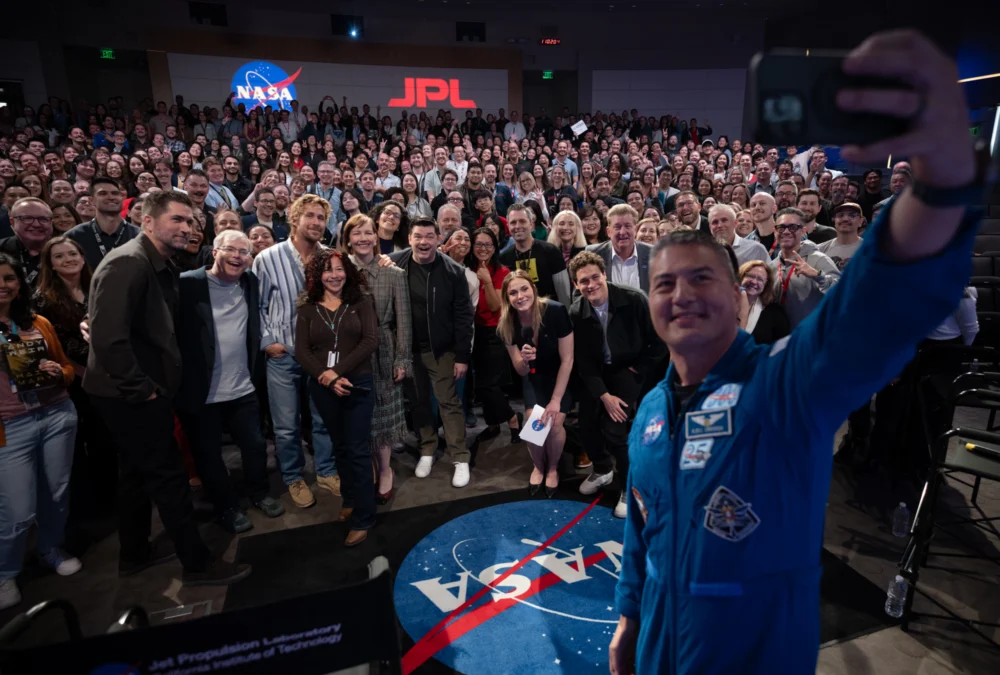
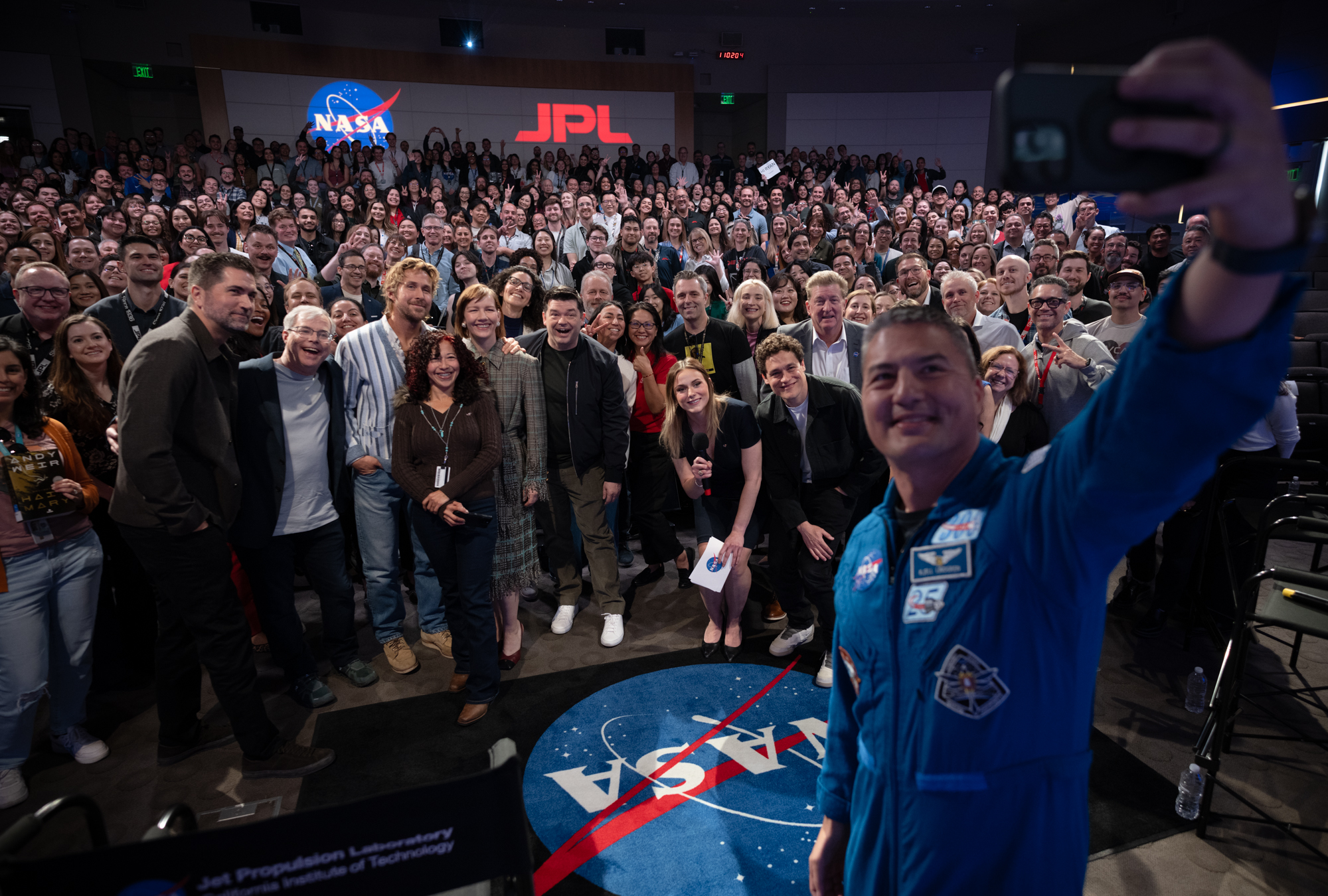
On February 25, 2026, a notable convergence of scientific rigor and cinematic artistry unfolded at NASA’s Jet Propulsion Laboratory (JPL) in Pasadena, California, as NASA astronaut Kjell Lindgren, currently serving as Deputy Director of the Flight Operations Directorate, hosted an esteemed delegation of Hollywood luminaries. The gathering centered on the highly anticipated film adaptation of Andy Weir’s acclaimed novel, "Project Hail Mary," and underscored the critical collaboration between the scientific community and creative media. Lindgren captured the essence of the event with a selfie alongside panelists and the engaged audience, featuring prominent figures such as actors Ryan Gosling and Sandra Hüller, screenwriter Drew Goddard, directors Phil Lord and Christopher Miller, and the celebrated author and producer, Andy Weir. The purpose of their visit was to delve into their experiences in bringing the complex scientific narrative to the screen and to discuss the intricate partnership forged between NASA scientists and the film’s creative team.
The event at JPL, a nexus of robotic space exploration, served as a poignant backdrop for a discussion on how scientific authenticity enriches storytelling and how popular media can inspire a new generation of scientists and engineers. The presence of such a high-profile ensemble from the "Project Hail Mary" production team signified a growing trend within the entertainment industry to ground speculative fiction in credible scientific principles, often leveraging direct input from leading experts at institutions like NASA. This symbiotic relationship not only elevates the quality of cinematic narratives but also amplifies NASA’s outreach efforts, making complex scientific concepts accessible and exciting to a global audience.
The Genesis of "Project Hail Mary" and Its Cinematic Journey
Andy Weir’s "Project Hail Mary," published in May 2021, quickly ascended bestseller lists, lauded for its compelling narrative, intricate problem-solving, and signature blend of humor and scientific accuracy. The novel follows Ryland Grace, a former science teacher turned astronaut, who awakens on a desperate mission to save humanity from an extraterrestrial threat to the Sun, with no memory of his identity or the specifics of his mission. Weir, renowned for his meticulous research and ability to weave complex scientific details into engaging plots, first captivated audiences with "The Martian" (2011), which was famously adapted into a critically acclaimed film in 2015 starring Matt Damon and directed by Ridley Scott. The success of "The Martian" adaptation, which also benefited from extensive NASA consultation, set a precedent for the industry’s embrace of scientifically informed storytelling.
The film rights for "Project Hail Mary" were secured swiftly, with MGM acquiring them in March 2020, even before the novel’s release. Ryan Gosling was attached to star and produce, signaling the project’s high cinematic potential. The selection of Phil Lord and Christopher Miller, known for their innovative work on films like "The Lego Movie" and "Spider-Man: Into the Spider-Verse," to direct, along with Drew Goddard, who adapted "The Martian" for the screen, as screenwriter, underscored the production’s commitment to both creative vision and narrative integrity. Sandra Hüller, an acclaimed German actress recognized for her roles in "Anatomy of a Fall" and "Toni Erdmann," joined the cast, further elevating the artistic caliber of the project. This powerhouse team embarked on a journey to translate Weir’s intricate universe into a visual spectacle, a task that inherently demanded a robust engagement with scientific realities.
NASA’s Integral Role in Production Support
NASA’s involvement in "Project Hail Mary" extended far beyond a simple endorsement; it was an active and integral partnership. The agency provided the creative team with unparalleled access to subject matter experts across various disciplines. These specialists answered a myriad of questions from the crew, ranging from the mechanics of interstellar travel and alien biology to the psychological impacts of long-duration space missions and the design of spacecraft systems. Such direct consultation ensures that the fictional elements, while imaginative, remain plausible within the bounds of known physics and engineering, or at least acknowledge where scientific extrapolation begins.
A significant aspect of this collaboration involved Astronaut Kjell Lindgren. As a veteran of two spaceflights and a highly experienced physician and flight engineer, Lindgren brought firsthand insights into the realities of human spaceflight. He met personally with Ryan Gosling during the filming phase, sharing invaluable perspectives on the day-to-day life of an astronaut, the physical and mental demands of living and working in microgravity, and the protocols of space missions. This direct interaction allowed Gosling to imbue his portrayal of Ryland Grace with a level of authenticity that theoretical research alone could not provide. Understanding the nuances of an astronaut’s movements, communication styles, decision-making processes under pressure, and even the subtle psychological effects of isolation in space, contributes immensely to a believable performance. Lindgren’s role highlights NASA’s commitment not only to advancing scientific knowledge but also to accurately communicating the human element of space exploration.
A Legacy of Collaboration: NASA and Hollywood
The partnership between NASA and the entertainment industry is not a novel phenomenon but rather a rich tradition that dates back decades. From early space race propaganda films to contemporary blockbusters, Hollywood has often turned to NASA for guidance, and NASA has leveraged these platforms for public engagement. Iconic films such as "Apollo 13" (1995) famously relied on extensive technical consultation from NASA personnel, including astronauts and mission controllers, to recreate the harrowing real-life events with meticulous accuracy. More recently, films like "Gravity" (2013), "Interstellar" (2014), and "The Martian" (2015) have continued this trend, pushing the boundaries of scientific realism in cinema.
For NASA, these collaborations serve multiple strategic objectives. Firstly, they are a powerful tool for public outreach and education. By embedding accurate scientific and engineering principles within popular narratives, NASA can demystify complex topics and ignite curiosity about space exploration among diverse audiences, including those who might not actively seek out scientific information. Secondly, such films can inspire future generations to pursue careers in Science, Technology, Engineering, and Mathematics (STEM). Witnessing heroic astronauts and brilliant scientists solve seemingly insurmountable problems on screen can motivate young viewers to explore these fields. Thirdly, these partnerships offer an opportunity for NASA to reinforce its brand as a leader in innovation and exploration, ensuring continued public and governmental support for its missions. The authenticity lent by NASA’s involvement also enhances the credibility and immersion of the cinematic experience, benefiting both the filmmakers and the audience.
Kjell Lindgren: Bridging Real Spaceflight and Fictional Narratives
Astronaut Kjell Lindgren’s participation in the "Project Hail Mary" discussions is particularly fitting given his extensive background. A board-certified emergency physician, Lindgren was selected as a NASA astronaut in 2009. He completed his first spaceflight in 2015 as part of Expedition 44/45 aboard the International Space Station (ISS), spending 141 days in orbit and conducting two spacewalks. His second mission, NASA’s SpaceX Crew-4, saw him serve as commander, launching to the ISS in April 2022 for another long-duration stay, bringing his total time in space to over 311 days. His current role as Deputy Director of the Flight Operations Directorate places him at the forefront of managing human spaceflight operations, providing him with a unique and comprehensive understanding of both the technical and human aspects of space exploration.
Lindgren’s ability to articulate the nuances of orbital mechanics, spacecraft systems, medical contingencies in space, and the psychological fortitude required for long-duration missions makes him an invaluable resource for filmmakers. His personal anecdotes and practical insights help bridge the gap between theoretical knowledge and lived experience, allowing actors like Ryan Gosling to develop more authentic portrayals. For Gosling, delving into Lindgren’s experiences likely offered a profound understanding of the isolation, camaraderie, and sheer dedication that defines an astronaut’s life, all critical components for portraying a character like Ryland Grace who faces an existential crisis alone in deep space.
The Jet Propulsion Laboratory: A Hub of Innovation and Inspiration
The choice of NASA’s Jet Propulsion Laboratory as the venue for this significant event further amplified its symbolic weight. JPL, managed by Caltech for NASA, is a federally funded research and development center and NASA field center located in La Cañada Flintridge, California, near Pasadena. It is renowned globally for its pioneering work in robotic exploration of the solar system, including the development and operation of Mars rovers (like Perseverance and Curiosity), the Voyager interstellar probes, and numerous Earth-observing satellites. JPL’s ethos is one of relentless innovation and problem-solving, often under extreme constraints—a thematic parallel to the challenges faced by the protagonist in "Project Hail Mary."
Hosting such an event at JPL allows the filmmakers and actors to immerse themselves in an environment where groundbreaking science is a daily reality. It provides a tangible connection to the cutting-edge research and engineering that informs their fictional narratives. The discussions held in such a prestigious scientific setting undoubtedly offered a deeper appreciation for the scientific enterprise, fostering a more profound commitment to accuracy in their storytelling. The audience, comprising scientists, engineers, and space enthusiasts, also benefited from the direct interaction, gaining insights into the creative process behind bringing complex science fiction to life.
Implications for Public Engagement and STEM Education
The event at JPL and the broader collaboration on "Project Hail Mary" carry significant implications for public engagement with science and for STEM education. In an era where scientific literacy is increasingly crucial, well-produced science fiction films serve as powerful conduits for public understanding and inspiration. They can popularize scientific concepts, showcase the scientific method in action, and highlight the importance of international collaboration in solving global challenges—themes central to "Project Hail Mary."
By presenting a future where humanity’s survival hinges on scientific ingenuity and daring exploration, such films can subtly influence societal attitudes towards scientific research and space programs. They foster a sense of wonder and possibility, encouraging young minds to consider careers that contribute to real-world scientific advancement. Moreover, the visibility of acclaimed actors like Ryan Gosling and Sandra Hüller discussing their engagement with scientific experts lends a certain cachet to science, making it appear more accessible and relevant to popular culture. This synergy between the arts and sciences demonstrates that these fields are not mutually exclusive but rather complementary forces driving human progress and understanding.
Looking Ahead: The Future of Science-Infused Cinema
The February 25, 2026, gathering at JPL stands as a testament to the evolving relationship between scientific institutions and the creative industries. As audiences increasingly demand narratives that are not only entertaining but also intellectually stimulating and credible, the demand for scientific consultation in filmmaking is likely to grow. This trend bodes well for both science and cinema. For science, it means greater public understanding and appreciation; for cinema, it means richer, more resonant stories that stand the test of scrutiny.
"Project Hail Mary," with its foundation in Andy Weir’s meticulously researched prose and its production team’s commitment to scientific accuracy, supported by NASA’s direct involvement, is poised to be another landmark film in this growing genre. The discussions at JPL, facilitated by Kjell Lindgren, not only celebrated the collaborative spirit behind this particular project but also reaffirmed the profound impact that storytelling, when grounded in scientific truth, can have on inspiring humanity’s collective future in space and on Earth. The image of an astronaut and filmmakers united in conversation, captured in a selfie, symbolizes a powerful alliance dedicated to exploring the cosmos, both real and imagined.