


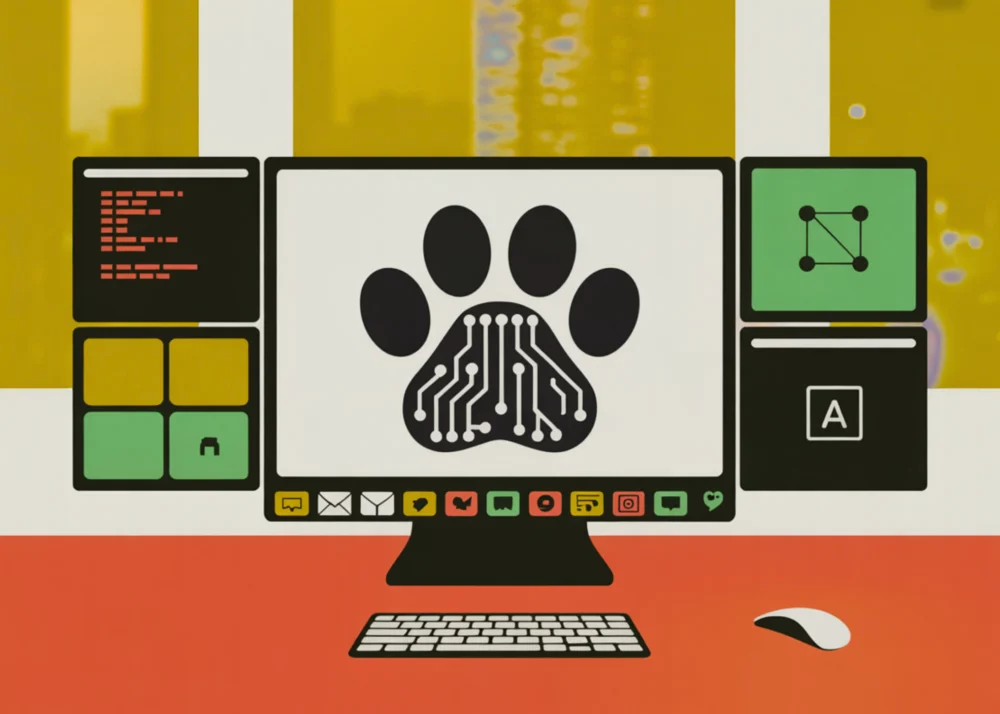
The artificial intelligence landscape is undergoing a fundamental transformation, transitioning from simple Large Language Model (LLM) inference—where users interact with static chatbots—to the development of sophisticated, autonomous agentic systems. As developers move beyond prompt engineering and into the realm of complex agent orchestration, the primary challenge has shifted from the capabilities of the underlying model to the robustness of the environment in which that model operates. To address this infrastructure gap, a team of researchers from Alibaba has released CoPaw, an open-source framework designed to serve as a standardized workstation for deploying and managing personal AI agents. By providing a comprehensive technical stack that bridges the gap between high-level logic and practical implementation, CoPaw aims to democratize the creation of "Agentic Apps" that can perform multi-step tasks, maintain persistent memory, and interact across diverse communication platforms.
The Shift Toward Agentic Workstations
For much of 2023 and early 2024, the AI industry focused heavily on "model-centric" development, emphasizing parameters, context windows, and benchmark scores. However, as the limitations of stateless chat interfaces became apparent, the focus pivoted toward "agentic" workflows. Unlike traditional LLMs, AI agents are designed to use tools, reason through multi-step problems, and execute actions in the real world. Despite this potential, developers have frequently struggled with the overhead of building the necessary infrastructure to support these agents, including database management for memory, API integrations for tool use, and the logic required to handle asynchronous tasks.
CoPaw addresses these systemic hurdles by functioning not merely as a standalone bot, but as a cohesive workstation. It provides a standardized environment where agents can be developed, tested, and deployed with a focus on long-term utility and user personalization. The release of CoPaw follows Alibaba’s broader commitment to the open-source community, building upon their previous successes with the Qwen series of models and the AgentScope framework.
Architectural Foundation: AgentScope, Runtime, and ReMe
The technical efficacy of CoPaw is rooted in its modular architecture, which integrates three primary layers to create a unified agentic environment. This trifecta—comprising AgentScope, AgentScope Runtime, and ReMe—allows for a clear separation of concerns between the agent’s "brain," its "body," and its "memory."
At the base of the system is AgentScope, a high-level framework specifically engineered for multi-agent collaboration. AgentScope simplifies the process of defining agent roles, communication protocols, and task-sharing logic. By utilizing AgentScope as its core, CoPaw enables users to deploy not just a single assistant, but a team of specialized agents that can work in tandem to solve complex problems, such as a "researcher agent" gathering data while a "writer agent" synthesizes the findings.
The second layer, AgentScope Runtime, acts as the execution engine. It manages the lifecycle of the agents, handling task scheduling and ensuring that the agent remains responsive even when performing long-running background tasks. This is particularly critical for personal assistants that must operate autonomously, such as monitoring a stock price or managing a calendar, without requiring constant user supervision.
The third and perhaps most critical component for personalization is ReMe. ReMe serves as the workstation’s memory management system, providing a structured way to store and retrieve user data, past interactions, and context. In traditional LLM setups, context is often lost once a session ends. ReMe solves this by ensuring persistent memory across different sessions and platforms. Crucially, ReMe is designed with data privacy in mind, allowing users to maintain control over their information while ensuring the agent becomes more effective over time by learning from previous interactions and specific user workflows.
Enhancing Capability through the Skills Extension System
A defining characteristic of the CoPaw workstation is its extensibility. In the context of this framework, a "Skill" is defined as a discrete unit of functionality—essentially a modular tool that the agent can invoke to interact with the external environment. This design philosophy mirrors the evolution of operating systems, where the core kernel remains stable while third-party applications provide specialized utility.
CoPaw’s Skill Extension capability allows engineers to add new functionalities without modifying the core engine. The framework supports a custom skill directory where developers can simply drop Python-based functions. These skills follow a standardized specification, largely influenced by the anthropics/skills protocol, which ensures interoperability and ease of use. Through this system, an agent can perform a variety of actions, including:
- Web Navigation and Search: Accessing real-time information to answer queries or monitor news.
- File Management: Reading, writing, and organizing documents on the user’s local or cloud storage.
- API Integration: Interacting with third-party services like Google Calendar, Slack, or GitHub.
- Data Processing: Executing complex mathematical calculations or data visualization tasks.
By standardizing how these skills are integrated, CoPaw enables the creation of complex workflows. For example, a user could define a workflow where the agent automatically monitors an email inbox for invoices, extracts the relevant data using a specialized skill, and logs the information into a spreadsheet—all without manual intervention.
All-Domain Access: Solving the Connectivity Fragmentation
One of the most significant technical hurdles in the deployment of personal AI is the fragmentation of communication platforms. A personal assistant is only useful if it is accessible where the user is, whether that be on a desktop computer, a mobile messaging app, or via email. CoPaw addresses this through its "All-Domain Access" layer, which standardizes the interaction between agents and various messaging protocols.
Currently, CoPaw supports a wide array of integrations, including:
- Messaging Platforms: Telegram, Discord, and WeChat.
- Enterprise Tools: Email (SMTP/IMAP) and web-based dashboards.
- Custom Endpoints: Developers can extend the connectivity layer to include proprietary internal tools or other emerging social platforms.
The All-Domain Access layer functions as a translation service. It takes the agent’s internal logic and output and formats it correctly for the specific API of the communication channel. More importantly, it maintains a consistent state and memory across these channels. A user could start a conversation with their CoPaw agent on Telegram during a commute and continue the same task via email once they reach their office, with the agent retaining full context of the previous exchange. This multi-channel connectivity is essential for the transition of AI from a novelty into a reliable daily tool.
Chronology of Development and the Rise of Agentic AI
The release of CoPaw is the latest milestone in a timeline characterized by rapid iteration in the autonomous agent space.
- Early 2023: The emergence of AutoGPT and BabyAGI demonstrated the potential for LLMs to loop through tasks autonomously, though these early versions often suffered from "hallucination loops" and high token costs.
- Late 2023: Alibaba and other major tech entities began focusing on frameworks that could provide more structure to these autonomous loops. The initial release of AgentScope provided the industry with a robust multi-agent orchestration tool.
- Mid 2024: The industry identified "environment management" as the primary bottleneck. Developers realized that having a smart model was insufficient if the model lacked a persistent way to remember user preferences or a standardized way to use tools.
- Late 2024/Early 2025: Alibaba researchers introduced CoPaw as the solution to this infrastructure problem, moving away from "agents as scripts" toward "agents as workstations."
This chronology reflects a maturing market that is moving away from the "magic" of AI and toward the "utility" of AI. By open-sourcing the framework, Alibaba is positioning CoPaw as a foundational layer for the next generation of personal productivity software.
Data Privacy and the Personal AI Paradigm
As AI agents become more integrated into daily life, the volume of sensitive data they handle increases exponentially. Traditional cloud-based AI assistants often require users to upload their data to centralized servers, raising significant privacy and security concerns. CoPaw’s integration of the ReMe memory system represents a shift toward a more localized, privacy-centric approach.
Because CoPaw is an open-source workstation, it can be deployed on local hardware or private clouds. This allows users and enterprises to keep their data within their own security perimeters. The framework’s ability to handle persistent memory locally means that the "personal" aspect of the personal AI agent does not have to come at the cost of data sovereignty. This is expected to be a major selling point for enterprise developers who are wary of feeding proprietary corporate data into public LLM training sets.
Broader Impact and Industry Implications
The introduction of CoPaw is likely to have several long-term impacts on the AI development ecosystem. First, it lowers the barrier to entry for building complex agentic systems. By providing the "plumbing"—memory, connectivity, and task scheduling—Alibaba allows developers to focus on the unique logic and skills of their agents.
Second, CoPaw promotes standardization. In the current "Wild West" of AI development, every team is building their own custom solutions for tool-calling and memory. By adopting standards like those from Anthropic for skills, CoPaw encourages a more interoperable ecosystem where tools built for one agent can be easily adapted for another.
Finally, CoPaw signals the arrival of the "Agentic App." Unlike traditional apps that require manual input for every action, Agentic Apps built on CoPaw can operate in the background, making decisions based on predefined goals and real-time data. This shift could redefine personal computing, moving the user’s role from "operator" to "supervisor."
As the project continues to evolve on GitHub, the community’s contribution to the skill directory will be a key metric of its success. If CoPaw can cultivate a robust library of open-source skills, it could become the de facto operating system for autonomous personal assistants, further solidifying Alibaba’s influence in the global AI landscape. For now, CoPaw stands as a significant step toward making autonomous AI agents a practical, everyday reality for developers and power users alike.