


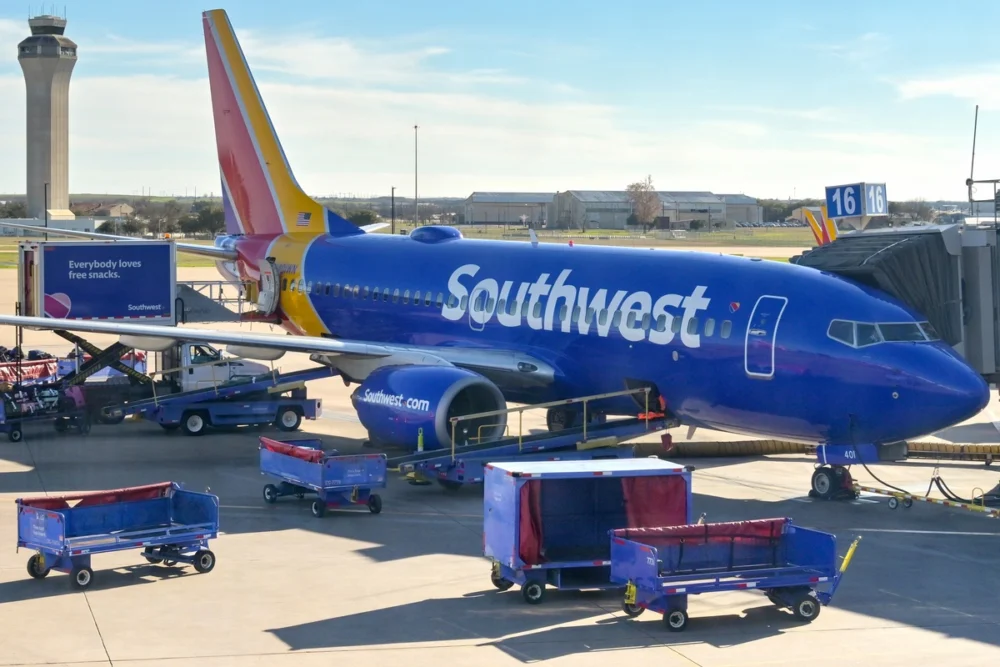
Southwest Airlines has officially prohibited its workforce from utilizing smart glasses and other wearable technologies equipped with recording capabilities during working hours, marking a significant shift in the carrier’s internal privacy and security protocols. According to an internal memorandum distributed to staff on Thursday, February 26, 2026, and subsequently reviewed by industry analysts, the Dallas-based airline is extending this ban to include both corporate and frontline employees, encompassing everyone from administrative personnel to flight crews and ground operations staff. The policy update addresses a rapidly growing category of consumer electronics that integrates artificial intelligence, cameras, and microphones into everyday accessories, raising concerns regarding passenger privacy, data security, and operational safety.
The directive specifically targets devices such as AI-powered smart glasses and high-tech wireless earbuds that possess the capacity to record audio or video. In a notable escalation of standard workplace device policies, the memorandum clarifies that these restrictions apply not only while employees are on company premises but also during the performance of duties off-site. This includes transit periods and layovers where employees are representing the brand or engaged in work-related activities. The airline’s move comes at a time when the consumer market for wearable technology is experiencing an unprecedented surge, driven largely by advancements in integrated AI and miniaturized optical sensors.
The Evolution of Wearable Technology in the Aviation Sector
The decision by Southwest Airlines follows a year of explosive growth for the wearable technology sector. Market data indicates that sales of smart glasses, particularly those developed through high-profile collaborations such as Meta’s partnership with Ray-Ban, have tripled over the last twelve months. Unlike the initial wave of "smart" eyewear like Google Glass, which was often criticized for its conspicuous design, modern iterations are nearly indistinguishable from traditional prescription glasses or sunglasses. This stealthy integration of technology has created a new set of challenges for the aviation industry, where the recording of sensitive operations or private passenger interactions can have legal and reputational consequences.
The chronology of this policy change reflects a broader industry-wide concern regarding the "always-on" nature of modern gadgets. Throughout 2024 and 2025, several minor incidents were reported across various domestic carriers involving unauthorized filming of cockpit procedures or passenger disputes by employees using discreet wearable tech. While Southwest has not publicly cited a specific catalyst for the ban, the timing suggests a proactive attempt to mitigate risks before such devices become ubiquitous among its nearly 75,000 employees. The memo emphasizes that the update is a necessary evolution of the company’s "Acceptable Use Policy" for electronic devices, which originally focused on smartphones and tablets.
Privacy Concerns and Passenger Confidentiality
At the heart of the ban is the protection of passenger privacy. In the confined environment of an aircraft cabin, the expectation of privacy is a sensitive issue. Flight attendants and gate agents are frequently privy to personal passenger information, medical emergencies, and high-tension interactions. The presence of recording-capable eyewear introduces the risk of these moments being captured without consent and potentially uploaded to social media or leaked to the public.
Security experts note that the aviation environment is also a high-security zone where specific protocols, such as the entry codes for flight decks or the handling of security-sensitive documentation, must remain confidential. "The integration of high-definition cameras into eyewear allows for hands-free recording that is difficult for supervisors or the public to detect," noted a workplace privacy analyst. "For an airline, this represents a massive liability. If an employee accidentally records a security procedure or a private conversation with a high-profile passenger, the airline could face significant legal ramifications under wiretapping laws or data protection regulations like the CCPA or GDPR."
Furthermore, the memorandum highlights that the ban extends to wireless earbuds with recording capabilities. While most earbuds are designed for audio output, a new generation of "hearables" includes built-in microphones optimized for high-fidelity environmental recording and AI-driven transcription. Southwest’s policy aims to close these loopholes, ensuring that no device capable of capturing ambient data is active during the workday.
Operational Safety and Federal Regulations
Beyond privacy, operational safety remains a paramount concern for Southwest. The airline industry operates under strict Federal Aviation Administration (FAA) guidelines regarding the use of personal electronic devices (PEDs). For flight crews, the "sterile cockpit" rule mandates that pilots focus entirely on essential flight operations during critical phases of flight. The introduction of smart glasses, which can display notifications or augmented reality (AR) overlays, presents a potential source of cognitive distraction.
Ground crews, including baggage handlers and mechanics, also face safety risks if their attention is diverted by wearable tech. The airport ramp is a hazardous environment where situational awareness is vital for survival. Southwest’s memo suggests that the ban is partly intended to ensure that employees remain fully present and attentive to their physical surroundings. Distractions caused by incoming messages or the recording of "behind-the-scenes" content for social media could lead to workplace accidents or operational delays.
The policy change also aligns with the airline’s recent efforts to streamline operations and improve its reliability metrics. By removing the potential for technological distraction, the carrier hopes to maintain its focus on its "Even Better" transformation plan, which seeks to modernize the airline’s business model while maintaining its signature efficiency.
Labor Relations and Employee Reaction
The implementation of such a broad ban is expected to trigger discussions with the various labor unions representing Southwest employees, including the Southwest Airlines Pilots Association (SWAPA) and the Transport Workers Union (TWU). While unions generally support measures that enhance safety, the extension of the ban to "off-premises" scenarios may be a point of contention.
Historically, airline employees have used personal devices during "deadheading" (traveling as a passenger for work) or during rest periods at hotels. If the policy is interpreted strictly, it could limit what employees can wear in their personal time if they are in uniform or on a layover funded by the company. Legal experts suggest that the "off-premises" clause is likely designed to prevent employees from recording content in public areas of airports or in shuttle buses where they are still perceived as representatives of the airline.
Inferred reactions from the workforce suggest a mix of understanding and frustration. Some employees recognize the need for privacy in a customer-facing role, while others view the ban as an overreach into personal technology choices, especially for those who use smart glasses for legitimate vision correction with integrated blue-light filters or photochromic lenses.
Comparative Industry Landscape
Southwest is not the first carrier to grapple with wearable tech, but its comprehensive ban is among the most stringent in the U.S. domestic market. Delta Air Lines and United Airlines have long-standing policies prohibiting the use of personal devices for non-work purposes while in view of passengers, but many of these policies were written before the current generation of AI eyewear reached mass-market appeal.
Industry analysts expect that other major carriers will follow Southwest’s lead. As the technology becomes more affordable and functionally superior, the "stealth" aspect of smart glasses makes them a unique threat to corporate confidentiality. "We are seeing a trend where the boundary between human perception and digital recording is blurring," said a consultant in aviation technology. "Southwest is essentially drawing a hard line in the sand, stating that while the technology exists, it has no place in a professional aviation environment."
Data Analysis: The Rise of the AI Wearable Market
To understand the urgency of Southwest’s policy, one must look at the data surrounding the wearable market. In 2025, the global smart glasses market was valued at approximately $1.2 billion, with a projected compound annual growth rate (CAGR) of over 25% through 2030. The primary drivers are the miniaturization of processors and the integration of Large Language Models (LLMs) that allow users to interact with their glasses via voice commands.
- Sales Volume: Meta reported a 300% increase in smart glasses shipments in the last fiscal year, moving the product from a niche gadget to a mainstream accessory.
- Technological Capability: Modern smart glasses now feature 12MP cameras capable of 1080p video recording and multi-microphone arrays that can isolate a single voice in a noisy cabin.
- Battery Life: Improvements in battery density now allow these devices to operate for an entire 8-hour shift, making them a persistent presence in the workplace.
By implementing this ban now, Southwest is attempting to stay ahead of a curve that could otherwise see thousands of recording devices entering its ecosystem every month.
Broader Implications and Future Outlook
The Southwest memo marks a pivotal moment in the intersection of workplace rights and the rapid advancement of consumer AI. As wearable technology continues to evolve, the definition of "personal equipment" versus "prohibited recording devices" will become increasingly complex. For example, the emergence of smart contact lenses or advanced hearing aids with recording features will likely challenge the enforcement of these policies in the future.
For now, Southwest’s stance is clear: the risk to passenger trust and operational security outweighs the convenience of wearable tech. The airline has stated it will provide further guidance on how employees can request exemptions for medically necessary devices that may inadvertently fall under the "wearable tech" umbrella, but the default position remains a total prohibition during working hours.
As the airline industry continues to navigate the post-pandemic landscape, maintaining a balance between technological innovation and the human element of service remains a top priority. Southwest’s decision serves as a reminder that in an era of constant connectivity and pervasive recording, the value of an unrecorded, private, and safe travel experience is higher than ever. The industry will be watching closely to see how this policy impacts employee morale and whether it successfully prevents the privacy breaches that the airline so clearly fears.