

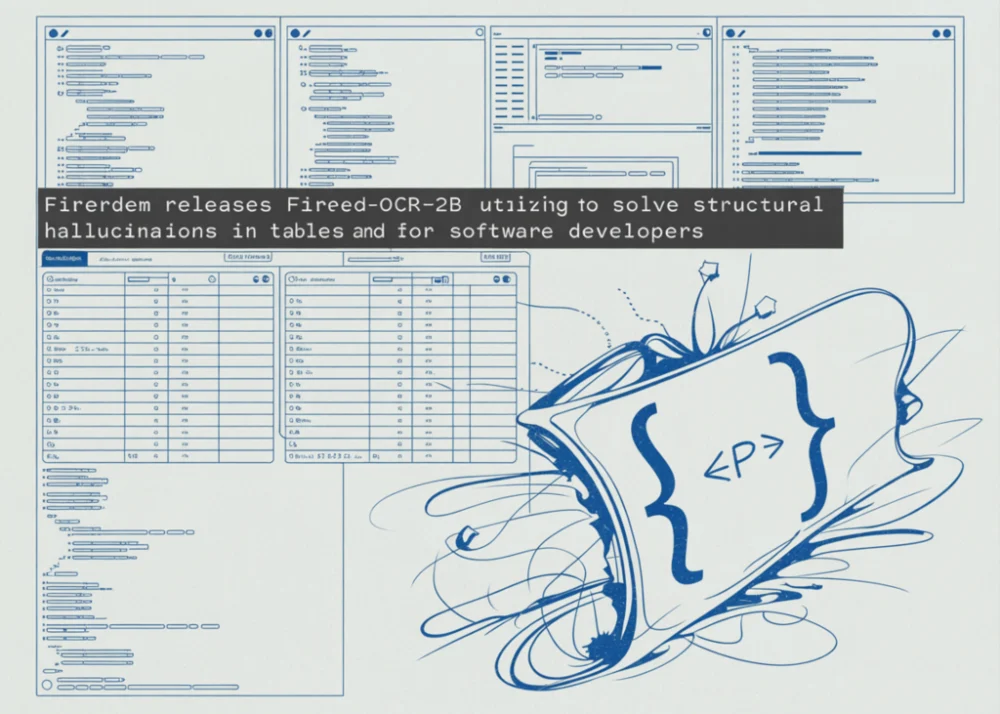
The FireRedTeam has officially announced the release of FireRed-OCR-2B, a high-performance vision-language model (VLM) specifically engineered to bridge the gap between visual document perception and structured data extraction. Built upon the Qwen3-VL-2B-Instruct architecture, this model represents a significant departure from traditional optical character recognition (OCR) methodologies, which have historically relied on fragmented multi-stage pipelines. By treating document parsing as a rigorous structural engineering challenge rather than a simple text generation task, FireRed-OCR-2B has established a new benchmark for end-to-end solutions, achieving a record-breaking overall score of 92.94% on the OmniDocBench v1.5 evaluation framework.
The release comes at a critical juncture in the evolution of artificial intelligence, as enterprises increasingly seek to integrate complex PDF documents, technical manuals, and academic papers into Large Language Model (LLM) workflows. For years, the industry standard involved a disjointed process: first employing a layout detection model to identify regions of interest, then utilizing an OCR engine to extract raw text, and finally applying a post-processing layer to reconstruct the original structure. This "pipeline" approach, while functional, often introduces cumulative errors, where a mistake in layout detection cascades into a total failure of structural reconstruction. FireRed-OCR-2B aims to eliminate these friction points by consolidating the entire process into a single, cohesive neural network.
The Evolution of Document Digitization: From Characters to Structure
To understand the significance of FireRed-OCR-2B, one must examine the historical trajectory of OCR technology. Early iterations of OCR, such as Tesseract, focused primarily on character-level recognition within clean, high-contrast environments. As deep learning matured, models began to handle more complex backgrounds and fonts, but the "structural" aspect of documents—tables, multi-column layouts, and mathematical formulas—remained a persistent hurdle.
The rise of Large Vision-Language Models (LVLMs) offered a potential solution, promising the ability to "read" and "understand" documents simultaneously. However, these models frequently suffered from what researchers call "structural hallucinations." In these instances, a model might correctly identify the words on a page but fail to maintain their spatial relationships, leading to disordered rows in tables, unclosed LaTeX syntax in equations, or the complete invention of data points that do not exist in the source material. FireRed-OCR-2B addresses these limitations through a specialized training philosophy that prioritizes geometric and semantic alignment over mere character accuracy.
A Three-Stage Progressive Training Pipeline
The development of FireRed-OCR-2B utilized a sophisticated Progressive Training Pipeline, designed to incrementally build the model’s competency from basic visual recognition to complex structural synthesis. This methodology ensures that the model does not lose its foundational vision-language capabilities while acquiring specialized OCR skills.
The first stage of the pipeline focuses on foundational vision-language alignment. During this phase, the model is exposed to vast quantities of image-text pairs to establish a robust understanding of how visual features correspond to linguistic descriptions. This provides the "common sense" required for the model to interpret the context of a document.
The second stage transitions into OCR-specific pre-training. Here, the model is trained on massive datasets containing diverse document types, ranging from standard office memos to complex technical blueprints. The goal is to sharpen the model’s ability to detect text at varying scales and orientations.
The final stage involves high-precision supervised fine-tuning (SFT). During this phase, the FireRedTeam introduced high-quality, human-annotated data that emphasizes structural integrity. This stage is where the model learns the nuances of Markdown formatting, LaTeX equation rendering, and complex table structures. By progressively increasing the difficulty and specificity of the training data, the developers ensured that FireRed-OCR-2B could handle the "long-tail" of document layouts that typically baffle general-purpose VLMs.
Technical Innovation: Format-Constrained GRPO
Perhaps the most significant technical differentiator of FireRed-OCR-2B is its implementation of Format-Constrained Group Relative Policy Optimization (GRPO). While traditional fine-tuning methods rely on cross-entropy loss to minimize the difference between the model’s output and a ground-truth label, GRPO introduces a reinforcement learning loop that explicitly rewards the model for adhering to structural constraints.
Unlike standard Reinforcement Learning from Human Feedback (RLHF), which often requires a separate "critic" model to evaluate outputs, the GRPO algorithm optimizes the training process by comparing the relative performance of multiple outputs generated from the same prompt. In the context of OCR, the FireRedTeam implemented specific reward functions that target high-friction areas:
- Syntactic Correctness: The model is rewarded for producing valid LaTeX and Markdown code. For example, ensuring that every mathematical environment opened with a "$" is correctly closed.
- Structural Consistency: Rewards are given for maintaining the correct number of columns and rows in tables, preventing the "row-shifting" errors common in other models.
- Geometric Fidelity: The model is penalized for hallucinating text that does not correspond to the geometric features identified in the visual input.
This reinforcement learning approach allows FireRed-OCR-2B to develop a "self-correcting" mechanism, where it prioritizes the logical structure of the document as much as the textual content.
The "Geometry + Semantics" Data Factory
A model is only as good as the data used to train it, and the FireRedTeam addressed this by creating a "Geometry + Semantics" Data Factory. This novel data synthesis engine uses geometric feature clustering and multi-dimensional tagging to generate balanced datasets that reflect the complexity of real-world documents.
In many existing OCR datasets, there is an over-representation of simple, single-column text documents. The Data Factory solves this by identifying "long-tail" scenarios—such as non-standard legal forms, academic papers with overlapping figures, and documents with handwritten annotations—and synthesizing new examples that mimic these challenges. By combining geometric awareness (the "where") with semantic understanding (the "what"), the Data Factory allows FireRed-OCR-2B to maintain "In-the-Wild Robustness." This robustness was put to the test on the FireRedBench dataset, where the model significantly outperformed traditional pipeline systems like PaddleOCR on complex, non-standard layouts.
Benchmarking Performance: Setting the SOTA
The performance of FireRed-OCR-2B has been validated against the most rigorous benchmarks in the field. On the OmniDocBench v1.5, which evaluates a model’s ability to parse diverse document types with high precision, FireRed-OCR-2B achieved an overall score of 92.94%.
When compared to other leading end-to-end models, the results are telling:
- FireRed-OCR-2B: 92.94%
- InternVL2-2B: 84.10%
- MiniCPM-V-2.6: 78.50%
While some highly specialized "pipeline" solutions—which utilize separate, heavy models for detection and recognition—occasionally achieve slightly higher scores on specific sub-tasks, FireRed-OCR-2B represents the pinnacle of performance for a single-model, end-to-end approach. For developers, this is a critical distinction. A single-model approach drastically reduces system complexity, simplifies deployment, and lowers inference latency, making it ideal for production-grade Retrieval-Augmented Generation (RAG) environments.
Broader Impact and Implications for AI Engineering
The release of FireRed-OCR-2B has profound implications for the field of AI engineering and data science. As the industry moves toward "Agentic" workflows—where AI agents are tasked with navigating software and processing documents autonomously—the need for reliable document parsing becomes paramount.
One of the primary bottlenecks in modern RAG systems is the "garbage in, garbage out" problem. If an OCR system fails to correctly parse a table in a financial report, the downstream LLM will inevitably provide incorrect analysis. By providing a high-fidelity structural map of a document, FireRed-OCR-2B ensures that the data fed into LLMs is accurate and well-organized.
Furthermore, the model’s 2B parameter size is a strategic choice. While 70B or 400B parameter models offer immense reasoning capabilities, they are often too slow and expensive for high-volume document processing. A 2B parameter model strikes the perfect balance between sophisticated understanding and computational efficiency, allowing for local deployment on edge devices or cost-effective scaling in the cloud.
Conclusion and Availability
The FireRed-OCR-2B model marks a shift in how the AI community approaches the problem of document understanding. By moving away from "impressionist" text generation and toward a philosophy of structural engineering, the FireRedTeam has provided a tool that is both powerful and practical.
In a move to support the broader research and development community, the FireRedTeam has made the model weights and the underlying repository publicly available on Hugging Face and GitHub. This open-access approach is expected to accelerate the adoption of end-to-end OCR solutions across various industries, from legal and finance to healthcare and academia. As the digital transformation of physical and "dark" data continues, models like FireRed-OCR-2B will serve as the essential foundation for a more interconnected and data-literate AI ecosystem.