

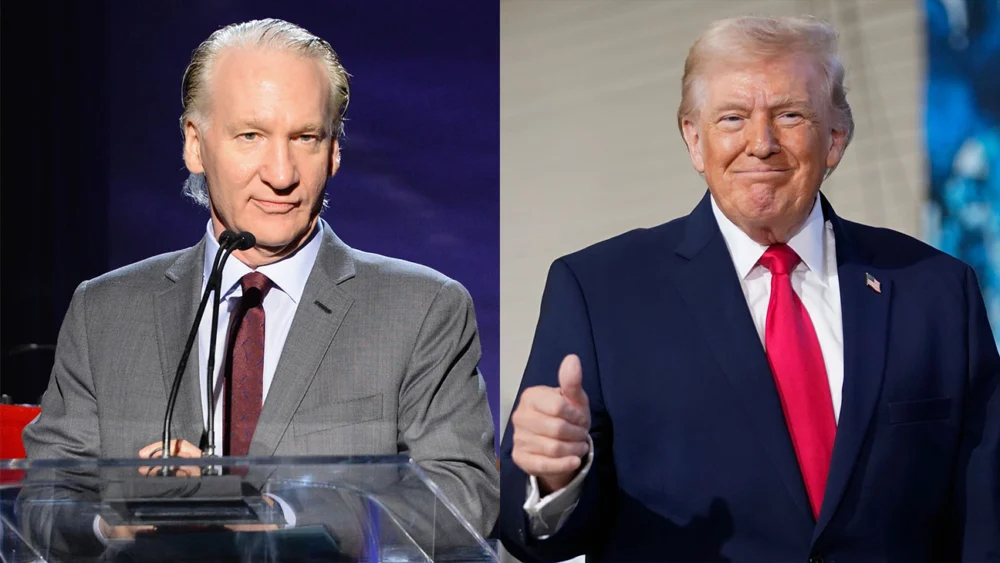
Nearly three weeks after Donald Trump publicly declared that his past dinner with Bill Maher was a "waste of time," the HBO host used his "New Rules" segment on Real Time to offer a comprehensive and often pointed rebuttal. Maher, directly addressing Trump’s February 14th Truth Social posts, vehemently denied suffering from "Trump Derangement Syndrome," instead positing that the former president might be afflicted with "Bill Maher Derangement Syndrome," a condition he suggested Trump exhibits through his continued social media commentary on Maher.
The exchange began when Trump, referencing a dinner that took place in the spring of 2025, claimed Maher had "asked to have dinner" with him and appeared "extremely nervous," requesting a "Vodka Tonic" to "soothe his nerves." Trump also stated Maher was "scared" and that he was "no different than Kimmel, Fallon, or Colbert" in his eventual criticism. Maher, however, meticulously dismantled these assertions, presenting his own account of the evening and the subsequent fallout, using video clips from his show and previous interviews to underscore his points.
Reconstructing the Dinner: A Different Perspective
Maher began by correcting what he described as factual inaccuracies in Trump’s account. He stated that the invitation to dinner did not originate from him but was extended through a mutual friend, Kid Rock, for an appearance on Rock’s podcast. Maher also confirmed he had "a drink before dinner and then a couple more during," acknowledging he was enjoying himself.
"I was having a good time," Maher stated, "So were you, Don, because we were talking like real humans, not like that crazy act you put on in public, but I know that’s what you do." He characterized Trump during the dinner as a man who "wears his heart on his sleeve," listing his accomplishments and expressing hurt over perceived lack of recognition. Maher indicated he understood this feeling, noting, "I understand that feeling."
The comedian then revealed a crucial detail about the immediate aftermath of their meeting. Shortly after the dinner, Trump texted Maher, complaining that Maher was "still part of the lunatic left" and asserting that he should have "won a Nobel Prize for ending wars." Maher’s response, as recounted on his show, was a sarcastic retort: "Yeah, and I should have won 20 Emmys." This exchange, Maher suggested, highlighted a disconnect between the man he met and the public persona Trump projected.
Trump’s alleged final words to Maher that evening, as relayed by the host, were: "Bill, you know what? Don’t change. I wouldn’t know what to do with you if you did OK." Maher interpreted this as a sign of the "normal human being" he encountered, and expressed a belief that "as long as I think there’s even a spark of a possibility to bring that guy out more, I will not consider the dinner a waste of time." He added, with a touch of irony, that despite the president’s recent name-calling, he had new insults like "highly overrated lightweight" to add to his collection.
A Complex Relationship: Praise and Criticism Intertwined
A significant portion of Maher’s rebuttal focused on demonstrating that his stance towards Trump has been nuanced, encompassing both praise and criticism, rather than the uniformly negative portrayal Trump suggested. Maher presented clips from his show over the years, showcasing instances where he acknowledged and even applauded specific Trump administration policies and actions, despite facing backlash from his own more liberal audience.
Key instances of Maher’s acknowledged support for Trump initiatives included:
- Border Security: Maher conceded that the concept of a "perfect border" and "mass removal of stone cold criminals" was a policy that resonated with Trump’s base and contributed to his election. He stated, "The border is a win. You mentioned the mass removal of stone cold criminals. This is what got Trump elected. We’re going to get the gangs out.”
- Foreign Policy Actions: Maher cited his support for Trump’s decision to bomb a nuclear facility in Iran and his lack of opposition to a U.S. military operation that he believed led to the removal of Nicolás Maduro from power in Venezuela.
- NATO Contributions: Maher agreed with Trump’s assertion that NATO members should pay "their fair share" towards collective defense, a long-standing point of contention.
- Combating Extremism: Maher gave Trump credit for publicly disavowing the "Nick Fuentes Jew-hating wing of the Republican Party," quoting Trump’s stance: "We don’t want you."
- Economic Forecasts: Maher shared a clip where he admitted he was wrong in predicting that the U.S. economy would be "in the shitter" by July 4th. He used this as an example of his willingness to admit error, contrasting it with what he perceived as Trump’s inability to do so.
Maher’s overarching argument was that his critical approach stemmed from a desire for an "honest broker" perspective, even from the "lunatic left," as he put it. He stated, "I may be the last person from the lunatic left that is still an honest broker when it comes to you." He expressed regret that Trump could not accept criticism, suggesting that in an "alternative universe" where honest conversations were possible, he could offer "quite helpful" advice.
Unflinching Criticism: The Failures of the Trump Era
While Maher acknowledged areas where he found merit in Trump’s actions, he was equally unsparing in his critique of what he viewed as significant failures and detrimental aspects of the Trump presidency. This segment of his rebuttal aimed to directly counter Trump’s narrative of an administration solely focused on positive achievements.
Maher highlighted several areas of significant disagreement and concern:
- Immigration Policies: Despite acknowledging the rationale behind removing criminals, Maher condemned the "sadism and stupidity" that he believed accompanied the implementation of ICE policies.
- Economic Mismanagement: Maher pointed to Elon Musk’s Dogecoin as a "complete disaster," claiming that "people died for no reason" and that it did not cut government waste.
- Environmental Stance: Maher criticized Trump’s support for coal, calling it "not beautiful or clean," and his apparent disdain for renewable energy sources like wind power.
- International Relations: Maher accused Trump of "taking the side of autocrats instead of democratic allies around the world" and expressed disapproval of his antagonism towards Canada.
- Erosion of Democratic Norms: Maher explicitly condemned "criminalizing dissent," "juvenile trolling," and the tactic of "suing people into silence." He reiterated his criticism of Trump’s "election-denying obsession," his "pardons-for-my-friends-and-punishment-for-my-enemies mode of governing," and what he described as "side deals for your family that always seem to be part of everything."
Maher underscored the disconnect between Trump’s claims of "winning" and the economic realities faced by many of his supporters, citing a Democratic senator’s observation that the Trump administration was comprised of "the elites they pretend to hate." He warned that if Democrats effectively weaponized this message, Trump’s MAGA movement would face significant challenges.
The Broader Impact: Political Polarization and Media Discourse
The public spat between Donald Trump and Bill Maher offers a microcosm of the broader dynamics shaping American political discourse. Trump’s reliance on social media platforms like Truth Social for direct communication, often employing inflammatory language and personal attacks, has become a hallmark of his political brand. Maher, as a long-standing figure in political satire and commentary, represents a segment of media that engages with political figures, often critically, but also, as he demonstrated, with a capacity for acknowledgment of policy successes.
The fact that this exchange occurred nearly a year after their dinner meeting, and months after Trump’s initial criticisms, underscores the enduring nature of their public feud and the sensitivity of the former president to perceived slights. Maher’s detailed refutation, complete with documentary evidence in the form of video clips, suggests an attempt to control the narrative and to position himself not as a partisan adversary but as an independent observer capable of offering balanced, albeit often critical, analysis.
The involvement of figures like Larry David, who satirically compared Maher’s visit to the White House to "My Dinner With Adolf," further illustrates the polarized reactions to Maher’s engagement with Trump. Maher’s subsequent statement that David was "certainly is not really my friend anymore" highlights the personal cost of navigating these politically charged interactions within social circles.
The implications of this ongoing exchange extend beyond the personal animosity between two prominent figures. It speaks to the challenges of reasoned political debate in an era of hyper-partisanship and the complex relationship between politicians, the media, and the public. Maher’s attempt to articulate a nuanced position—acknowledging achievements while condemning perceived failures—is a rare endeavor in the current political climate, and its reception by both supporters and detractors will likely continue to be a subject of debate. The "Trump Estrangement Syndrome" Maher proposed as an alternative to "Trump Derangement Syndrome" serves as a sharp, if provocative, commentary on the former president’s perceived inability to tolerate dissent, even from those who have, at times, offered him qualified praise.