

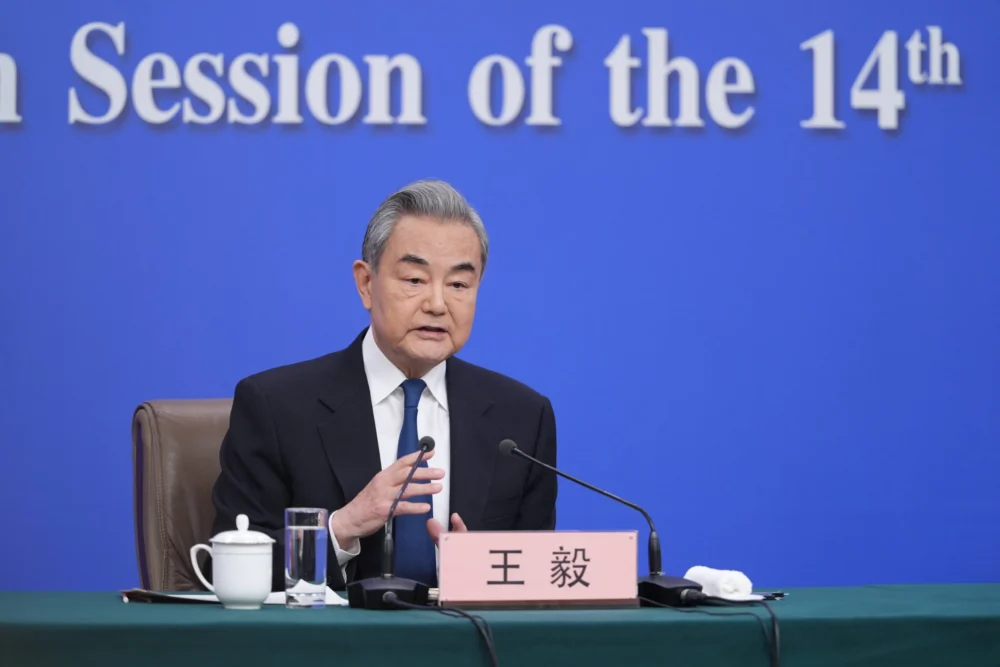
BEIJING – Chinese Foreign Minister Wang Yi, speaking on the sidelines of the fourth session of the 14th National People’s Congress (NPC) on March 8, 2026, in Beijing, emphatically championed the indispensable benefits of engagement with the United States. His remarks, delivered in Mandarin Chinese and subsequently translated, also strongly indicated that extensive preparations are actively underway for a highly anticipated meeting between the leaders of the world’s two largest economies, Chinese President Xi Jinping and U.S. President Donald Trump. This diplomatic overture comes amidst a fraught global landscape, marked by significant divergences over the escalating conflict in Iran and persistent disputes concerning bilateral trade tariffs.
"The agenda of high-level exchanges is already on the table," Wang Yi articulated to a room full of international and domestic journalists, highlighting the advanced stage of planning. "What the two sides need to do now is make thorough preparations accordingly, create a suitable environment, manage the risks that do exist and remove unnecessary disruptions." His words underscored a pragmatic approach to managing one of the globe’s most critical bilateral relationships, emphasizing the need for meticulous groundwork to ensure any future summit yields constructive outcomes. Wang’s cautionary tone further resonated as he warned against isolation, stating, "Turning our backs on each other would only lead to mutual misperception and miscalculation. Sliding into conflict or confrontation would only drag the whole world down." This statement serves as a stark reminder of the global ramifications inherent in the U.S.-China dynamic, stressing the imperative for dialogue over division.
Contextualizing the Diplomatic Overture: The Path to a Presidential Summit
The notion of a reciprocal visit between the two heads of state gained significant traction following an in-person meeting between President Xi Jinping and U.S. President Donald Trump in South Korea last fall. That encounter, occurring against a backdrop of complex geopolitical challenges, saw both leaders express a mutual desire to deepen communication and explore avenues for cooperation, culminating in public announcements regarding plans for reciprocal visits. Specifically, President Trump is tentatively scheduled to visit China from March 31 to April 2, 2026. If it proceeds as planned, this trip would mark the first visit to the People’s Republic of China by a sitting U.S. president since 2017, signifying a critical moment in contemporary U.S.-China relations.
However, Beijing has yet to issue an official confirmation of these exact dates, a detail Wang Yi refrained from elaborating upon during his press conference. Despite the lack of specific calendar details, the Foreign Minister emphasized the profound importance of the high-level interactions that have already transpired between the U.S. and Chinese presidents. He asserted that these engagements have "provided [an] important strategic safeguard for the China-U.S. relationship to improve and move forward." This framing suggests that even the prospect and planning of such meetings serve a vital function in stabilizing and guiding the relationship, irrespective of immediate outcomes. The historical context of U.S.-China presidential summits often reveals a pattern of carefully orchestrated dialogues, designed not only to address immediate crises but also to set a long-term strategic direction. For instance, past summits, from Nixon’s groundbreaking visit in 1972 to more recent encounters, have consistently aimed at managing competition while exploring cooperation in areas like climate change, global health, and non-proliferation. The current push for a summit reflects a similar strategic imperative, particularly as both nations navigate a turbulent international environment.
Geopolitical Flashpoints: The Iran Conflict and Regional Stability
The uncertainty surrounding President Trump’s visit dates is inextricably linked to a series of escalating global crises, particularly the intensifying conflict in Iran. Analysts and observers have voiced considerable doubt regarding the feasibility of the trip proceeding on schedule, especially given its proximity to recent joint U.S.-Israeli military strikes on Iran. These strikes, which commenced on February 28, 2026, have dramatically reshaped the Middle Eastern geopolitical landscape. One of the most significant and destabilizing outcomes of these operations was the reported death of Iran’s Supreme Leader, Ayatollah Ali Khamenei, a development confirmed by various international news outlets and, notably, a post by President Trump on his social media platform. Concurrently, the U.S. also announced the capture of Venezuelan leader Nicolas Maduro, adding another layer of complexity to an already volatile global situation.

While Wang Yi meticulously avoided naming either Ayatollah Khamenei or Nicolas Maduro in his public remarks on Sunday, his message unequivocally reiterated Beijing’s fervent calls for an immediate and comprehensive ceasefire in the ongoing Iran conflict. "This is a war that should not have happened," Wang declared, his tone conveying a deep sense of concern. "It is a war that does no one any good." This statement aligns with China’s long-standing diplomatic principle of non-interference and its consistent advocacy for peaceful resolution of international disputes, particularly in regions vital for global energy security and trade.
The gravity of the situation is further underscored by Wang Yi’s intense diplomatic activity in the immediate aftermath of the U.S.-Israeli strikes. Official readouts from Beijing indicate that the Foreign Minister has engaged in phone calls with at least seven of his foreign counterparts, including those of Russia, Iran, and Israel. These urgent consultations, spanning from March 1 to March 4, 2026, highlight China’s proactive role in attempting to de-escalate tensions and foster dialogue among key regional and global players. Beijing’s engagement with both sides of the conflict, as well as with other influential powers like Russia, demonstrates its aspiration to be seen as a responsible stakeholder capable of mediating complex international crises. The implications of the Iran conflict for global oil markets, regional stability, and the broader U.S.-China strategic competition are immense, making Beijing’s diplomatic efforts particularly salient. A prolonged or expanded conflict in the Middle East could severely disrupt global supply chains, trigger humanitarian crises, and further complicate efforts to address other pressing international issues, including climate change and economic recovery.
Economic Undercurrents: Trade Tariffs and Decoupling Concerns
Beyond the immediate geopolitical flashpoints, the bedrock of U.S.-China relations continues to be defined by complex economic interactions, particularly the contentious issue of trade tariffs. The bilateral discussions regarding a high-level summit come as the two economic powerhouses operate under a fragile truce, established in October of the previous year. This agreement saw both nations consent to lower tariffs on each other’s goods to below 50% for a period of one year. This represents a significant de-escalation from the height of trade tensions last spring, when duties had been ratcheted up to well over 100% on a vast array of goods, severely impacting industries and consumers in both countries. For example, during the peak of the trade war in 2019-2020, U.S. tariffs covered hundreds of billions of dollars worth of Chinese imports, leading to significant shifts in global supply chains and an estimated decrease in U.S. GDP by 0.3% to 0.7%, according to various economic analyses. China’s retaliatory tariffs similarly affected U.S. agricultural exports and manufacturing.
Wang Yi’s address also touched upon the philosophical underpinnings of global economic governance. When questioned about President Trump’s previous characterization of U.S.-China relations as a new "G2" – implying a dual leadership by the two nations in steering global affairs – Wang Yi offered a firm pushback. He rejected the notion that two countries alone could or should assume such a dominant role, instead emphasizing China’s unwavering commitment to the principle of multipolarity in international relations. This concept posits a world order where power is distributed among multiple major poles, fostering a more balanced and inclusive global governance system, rather than one dominated by a single or dual hegemon. This stance reflects China’s broader foreign policy objectives, which seek to empower developing nations and create a more equitable international order.
Furthermore, without directly naming the United States, Wang Yi issued a clear and pointed warning against policies characterized by "erecting tariff barriers and pushing [for] economic and technological decoupling." His metaphor was vivid and stark: "This is no different from using kindling to put out a fire. You will only get burned." This statement is a direct critique of protectionist measures and strategies aimed at severing economic and technological ties between nations, particularly those advocating for a complete separation of U.S. and Chinese supply chains in critical sectors like semiconductors, artificial intelligence, and telecommunications. The concept of "decoupling" has gained traction in certain U.S. policy circles as a means to reduce reliance on China and protect national security interests. However, from Beijing’s perspective, such policies are not only economically damaging but also destabilizing for the global trading system, risking fragmentation and inefficiency. Data from the World Trade Organization (WTO) consistently highlights the interconnectedness of global economies, with disruptions in major trade relationships having ripple effects across continents. For instance, the semiconductor industry, a focal point of decoupling efforts, relies on a highly complex global supply chain that cannot be easily replicated or bifurcated without significant cost and time.
The Global Governance Debate: Multipolarity vs. the ‘G2’
Wang Yi’s strong advocacy for multipolarity over a "G2" framework is not merely a rhetorical flourish; it represents a fundamental divergence in geopolitical vision. The "G2" concept, occasionally floated in Western policy circles, suggests that the sheer economic and military might of the United States and China necessitate their joint stewardship of global challenges. Proponents argue that cooperation between these two giants is essential for addressing issues ranging from climate change to nuclear proliferation. However, China views such a framework with skepticism, seeing it as potentially undermining the sovereignty of other nations and consolidating power in a way that contradicts its vision of a more diverse and balanced international system. Beijing consistently champions multilateral institutions like the United Nations and the Shanghai Cooperation Organization, advocating for a greater voice for developing countries and a rejection of any single nation’s or two nations’ hegemonic aspirations. This philosophical debate has significant implications for how global challenges will be addressed in the coming decades, influencing everything from trade negotiations to climate accords and regional security architectures.

Domestic Backdrop: The National People’s Congress
Wang Yi’s comprehensive address was delivered within the significant domestic context of China’s annual parliamentary meeting, the National People’s Congress (NPC). This eight-day gathering, a cornerstone of China’s political calendar, is set to conclude on Thursday. The NPC session is far more than a ceremonial event; it serves as the primary platform for the nation’s top leaders, including President Xi Jinping, Premier Li Qiang, and Vice Premier He Lifeng, to convene with delegates representing various regions and sectors from across the country. During this period, key policy directives are unveiled, legislative agendas are discussed, and the nation’s economic and social development goals for the upcoming year are formally endorsed.
For foreign policy, the NPC offers a crucial opportunity for China to articulate its stance on global issues, project its diplomatic priorities, and signal its strategic intentions to both domestic and international audiences. Wang Yi’s press conference, therefore, was not merely an impromptu briefing but a carefully calibrated diplomatic statement, reflecting the consensus and strategic direction forged within the highest echelons of Chinese leadership during the NPC session. His remarks on U.S.-China relations, the Iran conflict, and global economic principles thus carry the weight of the collective will of the Chinese state, underscoring the seriousness and strategic depth of Beijing’s engagement with these critical issues. The setting of the NPC provides a formal and authoritative platform for such pronouncements, lending them additional gravitas and ensuring they are interpreted as official state positions rather than individual ministerial opinions.
Path Forward and Implications
The coming weeks will be critical in determining the trajectory of U.S.-China relations and the broader geopolitical landscape. The successful execution of a Xi-Trump summit, should it materialize as planned, could offer a much-needed opportunity for de-escalation and strategic realignment, particularly concerning trade and regional conflicts. A productive dialogue could pave the way for renewed cooperation on shared global challenges, potentially leading to a more stable and predictable international environment. Conversely, a cancellation or a contentious summit could exacerbate existing tensions, deepen mistrust, and further entrench a confrontational dynamic between the world’s two most powerful nations.
The ongoing situation in Iran, the implications of leadership changes, and the volatility in global energy markets will undoubtedly cast a long shadow over any bilateral discussions. China’s consistent call for a ceasefire reflects a deep concern for regional stability and its economic interests, given its significant reliance on Middle Eastern oil. Its diplomatic engagement with all parties, including Russia, Iran, and Israel, underscores Beijing’s ambition to play a constructive, albeit non-aligned, role in resolving complex international crises.
Economically, the fragile tariff truce remains a focal point. While a temporary reprieve has been achieved, the underlying structural issues in U.S.-China trade relations, particularly those related to intellectual property, market access, and industrial subsidies, persist. Wang Yi’s warning against "decoupling" highlights China’s commitment to globalization and integrated supply chains, challenging protectionist impulses. The outcome of these economic discussions will have profound implications for global trade volumes, technological innovation, and the future of multilateral economic governance. As the world watches Beijing and Washington navigate these intricate challenges, the rhetoric from the NPC underscores China’s strategic resolve to shape a global order that reflects its vision of multipolarity and peaceful coexistence, even amidst significant geopolitical turbulence.