


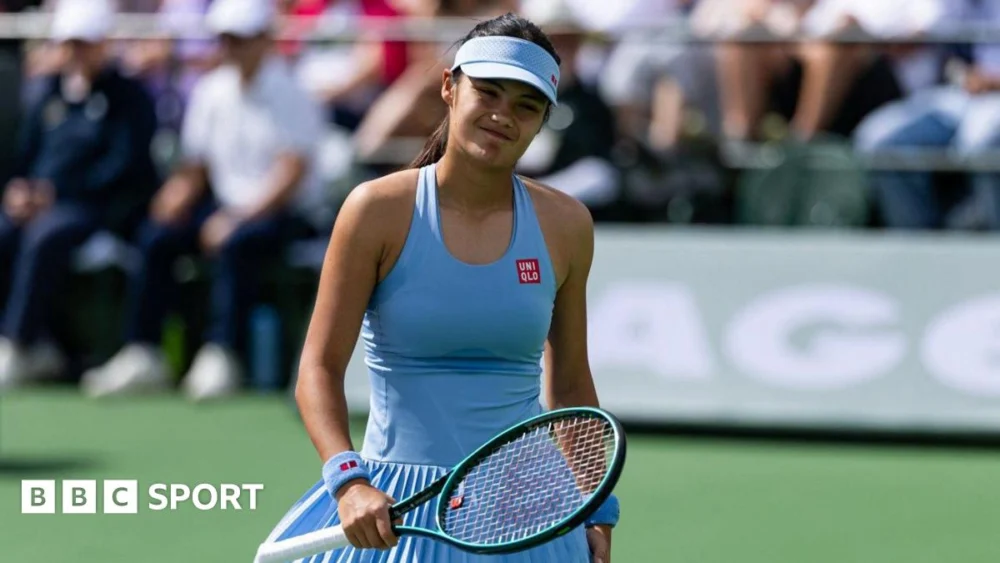
Britain’s Emma Raducanu experienced a swift and disheartening exit from the BNP Paribas Open at Indian Wells on Monday, falling decisively to the sixth seed, Amanda Anisimova, in a third-round encounter that concluded in a mere 52 minutes with a scoreline of 6-1, 6-1. The performance marked a significant regression from Raducanu’s dominant second-round victory and cast a shadow over her aspirations to recapture the scintillating form that propelled her to a historic US Open title in 2021.
Anisimova’s Dominance from the Outset
The match began with an immediate indication of the struggles that would define Raducanu’s day. The 25th seed was broken in the very first game, a pattern that would unfortunately persist throughout the contest. It rapidly became apparent that Raducanu, the 2021 US Open champion, found herself unable to counter the aggressive and focused approach of her American opponent. The first set slipped away with alarming speed, with Raducanu managing to win a mere 11 points. This statistic underscored Anisimova’s command of the court and Raducanu’s inability to establish any rhythm or foothold in the match.
The second set followed a depressingly similar trajectory. Raducanu found herself staring down a three-game deficit early on, a hole from which she ultimately proved unable to climb. While she managed to hold her serve at one point in the second set, it offered little respite as Anisimova continued to dictate play and relentlessly press her advantage. The American’s decisive play and unwavering confidence were in stark contrast to Raducanu’s apparent struggles, culminating in Anisimova securing the remaining games needed to advance to the next round.
Context of Raducanu’s Recent Coaching Changes and Aspirations
This decisive loss arrives at a juncture where Raducanu has been actively seeking to refine her game and coaching setup. In January, she parted ways with Francisco Roig, and in the lead-up to Indian Wells, she enlisted Mark Petchey as a temporary coach. Raducanu had spoken optimistically about this partnership, expressing a desire to "rediscover her ‘natural way of playing’." This sentiment was rooted in her ambition to build momentum towards regaining the form that led to her fairytale Grand Slam triumph. However, the reality on the court against Anisimova offered no such redemption, as the American’s clinical performance denied Raducanu any opportunity to showcase a resurgence.
The stark contrast between Raducanu’s performance in this match and her commanding second-round victory over Russia’s Anastasia Zakharova, which concluded 6-1, 6-3, highlights the unpredictable nature of professional tennis and the significant gap in performance witnessed on this occasion. While her second-round display demonstrated flashes of her undeniable talent and potential, her third-round outing revealed a player grappling with significant challenges.
Anisimova’s Perspective and the BNP Paribas Open Setting
Speaking on court after her emphatic victory, Anisimova conveyed a sense of calm and enjoyment in her performance. She stated that she was "just trying to go out there and have fun" and "be fearless." This relaxed yet determined mindset appeared to serve her well against the pressure that often accompanies matches against a Grand Slam champion. Anisimova’s clean hitting and strategic play effectively neutralized Raducanu’s attempts to dictate rallies, leaving the British star searching for answers.
The BNP Paribas Open, held annually in Indian Wells, California, is one of the most prestigious tournaments outside of the four Grand Slams. Often referred to as the "Fifth Slam," it attracts the top talent in both men’s and women’s professional tennis. The desert conditions, with their dry air and often strong winds, can present unique challenges for players, demanding adaptability and resilience. For Raducanu, who has shown remarkable ability to perform under pressure on the biggest stages, this early exit in such a significant event will undoubtedly be a source of disappointment.
Supporting Data and Performance Metrics
To further contextualize the match, an examination of key performance metrics reveals the extent of Anisimova’s superiority. While official match statistics are typically released post-match, the brevity of the encounter and the consistent pattern of play suggest a significant disparity in several areas. Anisimova likely dominated in terms of winners, unforced errors, and the percentage of points won on both her first and second serves. Raducanu’s inability to convert her service games and to consistently return Anisimova’s powerful serves were evident throughout the contest.
The average duration of a professional women’s singles match can vary significantly, but a 52-minute contest, especially one with such a lopsided scoreline, indicates a complete lack of competitive engagement. For comparison, Raducanu’s second-round match against Zakharova lasted approximately 70 minutes, demonstrating a more typical duration for a competitive tennis match at this level. The difference in time spent on court between the two matches highlights the degree of Anisimova’s dominance.
Broader Implications and Future Outlook
This defeat raises pertinent questions about Emma Raducanu’s current trajectory in professional tennis. Since her sensational US Open victory in 2021, she has faced numerous challenges, including injuries and a period of adaptation to the demands of the professional tour. The constant scrutiny and expectation that accompany a Grand Slam champion can be immense, and Raducanu’s journey has been closely followed by fans and media alike.
Her continued search for a stable coaching partnership and her stated desire to rediscover her "natural way of playing" suggest an ongoing process of development. While setbacks are an inevitable part of any athlete’s career, the nature of this loss, characterized by a swift and overwhelming defeat, will likely lead to further analysis of her game and preparation.
For Amanda Anisimova, this victory represents a significant boost to her confidence and a strong statement of intent at a major tournament. As the sixth seed, she entered Indian Wells with high expectations, and her performance against Raducanu demonstrates her capability to compete with and defeat top-ranked players. Her progress in the tournament will be closely watched, as she aims to capitalize on this momentum.
The immediate future for Emma Raducanu will likely involve a period of reflection and further adjustments. The tour schedule is demanding, and upcoming tournaments will present new opportunities to demonstrate her resilience and to implement the lessons learned from this experience. The ability to bounce back from such a significant defeat will be a crucial test of her mental fortitude and her long-term potential in the sport. Tennis fans will be keenly observing her next steps as she navigates the challenges of maintaining a career at the highest level of the sport. The journey since her extraordinary Grand Slam breakthrough has been a complex one, and this latest chapter at Indian Wells adds another layer to her evolving narrative.