

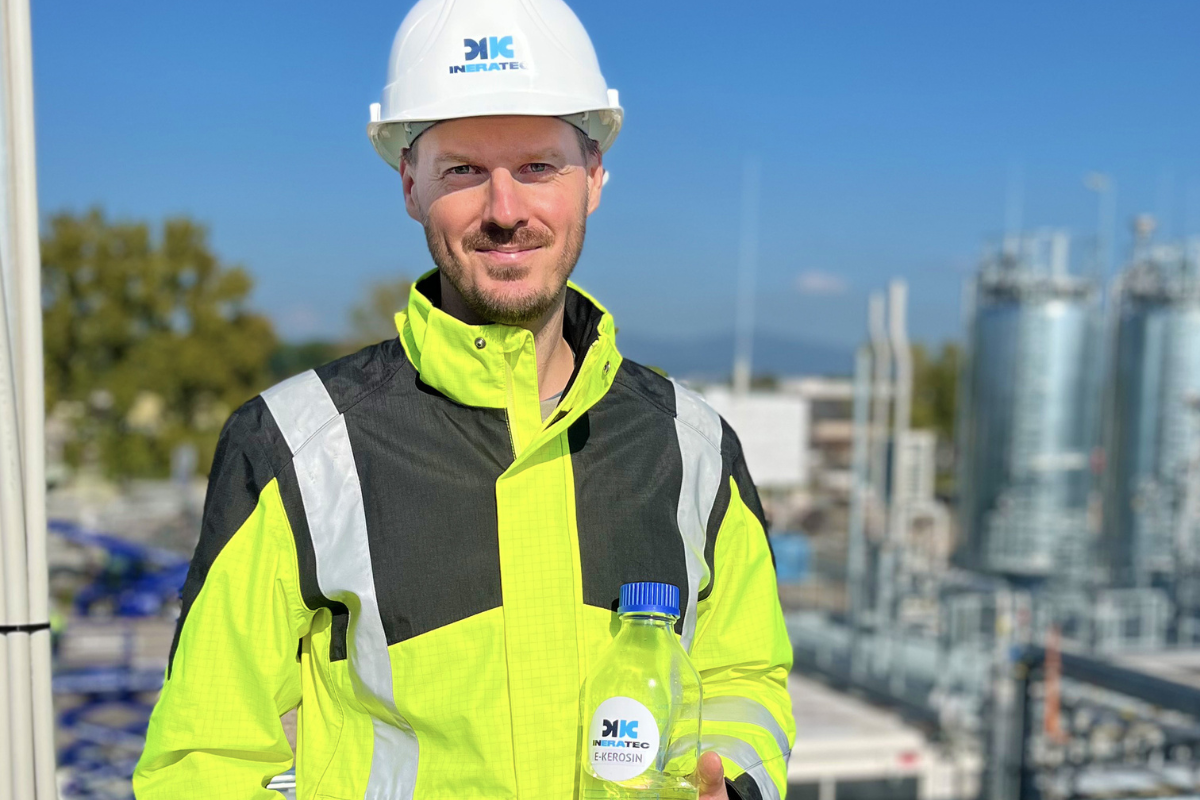
In an industrial park located on the fringes of Frankfurt, Germany, a pioneering technological shift is taking place within a structure no larger than a standard shipping container. This facility, developed by the German cleantech company Ineratec, represents the commercial debut of "Era One," a plant designed to convert carbon dioxide and hydrogen into synthetic liquid hydrocarbons. The primary output of this process is electro-sustainable aviation fuel (eSAF), a substance that, while possessing the clarity and consistency of water, holds the potential to fundamentally transform the carbon footprint of the global aerospace industry. As the aviation sector faces mounting pressure to decouple its growth from greenhouse gas emissions, the commissioning of Era One serves as a critical proof-of-concept for Power-to-Liquid (PtL) technology.
The fuel produced at this site is more than a laboratory curiosity; it is a drop-in solution certified for use in existing aircraft turbines and refueling infrastructure. Unlike traditional biofuels, which rely on organic matter like used cooking oil or agricultural waste, eSAF is synthesized from captured carbon and hydrogen derived from water electrolysis. This "synthetic" nature allows for a higher degree of purity and scalability, provided that the energy used in production is sourced from renewable grids. The significance of this breakthrough has not gone unnoticed by global investors. Breakthrough Energy Catalyst, the investment vehicle founded by Bill Gates to accelerate the commercialization of high-impact climate technologies, has identified Ineratec’s modular approach as a "promising path" to decarbonizing one of the world’s most difficult-to-abate sectors.
The Technological Architecture of Era One
The heart of the Era One facility lies in its modular chemical reactor technology. By utilizing a compact Fischer-Tropsch synthesis process, Ineratec has managed to miniaturize what was once a massive industrial undertaking. The process begins with the procurement of carbon dioxide—either captured from industrial point sources or potentially through Direct Air Capture (DAC)—and green hydrogen produced via electrolysis. These two elements are synthesized into a "syncrude," which is then refined into eSAF, synthetic diesel, and naphtha.
The modularity of the design is a strategic choice. Rather than building a single, multi-billion-dollar refinery that takes a decade to commission, Ineratec’s shipping-container-sized units can be manufactured in series and deployed closer to energy sources or airports. This decentralized model reduces the logistical complexities of transporting hydrogen, which is notoriously difficult to move over long distances. The Frankfurt plant currently boasts a production capacity of 2,500 tonnes of eSAF per year. While this is a fraction of the millions of tonnes consumed annually by the aviation industry, its primary purpose is to demonstrate that the technology can operate reliably at an industrial scale, paving the way for larger "megaplants."
Regulatory Drivers and the ReFuelEU Mandate
The launch of Era One coincides with a period of unprecedented regulatory shifts within the European Union. Under the "Fit for 55" package and the specific "ReFuelEU Aviation" initiative, the EU has established a legal framework that mandates the gradual integration of sustainable fuels into the aviation market. This is not a voluntary guideline but a strict requirement for fuel suppliers and airlines operating within the bloc.
According to the current timeline, EU airlines are mandated to include a minimum of 2% SAF in their fuel mix by 2025. However, the specific sub-mandate for eSAF—the synthetic variety produced by Ineratec—is where the real challenge lies. By 2030, at least 1.2% of the total fuel mix must be eSAF. While 1.2% may sound like a marginal figure, it equates to approximately 600,000 tonnes of synthetic fuel across the European market. The trajectory steepens sharply thereafter, with the total SAF requirement reaching 70% by 2050, of which 35% must be eSAF.
The financial stakes for non-compliance are high. The EU has signaled that failure to meet these blending targets could trigger penalties as high as €13,000 per tonne of shortfall. For an airline operating a fleet of long-haul jets, these fines would represent an existential threat to profitability, effectively making eSAF—despite its current high production cost—the more economical choice in the long term.
Scaling Challenges: From 2,500 to 600,000 Tonnes
The 2,500 tonnes produced annually by Era One provides a stark illustration of the scaling challenge ahead. To put this volume into perspective, the current output is sufficient to power roughly 30 long-haul flights (such as Frankfurt to New York) or approximately 1,000 average short-haul flights. To meet the 2030 EU mandate of 600,000 tonnes, the industry would require roughly 240 plants of the size and capacity of Era One.
This gap between current capacity and future demand has created a "chicken-and-egg" dilemma. Airlines are hesitant to commit to long-term purchase agreements without guaranteed supply, while fuel producers are reluctant to build massive plants without guaranteed buyers. Ineratec’s modular approach aims to bridge this gap by allowing for incremental scaling. By proving the technology in Frankfurt, the company aims to secure the "offtake agreements" necessary to fund larger facilities.
Supporting data suggests that the global demand for SAF will need to reach 450 billion liters annually by 2050 to meet the aviation industry’s net-zero goals. Currently, SAF accounts for less than 0.1% of global jet fuel consumption. The transition from Bio-SAF (HEFA-based fuels) to eSAF is considered essential because the availability of sustainable biomass and waste oils is limited and will eventually hit a ceiling. eSAF, by contrast, is limited only by the availability of renewable electricity and captured carbon.
Stakeholder Reactions and Strategic Partnerships
The commissioning of the Frankfurt plant has drawn reactions from across the political and corporate spectrum. Industry analysts view the project as a litmus test for Germany’s "Hydrogen Strategy." By hosting the plant in Frankfurt, a major global aviation hub, Germany is positioning itself as a leader in the "Power-to-X" economy.
Breakthrough Energy Catalyst’s involvement has been particularly influential. In a statement following the plant’s announcement, the firm emphasized that "bringing down the Green Premium"—the additional cost of a clean technology compared to its fossil-fuel counterpart—is the primary goal. By investing in Ineratec, the Catalyst program is providing the "first-of-a-kind" project financing that traditional commercial banks are often too risk-averse to offer.
Airlines have expressed cautious optimism. Major carriers like Lufthansa, which operates out of the nearby Frankfurt Airport, have been active participants in SAF trials for over a decade. However, the industry remains concerned about the price disparity. Currently, eSAF can cost three to five times more than conventional kerosene. Airlines are calling for government subsidies similar to those provided in the United States under the Inflation Reduction Act (IRA), which offers significant tax credits for SAF production, to ensure that European carriers remain competitive during the transition.
Chronology of the eSAF Transition
To understand the significance of Era One, it is necessary to look at the timeline of synthetic fuel development:
- 2016: Ineratec is founded as a spin-off from the Karlsruhe Institute of Technology (KIT), focusing on modular chemical plants.
- 2021: The EU proposes the ReFuelEU Aviation mandate as part of the Green Deal.
- 2022: Breakthrough Energy Catalyst announces its partnership with Ineratec to scale eSAF production.
- 2024: Era One is officially launched in Frankfurt, marking the transition from pilot phase to industrial-scale production.
- 2025: The first 2% SAF blending mandate takes effect in the EU.
- 2030: The 1.2% eSAF sub-mandate takes effect, requiring a massive surge in PtL infrastructure.
Environmental and Economic Implications
The environmental logic of eSAF is compelling. Conventional jet fuel releases carbon that has been sequestered underground for millions of years. eSAF, however, uses carbon that is already in the atmosphere or is being emitted by industrial processes, creating a circular carbon economy. When burned, it still releases CO2, but since that CO2 was captured during the production process, the net addition to the atmosphere is reduced by up to 80-90% compared to fossil fuels. Furthermore, eSAF contains fewer impurities like sulfur and aromatics, leading to a reduction in contrail formation, which is increasingly understood to contribute significantly to aviation’s non-CO2 warming effects.
Economically, the rise of eSAF could shift the geopolitics of energy. Traditional aviation fuel is tied to oil-producing regions. eSAF production, however, is tied to regions with abundant renewable energy. This could allow countries with high solar or wind potential to become the "energy hubs" of the future, exporting synthetic fuels in the form of liquid energy.
However, the path forward is not without hurdles. The production of eSAF is incredibly energy-intensive. To produce 600,000 tonnes of fuel, a staggering amount of renewable electricity is required to power the electrolyzers. If this electricity is not truly "green," the environmental benefits of the fuel are negated. Critics also point out that the carbon capture component of the process is still in its infancy, with high costs associated with Direct Air Capture.
Conclusion: A Blueprint for the Future
The Era One plant in Frankfurt is more than just a piece of industrial machinery; it is a physical manifestation of the aviation industry’s future. It demonstrates that the technical barriers to producing carbon-neutral jet fuel are being dismantled. However, the transition from a 2,500-tonne facility to a global supply chain capable of fueling thousands of aircraft daily will require a massive coordination of policy, capital, and engineering.
As the EU’s 2030 deadline approaches, the success of modular facilities like Ineratec’s will determine whether the aviation industry can meet its climate obligations without grounding its fleets. For now, the "shipping container" in Frankfurt stands as a lonely but vital outpost in the quest for sustainable flight, proving that the molecules needed to power the skies can be harvested from the air itself. The next decade will reveal whether this "promising path" can be widened into a global highway for the next generation of aviation.