

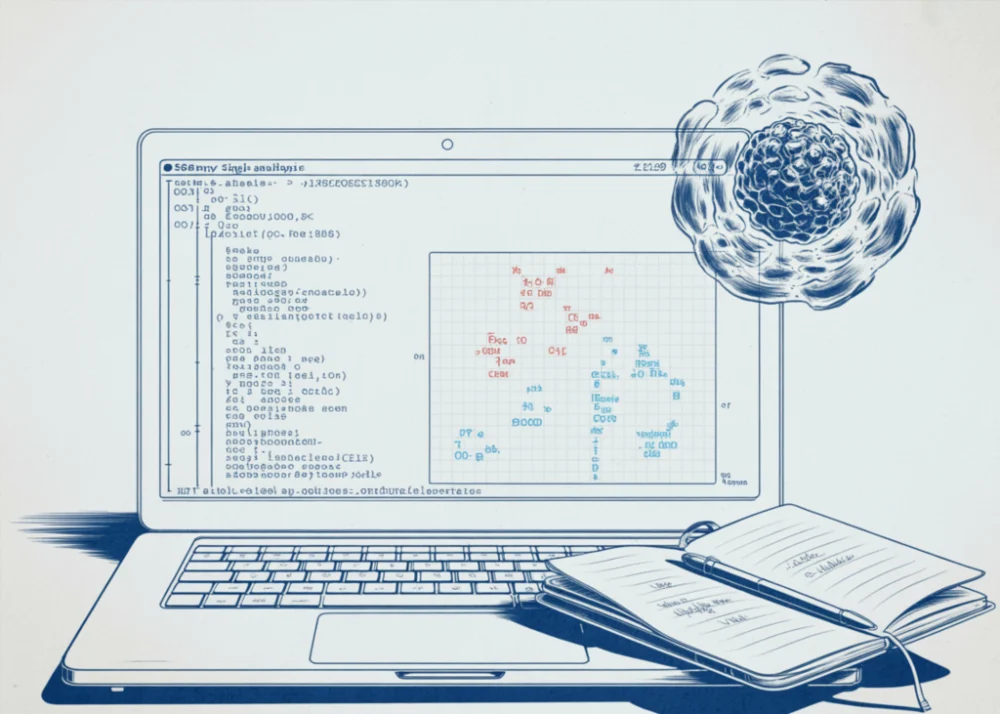
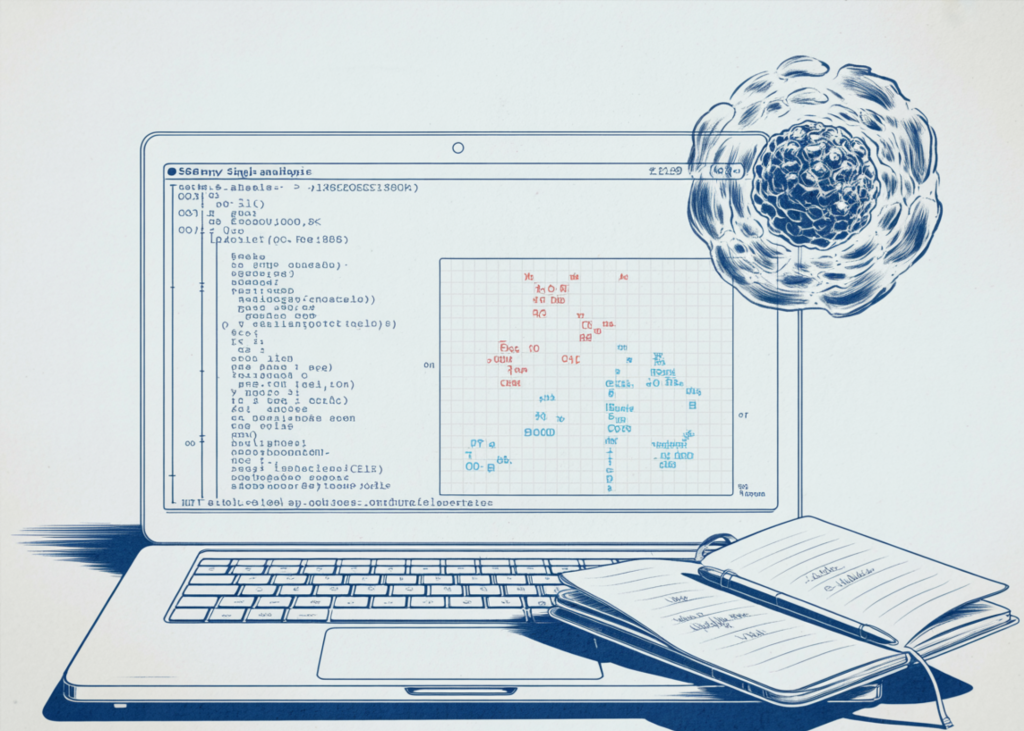
The field of transcriptomics has undergone a radical transformation over the last decade, transitioning from bulk RNA sequencing, which provides an average signal across thousands of cells, to single-cell RNA sequencing (scRNA-seq), which allows researchers to examine the gene expression profiles of individual cells. Central to this analytical revolution is Scanpy, a scalable Python-based framework designed for visualizing and analyzing large-scale single-cell gene expression data. By leveraging the AnnData format, Scanpy enables a modular and reproducible workflow that has become a cornerstone of modern bioinformatics. This report details the implementation of a comprehensive scRNA-seq pipeline, utilizing the classic Peripheral Blood Mononuclear Cell (PBMC) 3k dataset to demonstrate the journey from raw counts to biological discovery.
The Context of Single-Cell Analysis in Modern Biology
Single-cell RNA sequencing has become the gold standard for understanding cellular heterogeneity in complex tissues. Unlike traditional methods, scRNA-seq can identify rare cell populations, map developmental trajectories, and uncover how specific cell types respond to diseases or treatments. The PBMC 3k dataset, consisting of approximately 2,700 cells from a healthy donor, serves as the primary benchmark for these pipelines. It provides a diverse yet manageable snapshot of the immune system, including T-cells, B-cells, Monocytes, and Natural Killer (NK) cells.
The development of Scanpy by the Theis Lab and the broader scverse community addressed a critical need for memory-efficient and fast processing tools. As datasets grow from thousands to millions of cells, the Python ecosystem’s ability to handle high-dimensional data through libraries like NumPy, SciPy, and Pandas has made Scanpy an essential tool for researchers worldwide.
Initializing the Computational Environment
The first stage of any robust bioinformatics pipeline involves environment stabilization and dependency management. For this analysis, the core requirements include scanpy for the primary workflow, anndata for data structuring, and leidenalg for community detection in clustering. Supporting libraries such as matplotlib and seaborn provide the necessary visualization capabilities.
In this implementation, the environment is configured to ensure reproducibility. By setting a fixed random seed and defining high-resolution figure parameters (DPI 110), researchers ensure that the stochastic elements of dimensionality reduction, such as UMAP (Uniform Manifold Approximation and Projection), remain consistent across different runs. The loading of the PBMC 3k dataset initiates the process, creating an AnnData object that encapsulates the gene expression matrix, observation metadata (cells), and variable metadata (genes).
Quality Control and Biological Filtering
The integrity of downstream analysis depends entirely on the quality of the input data. Single-cell experiments often contain artifacts, such as "doublets" (two cells captured in one droplet) or "dead cells" (cells with ruptured membranes where cytoplasmic RNA has leaked out).
The pipeline implements three primary Quality Control (QC) metrics:
- Gene Count per Cell: Cells with too few genes (under 200) are likely empty droplets or poorly sequenced, while those with excessively high counts (over 5,000) may represent doublets.
- Total Counts: This measures the library size, ensuring that each cell has been sequenced to a sufficient depth.
- Mitochondrial Gene Percentage: A high percentage of mitochondrial RNA (typically over 10% in PBMCs) is a classic indicator of cell stress or death, as the mitochondrial genome is often more resilient to membrane degradation than nuclear RNA.
By visualizing these metrics through violin plots and scatter plots, researchers can identify the "sweet spot" of high-quality data. In this pipeline, cells failing these criteria are purged, and genes that appear in fewer than three cells are removed to reduce noise from stochastic expression.
Normalization and Feature Selection
Raw sequencing counts are subject to technical biases, primarily stemming from differences in sequencing depth between cells. To allow for meaningful comparisons, the pipeline applies a total-count normalization, scaling each cell to a target sum of 10,000 reads. This is followed by a log-transformation ($log(1+x)$), which stabilizes variance and reduces the impact of highly expressed "housekeeping" genes.
A critical step in reducing the dimensionality of the problem is the identification of Highly Variable Genes (HVGs). Out of the approximately 13,000 genes in the human genome, only a subset contributes significantly to the biological differences between cell types. By selecting genes with high mean expression and high dispersion, the pipeline focuses on the most informative features, typically narrowing the field to the top 2,000 to 3,000 genes. This focuses the computational power on biological signals rather than technical noise.
Dimensionality Reduction and Neighborhood Graph Construction
The high-dimensional nature of transcriptomic data—where each gene is a dimension—makes direct visualization impossible. The pipeline utilizes Principal Component Analysis (PCA) to project the data into a lower-dimensional space while preserving the maximum amount of variance.
However, PCA is a linear method and often fails to capture the complex, non-linear relationships in biological data. To address this, the pipeline constructs a neighborhood graph. By calculating the Euclidean distance between cells in the PCA-reduced space, Scanpy identifies the nearest neighbors for each cell. This graph serves as the foundation for UMAP, a manifold learning technique that flattens the multidimensional clusters into a two-dimensional map. UMAP is favored in the scientific community because it tends to preserve both the local structure (within clusters) and the global structure (relationships between clusters) of the data.
Unsupervised Clustering and Marker Discovery
With the neighborhood graph established, the pipeline employs the Leiden algorithm to partition cells into clusters. Unlike earlier methods like Louvain, the Leiden algorithm is mathematically guaranteed to produce well-connected communities, avoiding the "internal disconnect" issues that can plague large-scale graphs.
Once clusters are defined, the challenge shifts to biological interpretation: "What does Cluster 0 represent?" The pipeline answers this through differential expression analysis. Using the Wilcoxon rank-sum test, the system compares each cluster against the rest of the dataset to find "marker genes"—genes that are significantly upregulated in a specific group. For example, a cluster showing high expression of CD79A and MS4A1 is statistically likely to be a population of B-cells.
Rule-Based Annotation and Cell Type Identification
The transition from numerical clusters to biological identities is often the most labor-intensive part of the workflow. This pipeline automates the process using a rule-based scoring strategy. By defining a reference dictionary of known immune markers—such as NKG7 for Natural Killer cells, LYZ for Monocytes, and CD3D for T-cells—the pipeline calculates a cumulative "module score" for each cell.
By aggregating these scores at the cluster level, the pipeline can programmatically assign the most likely cell type to each Leiden cluster. This objective mapping reduces human bias and provides a scalable way to annotate large datasets. The final UMAP visualization, colored by cell type, offers a clear "atlas" of the immune landscape, showing distinct islands for T-cells, B-cells, Platelets, and Dendritic cells.
Data Export and the Importance of Reproducibility
The final stage of the pipeline involves the preservation of the analyzed data. The processed AnnData object is saved in the .h5ad format, a hierarchical data format designed for high-performance scientific data. Alongside the object, the pipeline exports CSV files containing the ranked marker genes and cluster statistics.
This structured output is vital for the broader scientific community. In the current era of "Open Science," the ability for peer reviewers or collaborating labs to load a pre-processed dataset and immediately verify findings is essential. It ensures that the insights gained from the PBMC 3k analysis—such as the proportions of specific cell types or the discovery of sub-populations—are verifiable and extensible.
Broader Implications and Future Directions
The implementation of this Scanpy-based pipeline has implications that extend far beyond the study of peripheral blood. The modular nature of the workflow allows it to be adapted for oncology (analyzing the tumor microenvironment), neurology (mapping brain cell types), and drug development (observing how cells change after exposure to a compound).
Furthermore, the integration of these Python-based tools with machine learning frameworks like PyTorch and TensorFlow is opening new doors. Researchers are now using deep learning for "batch correction"—merging datasets from different labs—and "velocity analysis," which uses unspliced mRNA to predict the future state of a cell.
In conclusion, the Scanpy pipeline represents a sophisticated fusion of biology, statistics, and computer science. By transforming millions of individual data points into a coherent biological map, it empowers researchers to decode the complexity of life at its most fundamental level. As single-cell technologies continue to evolve toward spatial transcriptomics and multi-omics (measuring RNA and protein simultaneously), the foundational principles of QC, normalization, and clustering established in this workflow will remain the bedrock of genomic discovery.