



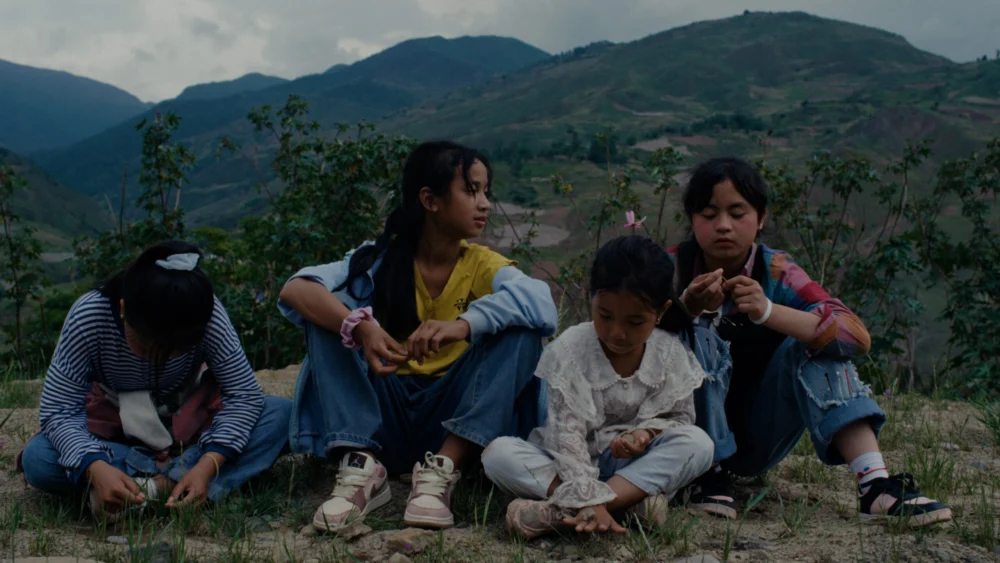
The cinematic landscape is abuzz with the arrival of Whispers in May, the highly anticipated second feature from acclaimed director Dongnan Chen. This groundbreaking film, a unique fusion of documentary and improvised fiction, delves into the profound and often uncharted territory of a girl’s transition into womanhood. Set against the evocative backdrop of China’s Liangshan Mountains, the narrative follows the journey of three young Chinese girls, offering an intimate and unflinching look at their experiences as they navigate this pivotal stage of life.
Whispers in May is poised to make its world premiere on Sunday, March 15th, as part of the prestigious main competition lineup at CPH:DOX, the Copenhagen International Documentary Film Festival. This selection underscores the film’s artistic merit and its potential to resonate with international audiences and critics alike.
The film’s central narrative thread is woven around Qihuo, one of the three protagonists. At the cusp of adolescence, Qihuo carries a significant secret: her recent onset of menstruation, a biological marker that, within her community, signifies readiness for the traditional "Changing Skirt" coming-of-age ceremony. With her parents working away from home as migrant laborers, and her grandfather, who raised her, recently deceased, Qihuo embarks on a quest with her two closest friends to acquire a special skirt for the ritual. This journey, blending vérité observations with spontaneous fictionalized sequences, captures the essence of their transition from girlhood to womanhood, a liminal space where childhood dreams begin to fade and the realities of adult life loom large.
Genesis of a Hybrid Narrative
Director Dongnan Chen’s inspiration for Whispers in May stemmed from a deeply personal encounter during a research trip to the Liangshan region. While working on a commission focused on Nuosu women across generations, Chen discovered the poignant writings of local schoolchildren. Among these was Qihuo, whose simple yet profound line, "I’ve made many wishes, but none has ever come true," struck a chord with the director.

"At 14, she was at a point where childhood was starting to slip away," Chen recalled in a recent interview. "The world was ready to name her – a woman, wife, and migrant worker – before she could choose her own course." This observation ignited Chen’s desire to create a film that would empower these young girls to define their own narratives.
Chen’s initial meeting with Qihuo was described as an immediate connection, a feeling that often serves as the catalyst for her filmmaking endeavors. Qihuo’s presence became a constant during the early stages of development, her curiosity and engagement drawing the filmmaker deeper into her world. The director noted Qihuo’s temporary "homeless" state, drifting between relatives’ homes after her grandfather’s passing, as a period of solitude that amplified the weight of her secret and the impending ceremony. This rite of passage, in Qihuo’s community, signals not only a transition but also her availability for marriage, often accompanied by a substantial dowry. This impending reality created a sense of urgency for Chen, a feeling of "racing against time to do something."
The Art of Blending Realities
Whispers in May masterfully navigates the complex terrain between documentary and fiction, a deliberate choice by Chen to reflect the fluid nature of her subjects’ experiences. The director conceptualizes the film as "a dream running parallel to reality." The documentary elements provide the grounding – the rugged beauty of the Liangshan Mountains, the poignant absence of parental figures, and the cultural significance of the Changing Skirt Ceremony. Upon this foundation, Chen and the girls collaboratively "grew flowers," as she puts it, through improvised narrative and shared imagination.
The choice of a road trip as the film’s narrative structure was a natural extension of Qihuo’s deepest desire to explore the world beyond her immediate surroundings. For the young protagonists, the distinction between fiction and non-fiction often blurred. Chen invited them to view the filmmaking process as a collaborative space where they could actively shape their own adventures, becoming protagonists and co-creators.
"The interesting thing is that once we stop thinking about the boundary between the two, the process becomes beautifully blurry," Chen explained. "I can no longer clearly tell which moments were designed and which happened spontaneously. By letting the girls play themselves, I gradually felt we achieved something truer than facts." This approach challenges conventional notions of cinematic truth, suggesting that invented realities, when rooted in authentic emotions and experiences, can offer a profound form of self-discovery and empowerment. The film aims to inspire viewers, particularly young women, to recognize their agency in shaping their own life stories, both within the context of the film and beyond.

Collaboration and Protection: A Playground for Creation
The creative process behind Whispers in May was meticulously designed to foster a sense of agency and safety for the young participants. Chen described the production environment as a "playground rather than a set," emphasizing that the girls’ own desire to embark on the journey was the film’s genesis. Protecting their courage and curiosity was paramount, not only as an ethical imperative but as a prerequisite for the film’s very existence.
Without a traditional script, the team operated with a shared outline of potential narrative directions. This flexible framework allowed the film to "breathe" and adapt to the girls’ rhythms. Regular viewings of filmed clips during production served as catalysts for spontaneous dialogue, guiding the direction of their journey. This collaborative discovery process ensured that the filmmaking itself was an organic unfolding of their experiences.
Chen observed a "fierce and quiet resistance of childhood" emerge from the girls as they navigated their journey. Witnessing them move away from a predetermined fate towards an unknown horizon represented, for Chen, cinema in its "purest and most original form." The power of film, she noted, lies in its ability to "extend the boundaries of a life."
Crucially, the production maintained a transparent dialogue with the girls’ parents and their school, establishing a foundation of formal trust. Simultaneously, a "private, sacred space" was maintained for the girls, ensuring that their disclosures were made on their own terms and at their own pace. This dual approach balanced external accountability with an intimate, child-centered environment.
The Landscape as a Mirror

The stunning natural landscapes of the Liangshan Mountains play a vital role in Whispers in May, serving as a visual metaphor for the girls’ inner lives and their burgeoning freedom. Chen noted how the wilderness "echoes the girls’ untamed energy," nourishing them as they grow and acting as an extension of their inner emotional world. In this untamed environment, their laughter and sorrows are not stifled by societal expectations, allowing them to exist simply as themselves, unburdened by social categories.
However, this beauty is not without its complexities. The layered mountains, while protective, also signify isolation. Construction scenes interspersed throughout the film subtly acknowledge the encroaching modernity and the shifting realities of their environment. The girls’ recurring question, "What is behind the mountains?" speaks to their curiosity about the world beyond their immediate sphere, a world shaped by both local community norms and the arduous path toward unseen possibilities. These mountains represent not just physical barriers but also the weight of tradition and the challenges of forging a new identity.
Echoes of Folklore: The Myth of Coqotamat
A compelling element woven into the film is the myth of Coqotamat, a tale frequently shared by the girls during their nighttime conversations. This ancestral oral tradition, passed down through generations, instills a profound sense of fear in the children. Chen discovered that versions of this myth exist across various communities in Liangshan, each with subtle variations, highlighting its significance as a shared heritage and a product of collective imagination.
The film embraces this fluidity, creating its own rendition of the myth in collaboration with the girls. Coqotamat is depicted as a shape-shifter who assumes the guise of a thousand women to lure and devour children. This terrifying figure can be interpreted as a symbolic representation of the dangers and uncertainties that await young girls as they transition into adulthood, a parallel to Western fairy tales like "Little Red Riding Hood."
Chen’s research into Nuosu folklore revealed striking similarities to Western tales, suggesting universal psychological underpinnings. Fairy tales, she posits, function as survival manuals for young girls, encoding the inherent dangers of the adult world. In this context, the Changing Skirt Ceremony itself can be viewed as a parallel to the wolf in "Little Red Riding Hood," a formidable obstacle that must be navigated as girls step into womanhood.

The Nuances of Title and Future Visions
The film’s title, Whispers in May, carries distinct meanings across its different language versions, reflecting the director’s sensitivity to cultural and linguistic nuances. The English title is derived from the Nuosu title, May, Hidden. The filming coincidentally occurred in May, mirroring the "last moments of childhood." Chen observes that the transition to womanhood is not a dramatic event but a "quiet, drifting slip just before reality settles in."
Arthur Jones, a friend of Chen’s, contributed to the English translation, capturing the gentle, subtle sounds of the film – the wind, the girls’ voices – with "Whispers of May." This translation conveys the essence of what is "hidden" while translating it into a sensory experience. The Mandarin title, Spring Reverie, further evokes a sense of gentle awakening and dreaming.
Looking ahead, Dongnan Chen is in the early stages of developing a new hybrid narrative feature. This project will explore the theme of preserving one’s hometown through the lens of a camera, only to discover that the act of recording leads to the dissolution of the real world into digital fragments. Drawing from her extensive experience filming real people, this new film aims to examine the fragility of storytelling in an image-saturated era and the quest for a truth that may lie beyond the confines of the frame. It promises to continue Chen’s exploration of memory, reality, and the power of narrative in shaping our understanding of ourselves and the world.
The production of Whispers in May was a collaborative effort involving Jia Zhao of Muyi Film as producer, with Chen’s Tail Bite Tail Films serving as co-producer alongside Malin Hüber for Her Film in Sweden and Heejung Oh for Seesaw Pictures in South Korea. The film’s international co-production further highlights its global appeal and the shared vision of its creative team.