


The global cryptocurrency market demonstrated remarkable stability during the early hours of Saturday morning, with Bitcoin maintaining a valuation of approximately $71,000. This resilience comes in the wake of significant geopolitical escalation in the Middle East, specifically following United States military strikes against targets on Kharg Island, which serves as the primary terminal for Iran’s crude oil exports. Despite a sharp reversal from a Friday peak of $73,838, the premier digital asset has managed to preserve a 4.2% gain over the seven-day period, signaling a maturing market response to international conflict and energy supply volatility.
As the conflict enters its third week, the digital asset landscape has shifted from panic-driven volatility to a more calculated, framework-based trading environment. While the initial reaction to the Kharg Island headlines triggered a 3.5% retracement, the sell-off was notably more contained than previous escalations. Market analysts suggest that the "reflexive sell-the-headline" impulse is being replaced by a sophisticated understanding of tail risks, even as attention shifts toward the upcoming Federal Reserve meeting on March 17-18 and the looming threat of stagflation driven by oil prices exceeding $100 per barrel.
The Strategic Significance of Kharg Island and the Trump Doctrine
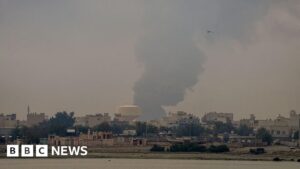
Kharg Island, located in the Persian Gulf, is the critical node of Iran’s petroleum infrastructure, accounting for roughly 90% of the nation’s total crude oil exports. The U.S. strikes on military targets within the vicinity of the island represent a significant shift in engagement strategy. In a statement released via Truth Social late Friday, President Donald Trump clarified the administration’s stance, noting that while oil infrastructure had been spared "for reasons of decency" during the initial sorties, this restraint was conditional.
The President warned that the U.S. would "immediately reconsider" its targeting strategy should Iran persist in its efforts to block the Strait of Hormuz, a vital maritime chokepoint through which approximately one-fifth of the world’s total oil consumption passes. Iran’s response was swift, with Tehran stating that any direct strike on its energy assets would result in retaliatory measures against U.S.-linked facilities across the region. This "conditional escalation" has introduced a new variable into the global markets, elevating the risk of the largest energy supply disruption in modern history—a scenario the International Energy Agency (IEA) has already begun to model.
Market Dynamics: Liquidations and Resistance Levels
The volatility surrounding the Kharg Island headlines resulted in $371 million in total liquidations over a 24-hour window, according to data from Coinglass. The nature of these liquidations highlights the "two-way" volatility currently gripping the sector. Short liquidations led the tally at $207 million, primarily triggered by Bitcoin’s initial surge toward the $74,000 level. However, as news of the strikes broke, $163 million in long positions were forcibly closed as the price retraced to the $71,000 support zone.
Technically, Bitcoin remains trapped beneath a formidable resistance ceiling between $73,000 and $74,000. This zone has now rejected upward momentum four times within the last fortnight. Traders are closely monitoring whether the current consolidation at $71,000 will provide the necessary base for a fifth attempt at a breakout or if the geopolitical weight will eventually force a retest of lower support levels near $68,500.
Altcoin Performance and Broad Market Sentiment
Despite the focus on Bitcoin, the broader cryptocurrency market has mirrored this trend of "geopolitical hardiness." Ether (ETH) saw a 5.5% increase over the week, trading at $2,090, while Solana (SOL) rose 4.2% to $88. Other major assets, including Binance Coin (BNB) and Dogecoin (DOGE), posted gains of 4.5% and 5% respectively. The uniform green performance across the top ten cryptocurrencies by market capitalization suggests that capital is not fleeing the space, but rather rotating within it as investors seek hedges against traditional fiat volatility.
This collective resilience is particularly noteworthy given the intensifying nature of the Middle Eastern war. In previous cycles, such high-level military engagements typically prompted a "flight to quality," which often excluded the volatile crypto sector. In 2026, however, the narrative appears to be shifting, with some institutional desks viewing Bitcoin as a "neutral" asset that operates outside the traditional banking system, which is increasingly susceptible to sanctions and geopolitical gatekeeping.
A Timeline of Resilience: Two Weeks of Conflict
The current market state is the result of a two-week evolution in trader psychology:
- Week 1: The outbreak of hostilities led to an immediate 8% drop in Bitcoin prices as "risk-off" sentiment dominated. Oil prices jumped to $85, and correlations between crypto and the Nasdaq tightened.
- Week 2 (Early): Prices recovered as the "digital gold" narrative resurfaced. Bitcoin climbed back above $70,000 despite continued regional skirmishes.
- Week 2 (Late): The Kharg Island strikes and Trump’s warnings created a sharp but brief 3.5% dip. Bitcoin stabilized at $71,000 within hours, refusing to break its weekly uptrend.
This timeline indicates that the market is "pricing in" the conflict in real-time. The shock value of military headlines is diminishing, replaced by a focus on the tangible economic consequences—specifically energy costs and their impact on central bank policy.
The Federal Reserve and the Stagflation Threat
As the geopolitical situation simmers, the focus of the global financial community is pivoting toward the Federal Reserve’s upcoming policy meeting on March 17-18. The economic landscape has grown increasingly complex; while the labor market remains relatively stable, the energy crisis is fueling inflationary pressures that complicate the Fed’s path toward interest rate cuts.
Current CME FedWatch data indicates a 95% probability that the Fed will hold interest rates steady at the 3.5% to 3.75% range. However, the true market mover will be the "dot plot"—the visual representation of where Fed officials expect rates to be in the future—and Chairman Jerome Powell’s post-meeting press conference.
The threat of stagflation—a period of stagnant economic growth combined with high inflation—is now a primary concern for risk assets. If oil remains above $100 per barrel, the Fed may be forced to abandon its planned rate cuts or, in a worst-case scenario, reintroduce hikes to combat energy-driven inflation. For a cryptocurrency market that has spent the better part of five months pricing in a more accommodative monetary environment, a hawkish shift from the Fed could prove more damaging than the war itself.
Infrastructure and Network Security Concerns
Beyond the immediate price action, the conflict has renewed interest in the physical resilience of the Bitcoin network. Recent discussions have centered on a Cambridge study suggesting that Bitcoin’s infrastructure is more robust than previously estimated. The study found that the network could survive the loss of 72% of the world’s submarine fiber-optic cables, thanks in part to the increasing adoption of TOR and satellite-based node synchronization.
However, the report also highlighted a vulnerability: a targeted attack on just five major hosting providers could potentially cripple network throughput. As cyber warfare becomes a standard component of modern geopolitical conflict, the security of the physical and cloud-based infrastructure supporting the blockchain remains a critical point of analysis for long-term investors.
Broader Implications for Global Finance
The ability of Bitcoin to hold the $71,000 level in the face of a potential "oil shock" and direct U.S. military involvement in the Middle East marks a significant milestone in the asset’s history. It suggests a decoupling from traditional "risk-on" assets like high-growth tech stocks, which have shown more sensitivity to the Kharg Island developments.
If the Strait of Hormuz is indeed blocked, as Trump’s warnings suggest is possible, the resulting spike in shipping costs and energy prices would likely trigger a global recessionary impulse. In such a scenario, the "store of value" thesis for Bitcoin will face its ultimate test. For now, the market remains in a state of "watchful waiting," anchored by the $71,000 support level but wary of the $74,000 resistance that continues to gate-keep a move toward new all-time highs.
The coming week will be decisive. Between the evolving military situation in the Persian Gulf and the Federal Reserve’s commentary on the state of the U.S. economy, Bitcoin sits at a crossroads. Its current resilience is a testament to the maturity of its investor base, but the volatility of the geopolitical landscape ensures that the "tail risks" are far from fully resolved. Market participants are advised to maintain a close watch on both the Brent Crude spot price and the Fed’s summary of economic projections, as these will likely dictate the next major move for the digital asset sector.