



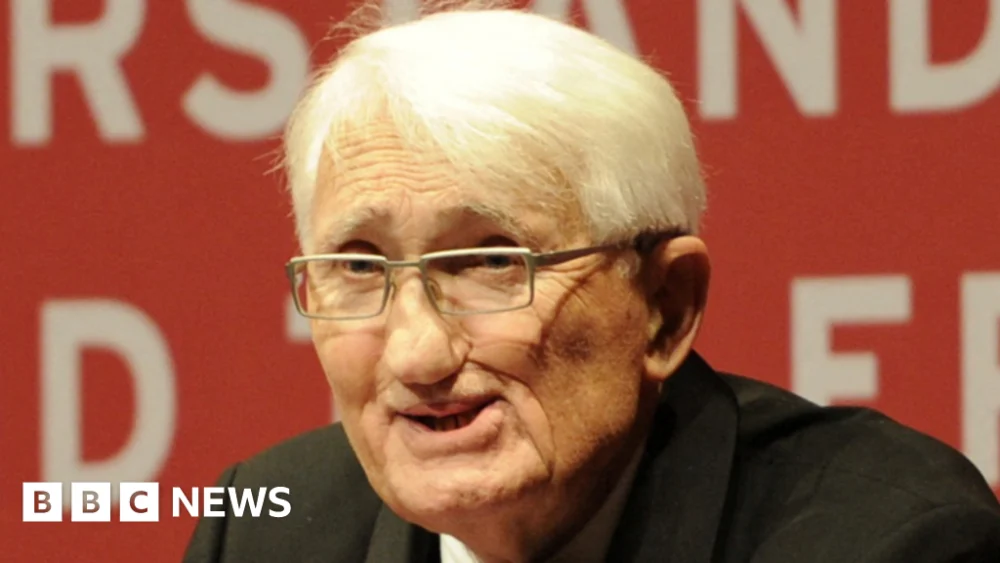
Jürgen Habermas, one of the most profoundly influential philosophers and public intellectuals of post-war Germany, whose work redefined critical theory and profoundly shaped contemporary understanding of democracy, communication, and modernity, has died at the age of 96. His death was announced on Saturday by his long-time publisher, Suhrkamp, marking the end of an era for European intellectual thought. Habermas’s extensive oeuvre, spanning over seven decades, engaged with some of the most pressing political, social, and philosophical questions of the 20th and 21st centuries, establishing him as a crucial voice in the global discourse on reason, justice, and the possibility of a truly democratic society.
Early Life and Formative Years Under Nazism
Born in Düsseldorf, Germany, in June 1929, Habermas’s formative years were inescapably shaped by the rise and fall of Nazism. His father, Ernst Habermas, who served as the head of the local chamber of commerce, joined the Nazi Party in 1933, a common if often opportunistic decision for many German professionals during that period. The young Jürgen was enrolled in the Hitler Youth, a mandatory experience for German boys of his generation, though he was too young to be conscripted into military service during the Second World War. This direct experience of totalitarianism, coupled with the profound moral and intellectual reckoning that followed Germany’s defeat, proved to be a foundational influence on his later philosophical preoccupations. The collapse of the Nazi regime and the subsequent Allied occupation exposed Habermas, like many of his generation, to the stark realities of war crimes and state-sponsored atrocities, compelling him to grapple with questions of moral responsibility, collective guilt, and the mechanisms by which a society could succumb to such barbarity.
Beyond the political landscape, Habermas also navigated a personal challenge that would later inform his thinking: he was born with a cleft palate, requiring repeated surgical operations throughout his childhood. This experience, which often impeded his speech and interaction, later led him to reflect deeply on the nature of language, communication, and the inherent human capacity for intersubjective understanding, laying the groundwork for his groundbreaking theories on communicative action.
Academic Ascent and the Reinvigoration of the Frankfurt School
Following the war, Habermas embarked on an intense academic journey, studying philosophy, history, psychology, and German literature at the universities of Göttingen, Zurich, and Bonn. He earned his doctorate in philosophy from Marburg University in 1956 with a dissertation on Friedrich Schelling. His intellectual trajectory then led him to the University of Frankfurt’s Institute of Social Research, the renowned home of the "Frankfurt School." Here, under the tutelage of Max Horkheimer and Theodor Adorno, he quickly established himself as a brilliant and incisive thinker, becoming a leading exponent of critical theory, though he would eventually develop his own distinct approach.
The Frankfurt School, established in the 1920s, had developed a unique brand of critical theory, drawing from Marxism, psychoanalysis, and sociology to critique modern capitalist societies. Figures like Horkheimer and Adorno had, by the post-war period, become increasingly pessimistic about the emancipatory potential of modernity, observing how instrumental reason and the culture industry seemed to absorb and neutralize all forms of critique, turning active citizens into passive consumers. Habermas, while deeply influenced by their foundational critiques, sought to steer the Frankfurt School in a more optimistic and reconstructive direction. He aimed to identify the normative foundations for a truly rational and democratic society within the very structures of human communication.
His early work, such as Structural Transformation of the Public Sphere (1962), explored the historical evolution of public discourse from the salons and coffee houses of the 18th century to the rise of mass media, arguing that the latter had led to a decline in rational-critical debate and a commodification of public opinion. This analysis laid the groundwork for his later, more expansive theories on the conditions necessary for genuine communication and democratic deliberation.
The Theory of Communicative Action: A Paradigm Shift
Habermas’s most influential and comprehensive work, The Theory of Communicative Action, published in two volumes in 1981, marked a pivotal moment in 20th-century philosophy and social theory. In this monumental treatise, he sought to reconstruct the foundations of critical theory by shifting the focus from instrumental reason (goal-oriented action) to communicative reason (understanding-oriented action). He argued that human societies are sustained not merely by political power or economic forces, but fundamentally by the capacity for rational dialogue and mutual understanding.
At the core of his theory is the concept of the "ideal speech situation," a regulative ideal where participants in a discourse are free from coercion, power imbalances, and deception, aiming solely for mutual understanding and agreement. While acknowledging that such a situation is rarely fully realized in practice, Habermas contended that it serves as an inherent normative standard against which all forms of communication and social interaction can be critically evaluated. He distinguished between "system" (economic and administrative subsystems governed by instrumental logic) and "lifeworld" (the sphere of everyday communication, culture, and personal identity), arguing that modern societies suffer from the "colonization of the lifeworld" by the system, where instrumental rationality encroaches upon and distorts communicative practices.
The Theory of Communicative Action offered a powerful framework for understanding social pathologies, critiquing distorted communication, and envisioning the possibility of a more just and rational society. Its impact was profound, extending beyond philosophy to sociology, political science, communication studies, legal theory, and even theology, establishing Habermas as a foundational figure for contemporary theories of deliberative democracy and discourse ethics.
A Public Intellectual Engaging with German History and European Future
Habermas was not merely an ivory-tower philosopher; he was a quintessential public intellectual, consistently engaging in the major political and moral debates of his time, particularly those concerning Germany’s identity and Europe’s future. His interventions were often decisive, characterized by intellectual rigor, moral conviction, and a steadfast commitment to democratic ideals.
The Student Revolt of the 1960s: In the 1960s, as student movements swept across West German universities, Habermas vocally supported their demands for university reform and a more critical engagement with Germany’s past. He saw the student protests as a crucial expression of critical consciousness, though he also famously criticized some radical elements for engaging in "left fascism" when their tactics bordered on authoritarianism, underscoring his nuanced approach to political activism. His engagement with these movements demonstrated his commitment to bridging theoretical critique with practical political action, a hallmark of his intellectual life.
The Historians’ Dispute (Historikerstreit) of the 1980s: Perhaps one of his most significant public interventions came in the mid-1980s during the "Historikerstreit" (Historians’ Dispute). This fierce intellectual and political debate centered on how Germany should come to terms with its Nazi past, particularly the Holocaust. Conservative historians like Ernst Nolte attempted to relativize the singularity of the Holocaust, suggesting it was a reaction to the Soviet Gulag or that German crimes were not unique. Habermas vehemently rejected these attempts at historical revisionism, arguing that such efforts undermined Germany’s moral responsibility and democratic self-understanding. He asserted the unique and unprecedented nature of the Holocaust and stressed the imperative for Germany to confront its past without equivocation, maintaining that a robust democratic culture depended on an honest engagement with its darkest chapters. His arguments were crucial in shaping a consensus that the Holocaust must remain central to German historical memory and identity.
German Reunification (1989-1990): When the Berlin Wall fell and German reunification became imminent, Habermas again took a cautious and critical stance. While acknowledging the desire for unity, he expressed concern over the rapid absorption of East Germany into the West, fearing a resurgence of nationalism and a lack of genuinely democratic deliberation in the process. He advocated for a more gradual, constitutionally deliberative process, emphasizing that reunification should not merely be an act of economic and political annexation but a democratic negotiation between two distinct entities. He worried that a rushed process might obscure the complexities of East German identity and undermine the potential for a truly unified, democratic, and post-national state.
Championing a United Europe: Throughout the 1990s and into the 21st century, Habermas became one of Europe’s most prominent intellectual champions of a united Europe. He viewed the European Union not merely as an economic bloc but as a crucial political project—a "post-national constellation"—that could serve as the best defense against the resurgence of nationalist rivalries that had plagued the continent for centuries. For Habermas, a united Europe offered a model for transnational democracy, where deliberative processes could transcend national borders and foster a shared civic identity. He consistently argued for strengthening European institutions, democratizing the EU, and developing a shared European public sphere as a bulwark against global challenges and a beacon for a more peaceful and just world order.
Legacy and Enduring Influence
Jürgen Habermas’s intellectual legacy is immense and multifaceted. He received numerous accolades throughout his career, including the Theodor W. Adorno Award (1980), the Kyoto Prize in Arts and Philosophy (2004), the Erasmus Prize (2001), and the Peace Prize of the German Book Trade (2001). His work is characterized by an extraordinary breadth of knowledge, encompassing philosophy, sociology, political theory, linguistics, and history, and by a relentless commitment to reason, critique, and human emancipation.
He successfully navigated the complex intellectual terrain of the 20th century, offering a powerful alternative to both the foundationalist certainties of earlier philosophy and the postmodern relativism that followed. By reconstructing critical theory on the basis of communicative rationality, he provided a robust framework for understanding and improving social and political life in increasingly complex and globalized societies.
His ideas continue to resonate deeply in contemporary debates surrounding:
- The Public Sphere: In an age of digital media, social networks, and "fake news," his analysis of the public sphere and its potential for distortion remains acutely relevant.
- Deliberative Democracy: His theories are foundational for models of deliberative democracy, which emphasize rational discourse and consensus-building as central to legitimate political decision-making.
- Post-National Identity: His vision for a post-national Europe and his arguments for global governance continue to inform discussions about international law, human rights, and the future of political communities beyond the nation-state.
- Critique of Capitalism: While evolving from traditional Marxism, his work maintained a critical stance on the pathologies of unrestrained capitalism and its impact on human freedom and public discourse.
Habermas was also instrumental in bridging the divide between continental European philosophy and Anglo-American analytical philosophy, engaging with thinkers from both traditions and fostering a more unified philosophical discourse. His tireless dedication to intellectual inquiry, his moral courage in public debate, and his unwavering belief in the power of reason and dialogue have left an indelible mark on modern thought.
Leading figures in academia and politics across Germany and beyond have begun to issue statements mourning his passing, celebrating his profound contributions. The University of Frankfurt, where he spent much of his academic career, is expected to release a comprehensive tribute to its most distinguished philosopher. Jürgen Habermas’s death marks the passing of one of the last giants of the 20th century’s intellectual landscape, but his ideas and his unwavering commitment to democratic principles will undoubtedly continue to inspire generations of thinkers and activists seeking a more rational, just, and humane world.