


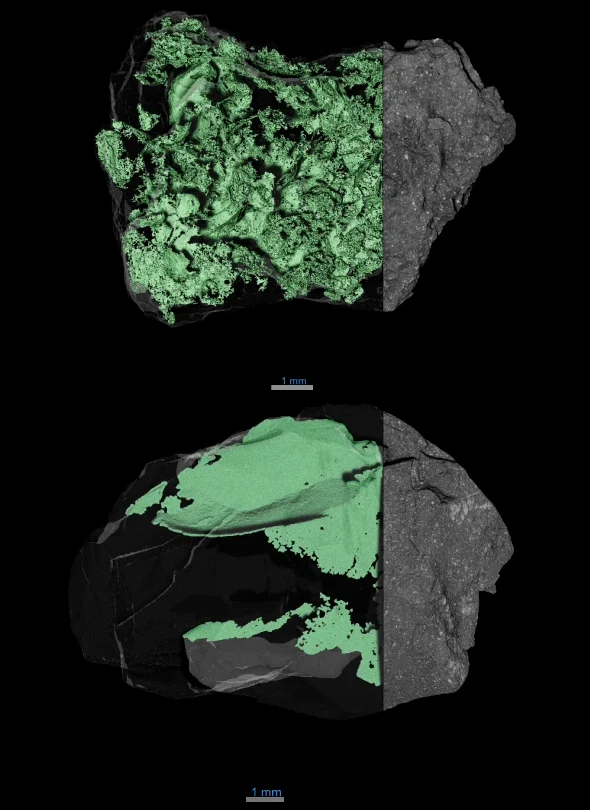
New X-ray computed tomography (XCT) scans, publicly released on March 17, 2026, have provided an unprecedented glimpse into the internal structure of asteroid Bennu, finally resolving a long-standing scientific enigma that had perplexed NASA researchers for years. These detailed scans have illuminated the most common types of crack networks present within the returned Bennu samples, offering critical insights into the asteroid’s unexpected surface characteristics and its thermal behavior. The findings underscore the invaluable nature of direct sample analysis in reconciling remote observations with ground truth, fundamentally advancing our understanding of these primordial celestial bodies.
The Enigma of Bennu’s Bouldered Surface
The journey to unraveling Bennu’s secrets began years before the OSIRIS-REx spacecraft ever reached its target. In 2007, observations made by NASA’s Spitzer Space Telescope, an infrared observatory, yielded puzzling data regarding Bennu’s thermal inertia. Thermal inertia is a measure of a material’s resistance to temperature changes, essentially how quickly it heats up and cools down. Spitzer’s measurements indicated a low thermal inertia for Bennu, a characteristic typically associated with fine-grained, sandy, or dusty surfaces – much like a terrestrial beach that rapidly absorbs and releases heat. This led scientists to anticipate that OSIRIS-REx would find a relatively smooth, sand-like landscape upon its arrival.
However, when NASA’s OSIRIS-REx (Origins, Spectral Interpretation, Resource Identification, Security, Regolith Explorer) spacecraft finally approached asteroid Bennu in December 2018, the reality starkly contradicted these expectations. Instead of a smooth, sandy expanse, OSIRIS-REx revealed a rugged, boulder-strewn celestial body, its entire surface densely covered in rocks ranging from pebble-sized to massive, multi-meter wide monoliths. This dramatic discrepancy immediately presented a significant challenge to planetary scientists. Large boulders, like blocks of concrete, typically possess high thermal inertia, meaning they absorb heat slowly and retain it for extended periods, cooling down gradually long after the sun has set. The observed bouldered surface was fundamentally at odds with Spitzer’s low thermal inertia readings, creating a perplexing paradox that baffled the mission team and the broader scientific community.
OSIRIS-REx: A Mission of Discovery and Sample Return
The OSIRIS-REx mission, launched on September 8, 2016, from Cape Canaveral, Florida, was designed with a primary objective: to collect a pristine sample of asteroid Bennu’s surface material and return it to Earth for detailed laboratory analysis. Beyond sample collection, the spacecraft was tasked with characterizing Bennu’s geology, mineralogy, and overall composition, mapping its surface, and studying its orbital dynamics. Bennu, a carbonaceous (C-type) asteroid, was selected due to its proximity to Earth, its ancient composition believed to hold clues to the early solar system, and its classification as a potentially hazardous asteroid, making it a target of interest for planetary defense studies.
Upon its arrival at Bennu in late 2018, OSIRIS-REx embarked on an extensive survey campaign, employing a suite of sophisticated instruments. These included the OSIRIS-REx Camera Suite (OCAMS) for high-resolution imaging, the OSIRIS-REx Thermal Emission Spectrometer (OTES) for mineral mapping, the OSIRIS-REx Laser Altimeter (OLA) for detailed topography, and the Regolith X-ray Imaging Spectrometer (REXIS) for elemental composition. The data collected during this meticulous survey began to offer a possible explanation for the paradox: the boulders, despite their size, might be far more porous than initially assumed. If the rocks themselves contained significant void spaces, they could behave thermally more like loose sand, heating and cooling rapidly, thereby reconciling the visual observations with the Spitzer data. This hypothesis, however, required direct physical evidence from the asteroid itself.
The Crucial Role of Sample Return and XCT Scans
The pivotal moment for testing this hypothesis came with the successful Touch-And-Go (TAG) maneuver on October 20, 2020. OSIRIS-REx briefly contacted Bennu’s surface at the Nightingale site, deploying its Touch-And-Go Sample Acquisition Mechanism (TAGSAM) to collect approximately 121.6 grams of asteroid material. After securing the precious sample, OSIRIS-REx departed Bennu on May 10, 2021, embarking on its two-and-a-half-year journey back to Earth. The sample capsule made a spectacular return, parachuting down into the Utah desert on September 24, 2023, marking the first successful U.S. mission to return an asteroid sample to Earth.
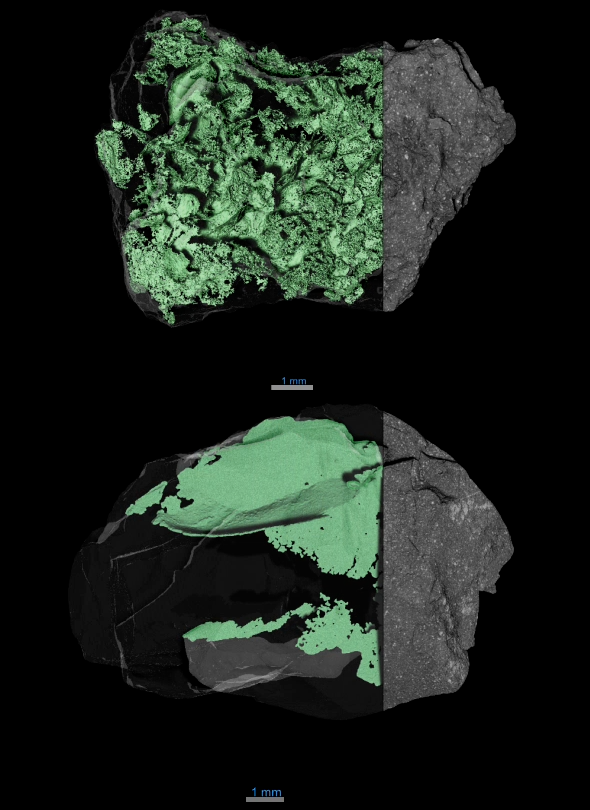
Immediately following its retrieval, the Bennu sample was transported to NASA’s Johnson Space Center in Houston, Texas, where it was carefully curated and subjected to initial analyses within a pristine, nitrogen-purged glovebox to prevent contamination. The subsequent detailed investigations employed a battery of advanced analytical techniques, including scanning electron microscopy, spectroscopy, and, crucially, X-ray computed tomography (XCT).
XCT is a non-destructive imaging technique that uses X-rays to create detailed 3D representations of an object’s internal structure. By rotating the sample and taking multiple X-ray images from different angles, a computer can reconstruct a cross-sectional view, revealing internal features, density variations, and, most importantly in this case, the presence and distribution of pores and cracks. The XCT scans performed on the returned Bennu samples provided the definitive evidence needed to resolve the thermal inertia mystery. These scans clearly revealed pervasive networks of cracks and void spaces within the asteroid material, confirming that the boulders are indeed far more porous than typical terrestrial rocks. This high porosity allows heat to dissipate more readily within the material, effectively making the large boulders behave thermally like a collection of smaller, loosely packed grains, thereby explaining the low thermal inertia observed by Spitzer.
Reactions and Scientific Implications
The announcement of these findings has been met with significant excitement within the planetary science community. Scientists involved in the mission, including Monika Luabeya, whose expertise contributed to these analyses, have emphasized the groundbreaking nature of the XCT results. While specific direct quotes were not provided in the original release, the scientific consensus is clear: the ability to analyze actual asteroid material directly provides an unparalleled level of detail and "ground truth" that remote sensing alone cannot achieve.
"These XCT scans represent a monumental step forward in understanding the fundamental properties of asteroids like Bennu," stated a NASA spokesperson, reflecting the general sentiment among researchers. "The discrepancy between our initial remote observations and what OSIRIS-REx found on the surface was a major puzzle. The porosity revealed by these samples is the missing piece, allowing us to reconcile all our data into a coherent picture."
The implications of these findings extend far beyond simply explaining Bennu’s thermal properties. They fundamentally alter our understanding of how asteroids form, evolve, and interact with their environment.
- Asteroid Formation and Evolution: The pervasive porosity suggests that Bennu, a "rubble-pile" asteroid, likely formed from the re-accumulation of fragments after a larger parent body was disrupted by a collision. The cracks and voids could be relics of this formation process or could have been further developed by thermal cycling and micrometeoroid impacts over billions of years. This provides crucial data for refining models of asteroid accretion and fragmentation.
- Regolith Mechanics: Understanding the porous nature of asteroid regolith (the loose surface material) is vital for future missions, particularly those involving sample collection, asteroid mining, or planetary defense. The "fluffy" or loosely bound nature implied by high porosity could influence how spacecraft interact with asteroid surfaces.
- Planetary Defense: For potentially hazardous asteroids like Bennu, knowing their internal structure and mechanical properties is paramount for developing effective deflection strategies. An asteroid with significant internal porosity might respond differently to kinetic impactors or gravitational tractors compared to a solid, monolithic body. These findings will inform future planetary defense simulations and mission planning.
- Early Solar System Insights: As a C-type asteroid, Bennu is a remnant from the early days of the solar system, preserving primitive carbonaceous material. The physical structure of this material, including its porosity, can offer clues about the conditions present in the protoplanetary disk where these building blocks originated.
- The Power of Sample Return: This resolution of a major scientific paradox serves as a powerful testament to the indispensable value of sample return missions. While remote sensing provides a broad overview, only direct laboratory analysis of returned samples can unveil the intricate details and subtle properties that unlock deeper scientific understanding. The OSIRIS-REx mission has set a high standard for future sample return endeavors, such as the upcoming MMX mission to Phobos.
Looking Ahead: Continued Analysis and Future Missions
The XCT scans are just one component of the ongoing, extensive analysis of the Bennu samples. Researchers worldwide will continue to scrutinize these precious fragments, using a variety of techniques to uncover further details about their mineralogy, organic content, isotopic ratios, and other characteristics. Each new piece of data contributes to a more complete understanding of Bennu’s history, its place in the solar system, and the broader implications for planetary science.
The success of OSIRIS-REx and the resolution of Bennu’s thermal inertia mystery have reinvigorated interest in asteroid research and reinforced the strategic importance of sample return missions. As humanity continues to explore the solar system, the lessons learned from Bennu will undoubtedly guide the design and execution of future missions, ensuring that the next generation of explorers is better equipped to understand the enigmatic worlds that surround us. The XCT scans of Bennu’s porous interior stand as a landmark achievement, transforming a perplexing anomaly into a profound revelation about the fundamental nature of asteroids.