

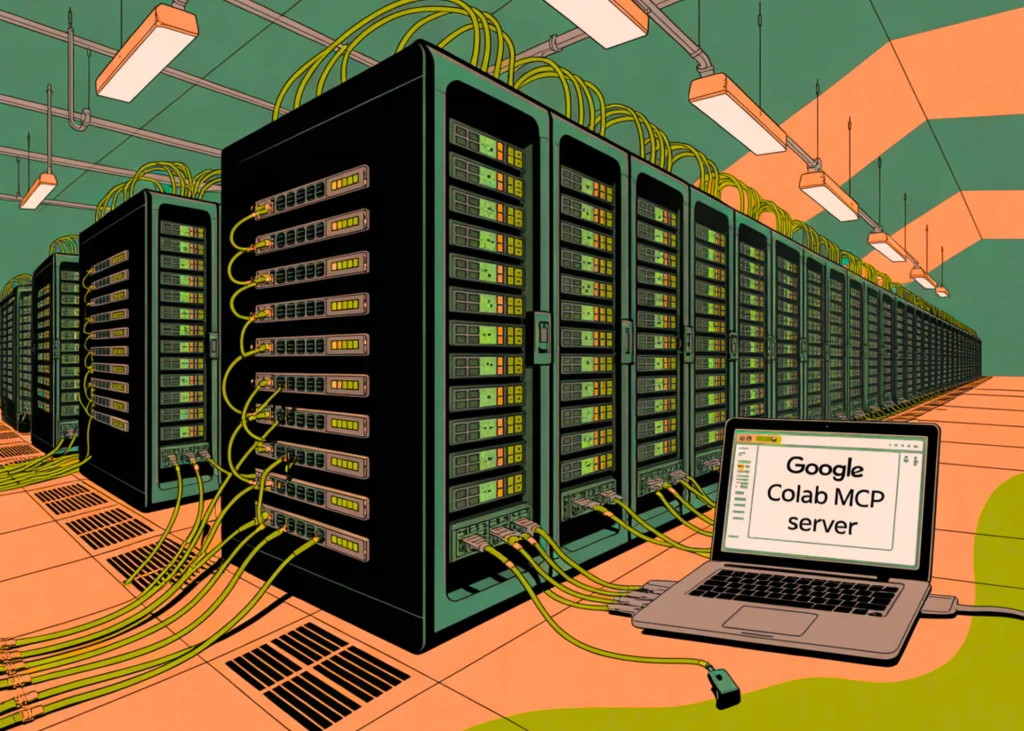
Google has officially announced the launch of the Colab MCP Server, a specialized implementation of the Model Context Protocol (MCP) designed to provide artificial intelligence agents with direct, programmatic access to the Google Colab environment. This development marks a significant milestone in the evolution of "agentic" workflows, transitioning from a paradigm where AI simply suggests code to one where it can autonomously provision resources, execute complex computations, and manage data within a cloud-hosted Jupyter notebook. By adopting the MCP standard, Google is enabling a diverse ecosystem of AI clients—ranging from Anthropic’s Claude Code to the Gemini Command Line Interface (CLI)—to treat Colab as a seamless extension of their reasoning capabilities.
The Shift Toward Agentic Orchestration
The release of the Colab MCP Server is a strategic response to the growing demand for AI agents that do more than generate text or static code snippets. In the traditional development workflow, a software engineer might ask an LLM to write a Python script for data analysis. The engineer would then manually copy that code, open a Google Colab notebook, paste the code, and execute it. If an error occurred, the engineer would copy the stack trace back to the AI, repeating the cycle.
The Colab MCP Server eliminates this friction. By acting as a standardized bridge, it allows an AI agent to assume the role of an operator. The agent can now "decide" to create a notebook, write the necessary Python code, execute it in a high-performance cloud environment, and interpret the results in real-time. This shift toward orchestration allows developers to focus on high-level logic while the AI handles the mechanical aspects of environment management and execution.
Historical Context and the Rise of MCP
To understand the significance of this release, it is necessary to examine the trajectory of both Google Colab and the Model Context Protocol. Google Colab, launched to the public in 2017, revolutionized data science by providing free access to computing resources, including GPUs and TPUs, through a browser-based interface. It effectively democratized machine learning by removing the hardware barriers to entry.
However, as Large Language Models (LLMs) became more sophisticated, a new bottleneck emerged: the "silo" problem. AI models were isolated from the tools and data environments they were meant to assist. In late 2024, Anthropic introduced the Model Context Protocol (MCP) as an open standard to solve this. MCP provides a universal interface, typically utilizing JSON-RPC, that allows "Clients" (the AI agents) to connect to "Servers" (data sources or tools). Google’s adoption of this protocol for Colab represents a major endorsement of MCP as the industry standard for AI-tool interoperability.
Technical Architecture: Bridging Local Clients and Cloud Runtimes
The Colab MCP Server operates as a sophisticated intermediary. While the AI agent and the MCP server often reside on the developer’s local machine or within a specific CLI environment, the actual computation is offloaded to Google’s global cloud infrastructure.
The technical workflow of a command typically follows a four-stage process:
- Instruction Receipt: The developer provides a high-level goal to an MCP-compatible agent (e.g., "Analyze this CSV and plot the trends").
- Standardized Request: The agent identifies that it needs a Python runtime. It sends a standardized request via the MCP protocol to the Colab MCP Server.
- Cloud Execution: The server communicates with the Google Colab API to provision a runtime, create a notebook, and inject the code into cells.
- Feedback Loop: The output of the code—whether it is a data table, a Matplotlib graph, or an error message—is sent back through the MCP server to the agent. The agent then processes this output to determine the next step.
This architecture ensures that the developer benefits from the security and power of the cloud while maintaining the low-latency interaction of a local development environment.
Core Capabilities and Toolsets
The colab-mcp implementation provides a robust set of primitives that allow agents to manipulate the Colab environment with precision. These tools are exposed to the AI model as functions it can call autonomously. Key capabilities include:
- Notebook Management: The ability to create new
.ipynbfiles, list existing notebooks in a user’s Google Drive, and delete or rename files as needed. - Cell Manipulation: Agents can programmatically add new code or markdown cells, edit the contents of existing cells, and rearrange the structure of a notebook to ensure logical flow.
- Execution Control: The server allows agents to trigger the execution of specific cells or the entire notebook. This is critical for iterative debugging and data exploration.
- Resource Access: By operating within the Colab ecosystem, the agent gains indirect access to the underlying virtual machine, allowing it to install Python libraries via
pipor interact with the file system.
Supporting Data and Ecosystem Integration
The integration of MCP into Google Colab arrives at a time when the developer tool market is seeing explosive growth. According to industry reports, the use of AI coding assistants has increased by over 200% in the last 24 months. By providing a standardized way to interact with Colab, Google is positioning its platform as the primary backend for these assistants.
Current compatibility includes:
- Claude Code: Anthropic’s recently released CLI tool can utilize the Colab MCP server to run complex data science tasks that would be impossible in a local-only environment.
- Gemini CLI: Google’s own command-line tools leverage the protocol to provide a unified experience across Google Cloud and Colab.
- Custom Frameworks: Because the protocol is open, developers can build their own orchestration frameworks using Python or TypeScript that connect to the Colab MCP server.
Security and Authentication Protocols
One of the primary concerns with autonomous AI agents is security. Google has addressed this by ensuring that the Colab MCP Server operates within the existing Google Cloud security framework. The server requires authentication through the Google Cloud SDK (gcloud), ensuring that the AI agent only has access to the notebooks and resources that the human user has explicitly authorized.
The server uses OAuth 2.0 scopes to manage permissions. This means that even if an AI agent is compromised, its reach is limited to the specific Colab and Drive permissions granted during the session. Furthermore, because the code executes in a sandboxed Google Colab runtime, the developer’s local machine remains protected from potentially malicious or erroneous code generated by the LLM.
Broader Impact and Industry Implications
The release of the Colab MCP Server is likely to have far-reaching implications for several sectors of the technology industry:
1. Data Science and Research:
Researchers can now use AI agents to automate the tedious parts of data cleaning and exploratory data analysis. An agent can be tasked with "finding the best hyper-parameters for this model," and it will autonomously run dozens of Colab cells, comparing results and summarizing the findings.
2. Education:
In educational settings, the MCP integration can serve as an automated tutor. Students can interact with an agent that not only explains concepts but also demonstrates them by writing and running code in a Colab notebook that the student can then inspect and modify.
3. Enterprise Automation:
Enterprises that rely on Google Workspace can now build automated pipelines where AI agents monitor data in Google Sheets and automatically generate Colab-based reports or visualizations when certain thresholds are met.
Fact-Based Analysis of the Competitive Landscape
Google’s move is a clear signal in the ongoing "protocol wars" of the AI era. While OpenAI and Microsoft have focused heavily on integrating "Advanced Data Analysis" features directly into the ChatGPT interface, Google is betting on an open, extensible protocol. By supporting MCP, Google is inviting developers to use whatever model they prefer—be it Claude, GPT-4, or Llama—while keeping them within the Google Cloud/Colab ecosystem for the actual computation.
This strategy leverages Google’s strength in cloud infrastructure. While other companies provide the "brain" (the LLM), Google provides the "body" (the runtime environment). This distinction is crucial as AI tasks become more compute-intensive, requiring the specialized hardware that Google Colab offers.
Chronology of the Release
The path to the Colab MCP Server release followed a clear timeline of technological convergence:
- Q4 2023: Increased industry focus on "LLMs with tools," leading to various proprietary function-calling implementations.
- November 2024: Anthropic releases the Model Context Protocol (MCP) as an open standard to unify how agents interact with external data.
- January 2025: Early developer previews of MCP servers for local file systems and databases gain significant traction on GitHub.
- March 2025: Google officially releases the
colab-mcpserver, marking the first major cloud-based IDE integration for the protocol.
Future Outlook
As the Model Context Protocol continues to gain adoption, the distinction between local and remote development will continue to blur. The Colab MCP Server is likely the first of many integrations. Experts predict that we will soon see similar MCP implementations for Google BigQuery, Vertex AI, and other cloud services, creating a web of interconnected tools that AI agents can navigate with ease.
The ultimate goal of this technological trajectory is the creation of "Autonomous Research Environments." In such a future, a human developer provides a high-level hypothesis, and an AI agent, powered by protocols like MCP and runtimes like Google Colab, performs the heavy lifting of experimentation, documentation, and verification. The release of the Colab MCP Server is a foundational step toward making that future a reality for developers worldwide.